Gulf Shores Police Test License-Plate Reading Cameras on Patrol Cars
Gulf Shores police are trialing automated license-plate reading cameras on a patrol car, scanning tags for stolen vehicles and expired registrations.
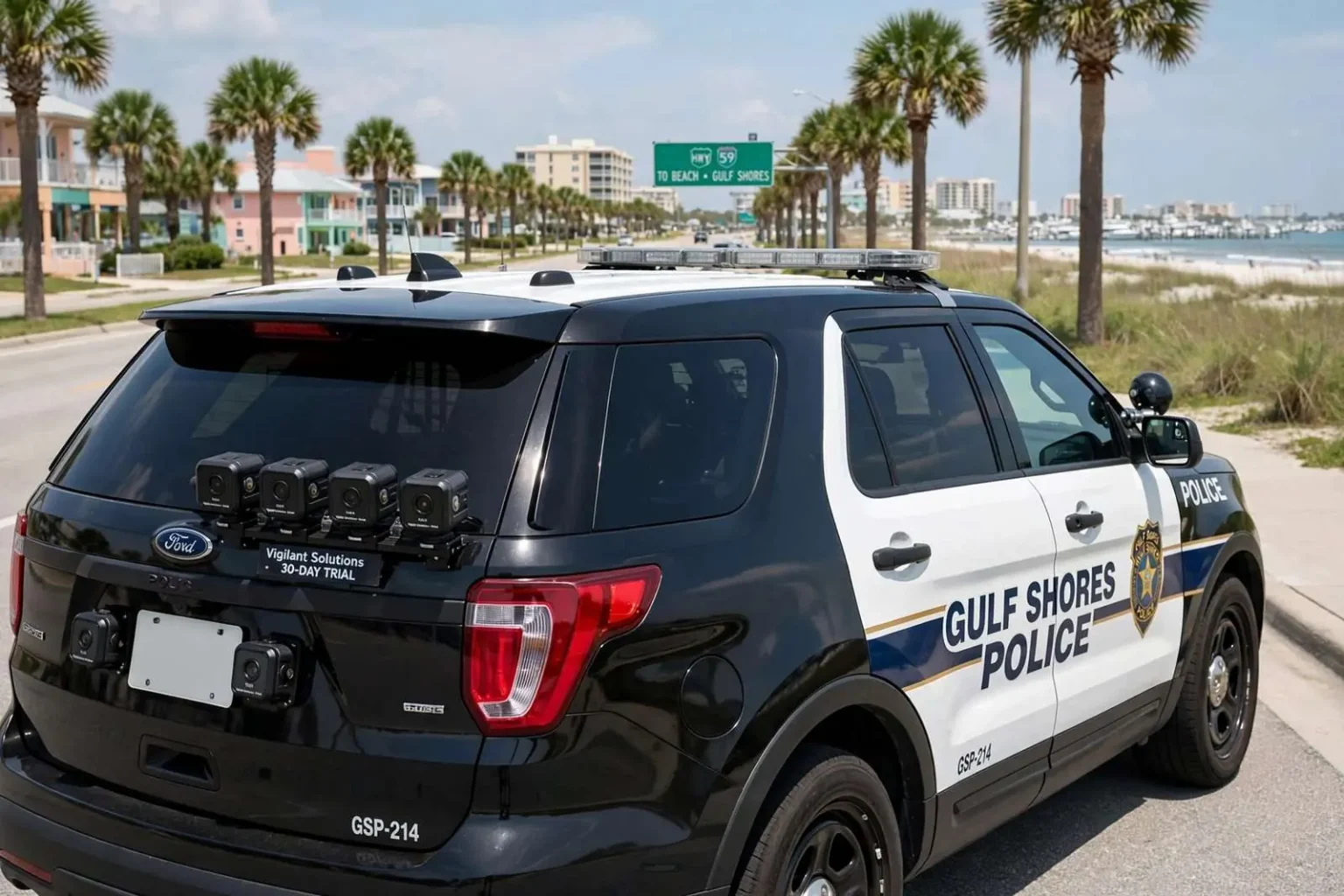
Drivers cruising through Gulf Shores got an extra set of eyes on them this fall as the city’s police department tried out automated license-plate reading equipment for the first time in Baldwin County. The trial marked a new chapter in how small Gulf Coast cities deploy technology on patrol, blending federal databases, private vendors, and everyday traffic enforcement into a single moving scan of the road.
A free test run on city streets
The department outfitted one of its patrol cars with four small cameras mounted on the trunk, part of a free 30-day trial with Vigilant Solutions, a California technology firm that supplies license-plate recognition systems to law enforcement agencies nationwide. The trial began in late August and let officers test the hardware on the road without committing city funds up front. For a department of Gulf Shores’ size — responsible for a beach resort city whose population swells with tourists every summer — the chance to evaluate the equipment in real conditions carried no budget risk.
As the equipped cruiser moves through traffic, the cameras continuously photograph the plates of nearby vehicles. Those images are converted into text and checked in real time against law enforcement databases at the local, state and national level, according to Gulf Shores police spokesman Cpl. Josh Coleman. The software can process plates at highway speeds and at angles no human spotter could manage, reading dozens of plates a minute while the officer drives a normal patrol route.
“It will notify us for expired tags, stolen vehicles, stolen tags,” Coleman said, adding that even a routine hit for an expired plate gets run through the National Crime Information Center to confirm what turns up. A flag in the system doesn’t mean an automatic stop, he said, but it does prompt officers to look closer. The distinction matters: the technology surfaces information, but the decision to stop a vehicle remains with a trained officer applying the same judgment that governs any traffic contact.
Modest results, larger ambitions
In the first two weeks of the trial, the technology didn’t lead to any arrests, though it did catch a handful of expired tags around town. Coleman said the appeal of the system isn’t necessarily about volume of tickets but about giving officers another tool while they’re already out patrolling. Recovered stolen vehicles, identified stolen plates, and flagged uninsured drivers are the kinds of hits that turn a routine presence on the road into a case, and vendors of plate-recognition systems argue that the accumulated value of those hits far exceeds the cost of the equipment over time.
Gulf Shores’ police department, like departments across Baldwin County, has grown alongside the city’s transformation into one of Alabama’s leading tourist destinations. Summer crowds bring traffic volumes that dwarf the resident population, and the city’s officers spend much of their time on traffic-related work. Equipment that automates part of that workload — turning a drive down Highway 59 or the Beach Express into a rolling database query — fits the city’s enforcement style.
The privacy question
Privacy has been a talking point wherever these systems roll out, and Gulf Shores officials addressed it directly. Coleman said the cameras themselves don’t grant officers access to personal information tied to a plate. Under the federal Driver’s Privacy Protection Act, that kind of lookup only happens after a confirmed violation triggers a separate records check. Absent a hit, he said, the system simply reads plates without identifying who owns the vehicle.
The Driver’s Privacy Protection Act, passed by Congress in 1994 after high-profile abuses of motor vehicle records, restricts how state motor vehicle departments may release personal data and binds law enforcement to use plate lookups for authorized purposes. Civil liberties groups have nevertheless raised concerns about plate readers more broadly — chiefly about how long plate images are stored, whether they can be used to track a person’s movements over time, and who else can access the data. Agencies experimenting with the technology have answered those concerns with retention policies and usage rules, and Gulf Shores’ decision to start with a free trial allowed the department to evaluate those questions before any purchase.
What comes next for Gulf Shores
At the end of the 30-day trial, the department was in a position to weigh what it had seen against the cost of buying or leasing the system. Vendors typically sell the cameras and software as a package, with ongoing database access fees, and departments across the country have adopted a range of models — from trunk-mounted units on a single patrol car to fixed cameras at city intersections. Baldwin County’s other police departments have watched the Gulf Shores trial with interest, since a shared adoption of the technology would let flagged vehicles be identified across jurisdictional lines from Dauphin Island to Spanish Fort.
For drivers on the island city’s streets, the practical effect during the trial was minimal — the cameras photograph plates, not drivers, and the system’s alerts touch only the small fraction of vehicles with problems already on record. But the arrival of plate-reading technology on Alabama’s beaches signals where patrol work is headed: quieter, faster, and increasingly mediated by software that never stops looking while the officer behind the wheel does the human work of judgment, caution, and contact.
How license-plate recognition works
Automated plate readers pair ruggedized cameras with optical character recognition software tuned to read plates at speed, in darkness, and in bad weather. Mounted in pairs on the front and rear of a patrol vehicle — four cameras in Gulf Shores’ configuration — the units sweep both sides of the road, capturing plates of oncoming and parked cars alike. Each capture is timestamped and geotagged, then converted to text and matched against watchlists in fractions of a second. The officer’s in-car terminal displays only the matches: a stolen vehicle entry, an expired registration, a wanted-person flag associated with the plate, or a missing-person alert.
The National Crime Information Center, the FBI-run clearinghouse behind many of those alerts, is the backbone of the system. NCIC entries — stolen cars, stolen tags, missing persons, protective orders — are placed by agencies across the country and updated around the clock. A plate reader in Gulf Shores can therefore surface a vehicle stolen in another state as easily as one taken from a parking lot on the beach, which is precisely the selling point vendors emphasize to small departments: the technology converts routine patrol miles into coverage that no number of officers could match.
Where the technology fits on the coast
Gulf Shores occupies a distinctive enforcement environment. The city’s permanent population is measured in the low tens of thousands, but summer weekends can multiply that figure many times over as visitors pour down Highway 59, the Foley Beach Express, and State Highway 182 toward the public beaches. Traffic enforcement is consequently the department’s most visible work, and the roads leading to the sand carry a mix of locals, out-of-state visitors, and seasonal workers. A plate reader on a patrol car in that environment scans a rolling sample of the entire region’s visitors — and, as officials were quick to note, produces personal information on none of them unless a lawful hit occurs first.
The trial also reflects the economics of modern police technology for smaller cities. A full purchase of plate-recognition hardware can run into the tens of thousands of dollars per vehicle once cameras, software, and database subscriptions are counted, a sum that demands justification for a department weighing its budget against training, radios, and patrol staffing. A free 30-day pilot shifts the burden of proof to the equipment: if the system produces meaningful hits in a month of ordinary patrol, the case for purchase writes itself; if not, the city owes nothing.
The debate over plate data
Nationwide, plate readers have generated a sustained policy debate. Advocates point to recovered stolen vehicles, located missing children, and identified suspects in serious crimes. Critics, including national civil liberties organizations, have focused on data retention — some systems store millions of plate scans with locations and timestamps, creating a record of vehicle movements that could, in principle, be queried to reconstruct someone’s travels. Several states have responded with statutes limiting how long plate data may be kept, and agencies elsewhere have adopted policies that purge non-hit scans within days.
Gulf Shores officials emphasized that the department’s use of the system begins and ends with lawful enforcement purposes, and that the Driver’s Privacy Protection Act firewall between a plate number and a person’s identity stands unless an officer has a confirmed hit and a separate, authorized reason to request records. For a city whose visitors’ plates come from across the Midwest and Southeast every summer, those boundaries are not just legal formalities; they are the terms under which a tourist town can deploy surveillance-adjacent technology without souring the welcome that defines it.
Whether the Gulf Shores department ultimately buys the system or passes, its trial has established a Baldwin County first, and the results — a handful of expired tags, no arrests in two weeks — will be read less as a verdict than as a baseline. Plate readers, like radar before them and body cameras after, tend to arrive one trial at a time, then quietly become part of the equipment every patrol car carries. Gulf Shores, as it has often done on the Alabama coast, got the first look.