
Oakleigh Mansion to Close Temporarily for Tour Overhaul
The Oakleigh Mansion in Mobile will close for nine weeks this fall so staff can overhaul its historic home tour using newly uncovered archival research.
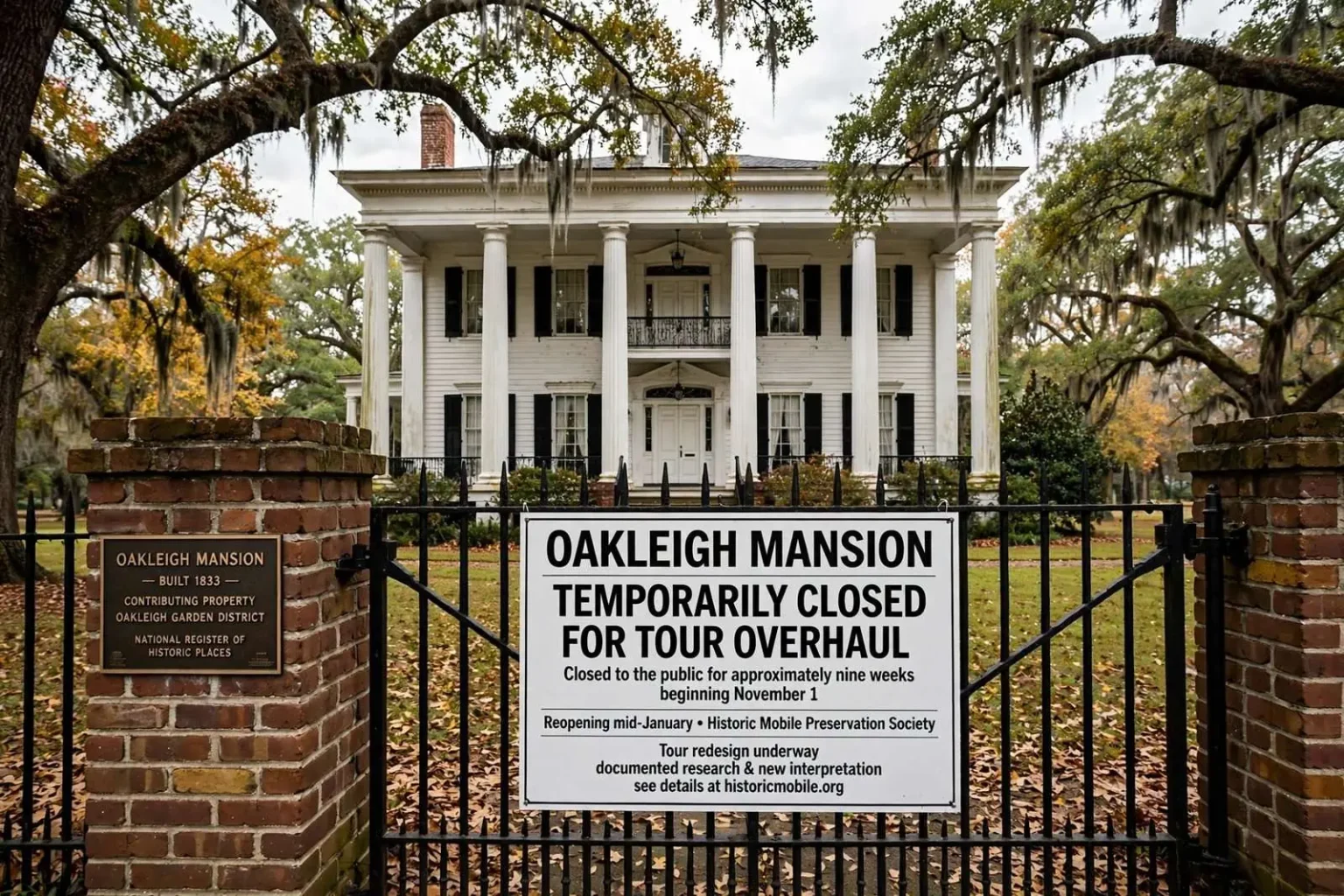
One of Mobile’s best-known antebellum landmarks is about to go dark for a stretch this fall, not because of storm damage or budget trouble, but because the people who run it decided the tour itself needed a rethink. The Oakleigh Mansion, built in 1833 and among the most visited historic homes in the city, will close to the public for roughly nine weeks starting in November, reopening in mid-January. During the closure, staff plan to rework how the tour is presented, moving away from a static walk-through narration toward something more grounded in documented research and the everyday lives of the people who occupied the house.
The closing is an unusual admission for a house museum to make: that the story visitors have been hearing is not good enough, and that fixing it requires shutting the doors. Oakleigh is one of Mobile’s signature historic attractions, its name given to the surrounding Oakleigh Garden District and its grounds a familiar stop on the city’s tour itineraries. A nine-week shutdown in the middle of the visitation year is a real cost for an organization of its size, which is precisely why the decision signals how seriously the Historic Mobile Preservation Society takes what its research turned up.
A Discovery Undermines the Lore
The Historic Mobile Preservation Society, which owns and operates the property, says the push for change grew out of a recent research project focused on a smaller structure on the grounds long referred to as the Cook’s House. For years, docents described the building using local lore passed down through generations of tours. That changed when a hired preservation consultant dug into the record and determined the structure was actually a barracks built for Union soldiers stationed in Mobile after the Civil War, not a kitchen building tied to the enslaved household staff as long assumed.
The finding is a case study in how house-museum history gets made — and unmade. A story repeated long enough on a tour becomes an established fact in the public mind, complete with details that sound researched because they have been recited so often. When the documentary record finally contradicts the recitation, everything built on it has to be re-examined. The Cook’s House revelation did not just correct one building’s story; it raised an uncomfortable and necessary question about how many other passages in the standard tour rested on tradition rather than evidence.
That discovery became the catalyst for a broader look at the rest of the mansion’s tour content. Society leadership said the goal now is to move past repeating inherited “urban legends” and instead present visitors with material backed by archival research, including photographs, timelines and the documented experiences of the families who lived in the home along with the servants and enslaved people who worked there. The emphasis on the enslaved workers whose labor sustained a household like Oakleigh’s reflects the approach that historic sites across the country have adopted as scholarship on urban slavery in the South has deepened.
The consultant who uncovered the Cook’s House history will lead the broader update, working alongside the society’s in-house collections manager. Their work will touch on daily life at Oakleigh across different eras, how the household economy functioned in the 19th century, and how the grounds themselves were maintained and used. That scope reaches well beyond the parlor-and-portrait tour of generations past. A household of Oakleigh’s stature in 19th-century Mobile was an economic operation — kitchens, outbuildings, grounds, staff — and the redesigned tour aims to explain how all of it actually worked rather than simply furnishing a sequence of pretty rooms.
How the Work Will Be Paid For
None of this comes cheap. The Historic Mobile Preservation Society operates on an annual budget of roughly $175,000, and society leadership says the tour redesign is being funded out of that existing operating budget rather than a special campaign, meaning the work will happen in phases as money allows rather than all at once. For an organization of that size, dedicating operating dollars to interpretation is a choice to spend on the mission itself — on what visitors learn — rather than on the maintenance projects and capital needs that small preservation groups usually have to prioritize.
The timing lines up with a fundraiser the society has planned for late September, an evening event called Columns and Cocktails, held on the mansion grounds. Proceeds from events like that one help underwrite exactly the kind of preservation and interpretive work now underway. The fundraiser will be one of the last chances to see the house before the closure begins, a bit of scheduling that turns the fall event into something of a farewell to the old tour as well as a benefit for the new one.
Events on the mansion grounds also serve the society’s quieter work of building an audience for the property — neighbors, members and donors who come for an evening and leave with a stake in what the place becomes. That constituency matters for a preservation organization that must fund scholarship, collections care and building maintenance from a budget smaller than many households spend in a year. The nine-week window also gives the society’s small staff a rare stretch of time to work without interruption: docents will be retrained on the new content, scripts checked against the research, and the way the story moves from room to room rebuilt with the same care the society applies to the physical object itself. Interpretation, done to archival standards, is slow work — and Oakleigh’s closure is what it looks like when an organization gives that work the room it needs.
Part of a National Shift
Society leaders describe the shift as bringing Oakleigh’s presentation in line with how historic sites nationally have moved in recent years, favoring visitor experiences that foreground original research and human stories over the more generic, sometimes fictionalized narration that older house-museum tours have long relied on. The trend has reshaped the country’s best-known house museums over the past two decades: guided by archival research, sites have retired the polished anecdotes that survived because they were pleasant, and replaced them with documented accounts that are more complicated but more truthful — including the lives of the enslaved and hired workers whose labor the houses depended on.
For Mobile, the change at Oakleigh carries particular weight because of what the city’s antebellum architecture represents. Houses like Oakleigh were built with the wealth of the cotton port’s merchant class, and their grandeur cannot be separated from the enslaved people who maintained them. A tour that says so plainly — with photographs, timelines and named experiences drawn from the record — gives visitors a more honest encounter with the past than the version that lingered on furniture and family lore. It also gives Mobile’s own residents, particularly the descendants of the households on both sides of that history, a stronger claim on the story the museum tells.
House museums everywhere face the same test Oakleigh has just set for itself: whether they exist to celebrate an heirloom or to explain a history. The research-driven approach the society has chosen is harder to sustain — it requires ongoing scholarship rather than a memorized script — but it is also the approach that keeps a historic site credible as the historical profession moves. In phasing the work through its operating budget rather than waiting for a special campaign, the society has effectively decided the correction cannot wait.
What Visitors Will Find in January
Whether visitors notice much difference on a walk-through remains to be seen, but the society is framing the closure as an investment that should make the tour “dramatically better” once the doors reopen in January. The most visible changes will likely be in what guides say rather than what guests see: the Cook’s House reinterpreted as what the record shows it to be, the mansion’s rooms explained through documented daily life rather than inherited anecdote, and the workforce of the household given its place in the narrative instead of a mention at the edge of one.
For a city that markets its history as heavily as Mobile does — from its antebellum districts to its colonial roots under three flags — the credibility of that history is a working asset, and Oakleigh’s nine-week pause is best read as maintenance of it. When the mansion reopens in mid-January, visitors will walk the same rooms under the same oaks, but they will be hearing a version of Mobile’s past that its own custodians have checked against the record, corrected where the lore failed, and rebuilt on evidence. That is what the preservation trade means by stewardship, and it is the standard the Historic Mobile Preservation Society has now set for the city’s most visited antebellum home.