Spanish Fort Approved Its First-Ever Gas Tax and a Higher Business License Fee
The Spanish Fort City Council unanimously created a one-cent gas tax and raised the business license fee in September 2014, moves projected to bring in more than $95,000 a year.
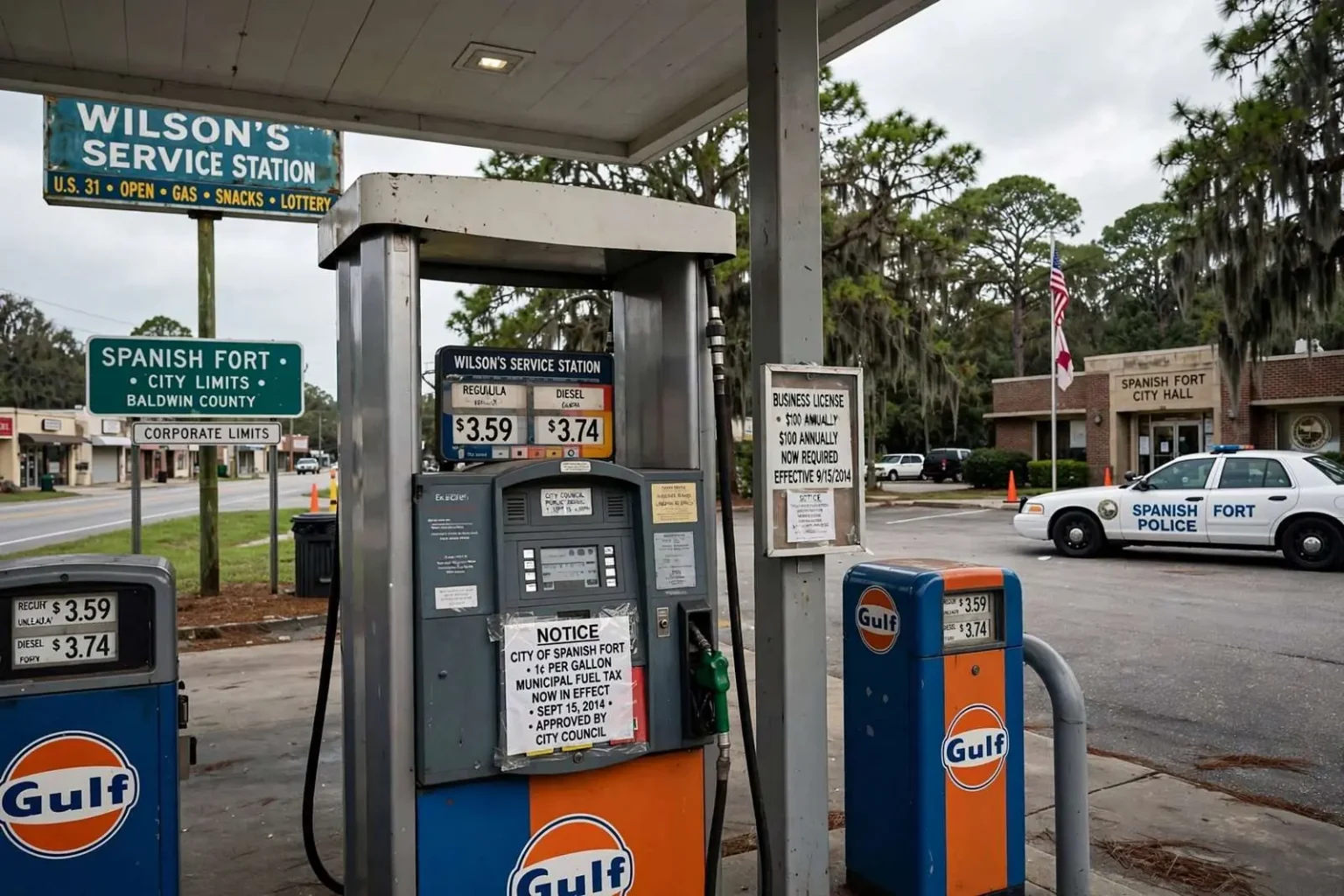
The Spanish Fort City Council approved a new tax and higher business fees in September 2014, measures expected to raise more than $95,000 a year for the fast-growing Baldwin County city. In two unanimous votes on Monday, Sept. 15, the council agreed to create the city’s first-ever tax on gasoline — one cent for every gallon sold within Spanish Fort’s corporate limits — and to raise the municipality’s annual business license fee from $60 to $100. Mayor Mike McMillan was absent from the meeting; he was in Washington, D.C., with other Eastern Shore mayors lobbying for the proposed Interstate 10 bridge.
The mayor’s absence was itself a sign of the moment. The mayors of Spanish Fort, Daphne and Fairhope had made the case for a new crossing of Mobile Bay a shared regional priority, and McMillan was pressing that case in the nation’s capital while his council took up the question of how to pay for the city’s own growth at home. The two agendas were more connected than they might appear: Spanish Fort sits astride the Interstate 10 corridor at the eastern approach to the bay, and the traffic, development pressure and service demands that come with that position were exactly what the new revenue measures were designed to address.
Two Revenue Measures, Two Public Hearings
Public hearings were held before each vote. No one spoke for or against the business license fee increase, but two residents voiced concerns about the gas tax. The split reaction was telling: a license fee of $100 a year is a line item most business owners absorb without comment, while a tax on gasoline touches every driver who fills up within the city limits — a group that, along a commercial corridor like Spanish Fort’s, includes thousands of commuters and travelers passing through on I-10 and U.S. 98.
Resident Sonya Hess Van Cleave told the council that gas prices were already too high in Spanish Fort and across Baldwin County and that an additional tax would only worsen the problem. She suggested the council consider raising property taxes instead. Her argument — that the cost of city government should fall on property owners who vote there rather than on the pump — is a familiar one in Alabama municipal finance debates, where sales and fuel taxes are often favored precisely because they draw revenue from the heavy through-traffic that growth brings without touching the homeowner’s tax bill.
Tracey Wilson Goens, who owns Wilson’s Service Station on U.S. 31, said she had first heard about the proposed gas tax only that Monday. She questioned what the additional revenue would be used for and why the council had not looked at other options, such as a lodging tax. “Gas is already high,” she said. “I mean everybody has got to have gas. People are looking to save. I’ve got some people that told me they drive to Loxley and Robertsdale to get gas because it’s cheaper.”
Goens’ testimony put a retailer’s reality behind the policy debate. A station owner on U.S. 31 competes on thin margins against stations just beyond the city limits, and a one-cent-per-gallon gap is enough to send price-sensitive drivers down the highway. Loxley and Robertsdale, the nearby communities she named, sit along the same growth corridor with their own commercial strips, and customers who cross the line to save a few cents also take their convenience stops, their lottery purchases and their errands with them. For a service station owner, the fear was not the tax itself but the competitive asymmetry it created against stations in towns that had not passed one.
Fees Unchanged Since Incorporation
City Attorney David Conner said Spanish Fort was evaluating all of its taxes and fees, some of which had not changed since the city first incorporated in 1993. The annual business license charge was one such fee. Before voting, Councilman J.R. Smith noted the long gap. “This is the first time in 21 years that we have raised the fee, and I think the economy well outpaced us in that aspect,” he said.
Smith’s arithmetic made the case in a single sentence. A city that incorporated in 1993 and left its business license fee untouched for two decades had watched inflation erode the real value of that revenue year after year, even as its population and its service obligations multiplied. Spanish Fort grew in that period from a small Eastern Shore community into one of Baldwin County’s commercial anchors, with shopping centers along the I-10 and U.S. 98 corridors, expanding subdivisions, and a public safety workload to match. A $60 fee set for a town of the 1990s was being collected, essentially unchanged, in a city of the 2010s.
The review Conner described went beyond the two measures on the Sept. 15 agenda. Cities across Baldwin County were conducting similar exercises during those years, comparing fee schedules against current costs and finding the same lag. Spanish Fort’s leaders framed the votes not as an expansion of government but as a correction — bringing a handful of revenue streams into line with the city that actually existed rather than the one that had incorporated two decades earlier.
Where the Money Would Go
The additional revenue was pegged at $45,000 from the gas tax and $50,000 from the increased licensing fee. Conner said the money would go toward meeting rising demands for city services, including the purchase of new police vehicles in the coming year, road and drainage projects, and improvements to recreational amenities. “Because of the growth of population over the last 10 years and the anticipated growth in the next 10 years, demands on things like services” had increased, Conner explained, framing the votes as a response to Spanish Fort’s rapid expansion along the Eastern Shore.
The spending list reflected the pressures that come with growth. New police vehicles replace fleets that more calls and more miles wear out faster; road and drainage projects address the stormwater and traffic burdens that development lays on a city built around wetlands and creeks feeding Mobile Bay; and recreational amenities — parks, fields, trails — are the visible promise a fast-growing suburb makes to the families moving in. None of it is glamorous budgeting, but together it is the difference between a city keeping pace with its population and falling behind it.
A Sign of Baldwin County’s Growth Years
The council’s action reflected the balancing act facing many Baldwin County municipalities during those years, as booming residential and commercial development strained budgets built for a much smaller town. Countywide, the 2010s were a period of explosive expansion — new rooftops following new retail, new retail following the rooftops — and each cycle of growth brought demands for police coverage, road capacity and drainage that outlasted the one-time construction fees and sales tax bumps that came with it. Spanish Fort’s position along Interstate 10 made it a natural beneficiary of that growth and one of the first places its costs arrived.
The gas tax itself was a latecomer among Alabama municipal revenue tools, and Spanish Fort’s decision to adopt its first one in 2014 illustrates how the state’s cities pieced together funding in an era of constrained budgets. Alabama municipalities lean heavily on sales taxes and fees because their options for property taxation are comparatively narrow, and a fuel tax has the practical appeal of capturing some revenue from the enormous volume of traffic that merely passes through — every driver who tops off a tank within the corporate limits on the way to the beach contributes a penny a gallon whether or not they ever stop again.
The debate at the hearing also previewed the questions that would follow any fuel tax: whether neighboring cities would match it, and how long Spanish Fort’s pump prices could carry the difference. Those dynamics sit outside any council’s control, but they shape whether a measure like this one raises what it promises. The council, for its part, had heard the objections from the station owner and the resident alike, and voted unanimously anyway — a signal that the majority considered the service demands outrunning the city’s revenue to be the more urgent problem.
For Spanish Fort, the modest penny-per-gallon tax and the higher license fee represented a first step toward aligning the city’s revenue with the cost of serving a growing population. The two measures together were expected to bring in roughly $95,000 a year — real money for specific purchases like police vehicles, though a small fraction of the cost of the infrastructure demands a growing city faces. The votes in September 2014 were, in that sense, less a solution than an acknowledgment: that the city’s fee structure was two decades out of date, that growth was going to keep coming, and that the budget would have to start catching up one revenue stream at a time.