Lessons From a Hospital Bed: How a Mobile Stockbroker Learned to Stop Chasing the Last Dollar
The concluding installment of a Mobile memoir: a foul-mouthed doctor diagnoses a pulmonary embolism, a broker survives, and a man decides that a million-dollar year is not what he will be remembered for.
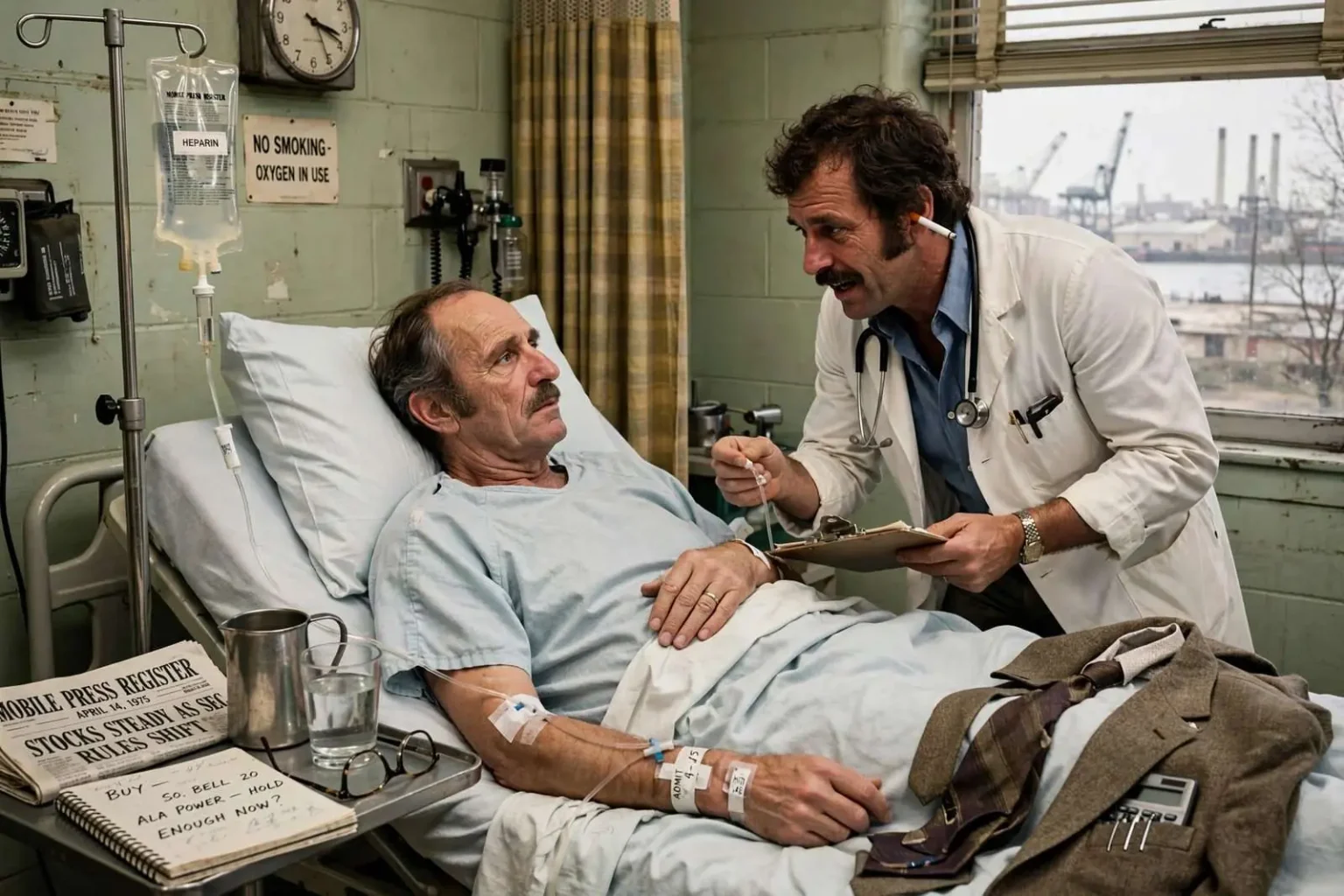
MOBILE — The concluding installment of a memoir series on life in a bygone Mobile ends where the previous one left off: in a hospital room in the spring of 1975, with a veteran stockbroker recovering from the removal of a kidney and suddenly seized by a severe pain in the chest. His doctors hovered. None of them could say what was wrong. Finally his internist went looking for help and came back with a name — a physician the patient had known for about a decade, and not from a clinic. “Haven’t Any of You Seen a Pulmonary Embolism?”
The two men had crossed paths years earlier through the Mobile Tarpons, the city’s ill-fated professional football venture, for which the broker had once handled publicity and the doctor had been part of the ownership group. The physician was, in the writer’s memory, a wise-cracking and profane character — pleasant enough company at a party, but not the man you would pick out of a crowd and identify as a medical genius. “Get him,” the patient told his internist. “Get somebody, for God’s sake.” The doctor arrived with blasphemies streaming from his lips and a diagnosis already formed. Hadn’t any of them ever seen a pulmonary embolism? Because that, he informed the room, was exactly what this was. He put a needle in a vein, started an anticoagulant drip, and administered morphine for the pain. The patient began to feel better within hours. By the next morning the pain had all but vanished. The internist returned the following day with a wry appraisal of his colleague: he was great with chests. The patient had to agree. Football, no. Chests, yes.
A longer stay than planned
The embolism kept him in the hospital considerably longer than expected. He remained on intravenous anticoagulant until his blood counts reached a level that allowed a switch to oral medication, and even after his release he was required to have his blood checked weekly for six months. He was back at his desk by mid-June and had no further trouble. But something had shifted in the calculation that had governed his working life. The broker, who had spent decades chasing the last dollar, the next deal, the marginal advantage that separated the merely comfortable from the genuinely wealthy, found himself confronting a ledger that did not balance the way he had always assumed it would.
Mobile in 1975 was a city in transition. The port, the paper mills, the shipyards at Alabama Dry Dock and Bender Shipbuilding still anchored the economy, but the downtown retail core was bleeding customers to Springdale Mall and the newly opened Bel Air Mall. The broker’s office, likely in one of the mid-rise buildings on Dauphin or St. Francis Street, would have looked out on a streetscape where the old department stores — Gayfers, Hammel’s, the Mobile franchise of D.H. Holmes — still held court but could feel the ground shifting beneath them. The financial district, such as it was, clustered around the RSA Battle House Tower construction site, a symbol of the state pension fund’s growing influence over Alabama’s urban skylines.
The Tarpons and the town that loved a loser
The Mobile Tarpons, the connection that saved the broker’s life, deserve their own footnote in the city’s sports history. The franchise, a member of the short-lived World Football League, played its home games at Ladd Memorial Stadium in 1974. The WFL, launched as a challenger to the NFL, offered contracts that lured players like Larry Csonka, Jim Kiick, and Paul Warfield from the Miami Dolphins — but the league folded halfway through its second season, leaving the Tarpons with a 6-8 record and a pile of unpaid bills. The ownership group, a consortium of local businessmen and physicians that included the doctor who would later diagnose the embolism, lost their investment. The broker’s publicity work for the team had been a labor of civic boosterism more than a profit center, the kind of project Mobile’s professional class undertook because the city deserved a team, or so the thinking went.
Ladd Stadium, built in 1948 and expanded for the Senior Bowl, had seen Bear Bryant’s Alabama teams, the annual Thanksgiving rivalry between Murphy and McGill Institute high schools, and the brief, bright flare of the Tarpons. The stadium’s concrete bowl, set in the piney woods west of downtown, embodied Mobile’s relationship with football: passionate, communal, and perpetually minor-league. The Tarpons’ failure stung but did not surprise. The city had watched the Mobile Bears and the Mobile A’s and the Mobile White Sox come and go in baseball; it would later host the Mobile BayBears and the Mobile Seagulls and the Alabama Lightning. The pattern held: Mobile loves a team, but the leagues never stay.
The doctor’s presence in the ownership group reflected a particular Mobile archetype — the physician-investor who treated medicine as a practice and business as a vocation. Mobile’s medical community, anchored by the University of South Alabama College of Medicine (established 1972) and the teaching hospitals at USA Medical Center and Mobile Infirmary, produced specialists who invested in real estate, oil leases, and speculative ventures like the Tarpons. The doctor’s profanity and diagnostic brilliance, remembered by the broker decades later, fit a type: the clinician who trusted his eyes over the chart, who had seen enough pulmonary embolisms in the charity wards and the VA hospital to recognize the presentation when his colleagues missed it.
The broker’s ledger
The stockbroker’s recovery coincided with a transformation in his profession. The Securities and Exchange Commission’s 1975 abolition of fixed commissions — “May Day” in Wall Street parlance — had just taken effect, opening the door to discount brokerages and the eventual democratization of equity ownership. In Mobile, where the brokerage community was small and relationship-driven, the change arrived more slowly. The broker’s firm, likely a regional office of a national house like Merrill Lynch or Paine Webber or a local partnership like the venerable J.C. Bradford operation, still operated on personal contacts, country club introductions, and the trust that accrued from managing a family’s portfolio across generations.
The embolism forced a reckoning with mortality that no market correction could replicate. Six months of weekly blood draws, the discipline of anticoagulant therapy, the awareness that a clot could return without warning — these experiences recalibrated the broker’s risk tolerance in ways that no bear market could. He began to decline the speculative issues that had once filled his ticket. He counseled clients toward quality, toward income, toward the boring stability of utility stocks and municipal bonds. His income dipped, then stabilized. His clients, initially skeptical, came to appreciate the steadiness.
A Mobile education in money and meaning
The broker’s memoir series, of which this hospital episode formed the conclusion, traced a life that spanned Mobile’s transformation from a sleepy port town to a Sun Belt aspirant. He had come of age when the city’s social architecture was still defined by the waterfront — the banana boats at the state docks, the shrimp fleet at the foot of Dauphin Street, the cotton warehouses that lined the riverfront. He had watched the tunnels open (the Bankhead Tunnel in 1941, the George Wallace Tunnel in 1973), the causeway expand, the interstate splice the city into quadrants. He had seen the Azalea Trail Maids evolve from a garden club project into a civic trademark, and the Mardi Gras societies navigate integration with the same quiet pragmatism that characterized Mobile’s approach to most volatile questions.
His clients were the people who built that Mobile: the shipyard foremen who bought shares in the companies that employed them, the widows of paper mill supervisors who lived on dividends, the young doctors and lawyers building practices in the new medical and office parks west of I-65. He knew their children’s names, their vacation plans, their anxieties about college tuition and elder care. The broker’s ledger was not merely financial; it was social, a record of the trust that bound a professional class to the families it served.
The pulmonary embolism, in this context, became a kind of grace note — a violent interruption that clarified what the steady accumulation of assets had obscured. The broker wrote later that the pain in his chest had done what no market crash could: it stripped away the illusion that the next deal, the next commission, the next tier of wealth would deliver the security he had been chasing. The doctor’s profane diagnosis, the internist’s wry assessment, the six months of blood work — these became the curriculum of a late-life education in sufficiency.
The view from the recovery
By the time the memoir reached its conclusion, the broker had retired. The firm had been absorbed into a regional consolidation, the office on Dauphin Street rebranded, the client relationships transferred to younger partners. He spent his mornings at the Mobile Yacht Club, not sailing but watching the traffic on the river — the tugs pushing barges of coal and steel, the container ships calling at the new McDuffie Terminal, the occasional research vessel from the Dauphin Island Sea Lab. He read the Wall Street Journal cover to cover, not for tips but for the pleasure of understanding the machinery he had once helped operate.
The doctor, the one who had saved him with a needle and a stream of curses, had retired to a place on the Eastern Shore, across the bay where the light falls differently on the water. They spoke occasionally, the way men of that generation did — rarely, briefly, with the economy of words that signals a debt too large to articulate. The Tarpons were a memory, the WFL a trivia answer, the embolism a chapter closed.
Mobile continued its slow metamorphosis. The broker’s grandchildren grew up in a city with an Airbus assembly line, a cruise terminal, a medical corridor that rivaled Birmingham’s. The stockbroker’s world — the fixed commissions, the personal relationships, the trust built on a handshake and a quarterly statement — had vanished, replaced by algorithms and apps and the frictionless trading of fractional shares. But the lesson he learned in that 1975 hospital room, the one the doctor delivered with blasphemy and morphine, remained: the last dollar is never the one that matters. The ledger that balances is the one you carry in the people who answer when you call.