University of South Alabama Mobile
Ladd-Peebles Stadium Board Weighs Fixes After Heat, Transit Problems at Record Crowd
Ladd-Peebles Stadium officials in Mobile are considering more water stations and better bus routing after heat problems hit a record football crowd.
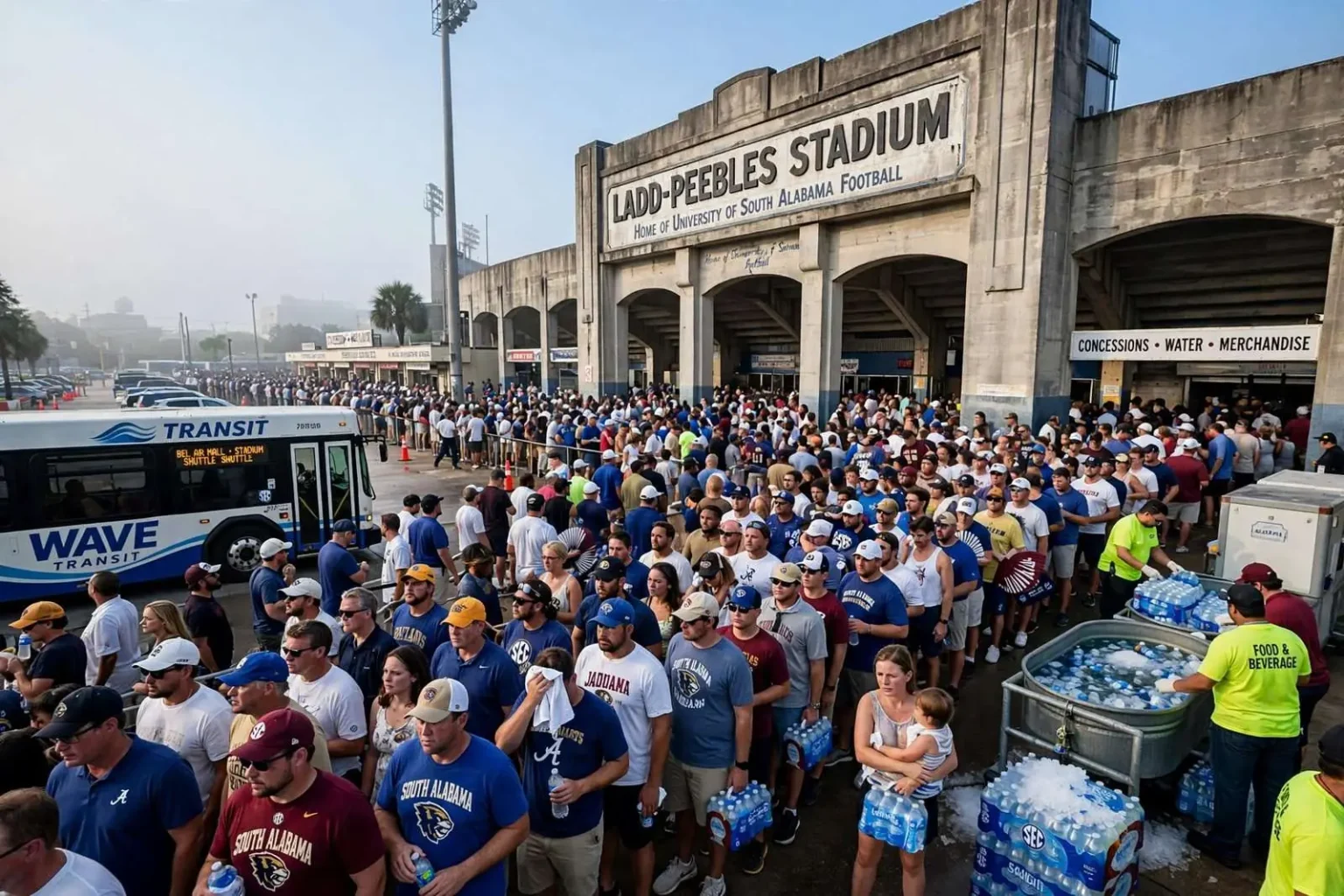
Stadium officials in Mobile are looking at a handful of practical fixes after a record-setting crowd at Ladd-Peebles Stadium ran into trouble staying cool and getting home during a recent afternoon football game. During a meeting of the stadium’s board of directors, representatives from the University of South Alabama, board members, and the venue’s food service contractor discussed what went wrong when temperatures topped 90 degrees with heavy humidity during a Saturday matchup against a visiting Southeastern Conference opponent.
The game drew the largest crowd the stadium has ever hosted and generated more revenue than the university’s GoDaddy Bowl and Senior Bowl appearances combined. Even so, officials acknowledged the experience wasn’t perfect.
A Crowd Bigger Than the Building
An associate athletic director for the university said the concourses simply weren’t built to handle the size of the crowd that showed up. The areas are designed to comfortably serve around 28,000 to 30,000 people, but attendance that day pushed closer to 38,000, overwhelming walkways and concession areas built for a smaller footprint.
The gap between a stadium’s seating capacity and the capacity of its supporting spaces is the kind of engineering detail invisible until it fails. Ladd-Peebles was built in an era when a college football crowd ate before it arrived, paid at a turnstile and spent little inside the gates. Modern expectations — concession stands, restrooms, merchandise, water sales — load a stadium’s concourses with demands the original designers never had to imagine, and the shortfall shows up exactly as it did that afternoon: in lines that lengthen faster than they shorten as the game clock runs.
The revenue record made the strain bittersweet for the university. A matchup against an SEC opponent is the kind of guarantee game that transforms an athletic department’s budget, and the day’s gate had exceeded what the university drew from two of its highest-profile annual events combined. But the same financial success multiplied every operational problem — more fans to cool, more bottles to sell, more buses to run — and turned the game into the most demanding test the venue had ever faced.
Roughly 60 medical calls came in from the stadium that afternoon, and about 10 fans were taken to a local hospital for heat-related illness. Officials stressed that heat-related medical transports aren’t new to the venue — afternoon games in a metal stadium during Alabama’s late summer heat have caused problems before — but they conceded that criticism over water and concession shortages, much of it aired on social media afterward, was pushing them to make changes before the next major crowd arrives.
The social media dimension changed the calculus. Fans stranded in long lines no longer suffer privately; they broadcast it, and by kickoff’s second quarter the stadium’s operational failures were circulating nationally among fans of both programs. For an athletic department courting a national audience, the reputational cost of a bad afternoon rivals the medical one, and both pointed to the same conclusion: the next big crowd would judge the venue on what it learned from this one.
Water Everywhere — Except Where It Was Needed
The stadium’s food service provider said staffing wasn’t the core problem; on the day in question, the venue had roughly 71,000 bottles of water on hand, or about a bottle and a half per attendee, and never actually ran out.
Instead, the issue was distribution — fans buying a dozen bottles at a time created bottlenecks, and warm bottles needing time to cool down couldn’t keep pace with demand.
The purchasing pattern was a rational response to a stressful afternoon. Fans who had waited twenty minutes in line were not going to return for their next bottle, so they bought in bulk, which emptied the cold inventory at the point of sale and left the stationary supply at ambient temperature. A stadium can have more water than it needs and still fail its customers if the water is in the wrong place at the wrong temperature — a supply-chain problem dressed up as a shortage.
The contractor said adding more water troughs to speed up cooling, along with parking a trailer to help transport ice more efficiently to the concourse, are both under consideration. The fixes are deliberately unglamorous. A chilled water trough is a low-technology answer to a high-volume problem: it converts warm inventory into cold inventory at the point of distribution, where the bottleneck actually sits, rather than adding refrigeration capacity that cannot be scaled by kickoff. The ice trailer addresses the same constraint from the logistics end, moving cooling capacity to the concourse instead of waiting for it to arrive case by case.
Board members also revisited the venue’s long-standing rule barring fans from bringing in their own water and beverages, with at least one board member saying he wasn’t even aware the policy existed and suggesting it should be reconsidered. The board’s president said a range of options, including that policy, will be up for discussion going forward.
The outside-beverage ban is standard policy at stadiums across the country, written for security and concession-revenue reasons and enforced without much controversy on fall nights when the temperature sits in the seventies. A 90-degree afternoon with heavy humidity reframes it. Hydration, on such a day, is a medical need rather than a purchase, and policies that restrict it invite exactly the criticism the stadium absorbed. Several major venues now permit sealed water bottles or empty containers for precisely this reason, and Mobile’s board signaled it was prepared to study whether its rule belonged to a different era.
The Bus Ride That Outlasted the Game
Transportation proved to be another sore spot. WAVE Transit buses running fans from the Bel Air Mall parking lot to the stadium saw roughly 10,000 riders that day, thousands more than a typical game draws, and wait times stretched from about 15 minutes early in the day to as long as two hours as kickoff approached.
The shuttle system was a victim of its own convenience. Free parking at a regional mall with a short bus ride to the gates is an attractive package, and a crowd facing 90-degree heat and scarce stadium parking used it heavily. Every additional rider, however, added minutes to a loop whose bus count was fixed, and the mathematical reality of a shuttle system is that wait times compound: each bus that arrives full leaves a longer line behind it, and by the hour before kickoff the system had fallen irrevocably behind schedule.
Board members suggested spreading bus pickup locations across the city, including downtown, rather than centralizing service at a single lot, noting that visiting fans staying in downtown hotels had to travel out to Bel Air just to catch a shuttle back toward downtown.
The geographic complaint had particular force for the visiting crowd. SEC fans traveling to Mobile book rooms in the downtown hotel district, within walking distance of restaurants and nightlife, and the stadium’s transit map forced them into a roundabout journey — a cab or rideshare west to Bel Air Mall, then a bus back east toward the stadium they could nearly see from parts of downtown. Decentralized pickup points would have matched the way a major-event crowd actually distributes itself across a city, and would have had the secondary effect of spreading the vehicle load over multiple routes instead of one.
WAVE Transit, Mobile County’s public transportation system, runs the shuttle service as part of its mission of moving large crowds to major events, and a 10,000-rider day represents several times the demand a typical game generates. Transit systems plan for averages; a marquee matchup delivers a surge that no fixed fleet can absorb without either additional vehicles or more routes, and the board’s discussion acknowledged both levers.
Lessons Applied Before November
With another sizable crowd expected when the university hosts Navy in late November, stadium and university officials say they intend to have adjustments in place well before then.
The deadline gives the fixes a forcing function. A November evening game against a service academy will not replicate September’s heat, but it will test every other variable that failed — crowd size, concession throughput, and the shuttle network — and it offers the board a bounded window in which to show measurable improvement. Operational reviews at public venues have a way of producing reports rather than changes; a scheduled date with a visiting fleet of midshipmen and their traveling fans makes the review actionable.
The intermediate fixes under consideration — water troughs, an ice trailer, a review of the outside-beverage ban — can be implemented without construction or capital expense, which matters for a stadium whose long-term renovation wishes have always outpaced its budget. The transit changes require coordination with WAVE Transit and, potentially, cooperation from downtown property owners for pickup locations, a more complex negotiation but one that could yield a system the venue uses for every major event thereafter.
A Venue Learning Its Own Limits
Ladd-Peebles has anchored Mobile football for more than half a century, hosting high school championships, bowl games and all-star classics that made it the most experienced big-crowd venue on the central Gulf Coast. Experience, however, is not the same as capacity, and the record afternoon demonstrated the difference with unusual clarity: the stadium’s institutional knowledge of crowds could not substitute for concourse square footage or bus counts.
The board meeting’s tone — candid about failures, specific about remedies — suggested a venue treating the episode as a rehearsal rather than a scandal. Stadiums across the Southeast have confronted the same arithmetic in recent years as game-day expectations have grown faster than mid-century venues can follow, and the ones that keep major events have been the ones that adapt operations while larger renovations await funding.
For the University of South Alabama, the calculus balances opportunity against obligation. Games against SEC opponents deliver revenue and visibility the program cannot otherwise buy, but they deliver crowds the venue must be prepared to serve, and the university’s representatives made clear at the meeting that the two are linked: the next invitation extended to a marquee opponent depends on the experience the last one’s fans received.
The promises made around the boardroom table will be tested in November. Between now and then, the work is logistical — troughs ordered, ice trailers contracted, bus routes drawn across a city map — and unglamorous in exactly the way that successful game-day operations always are. The fans who endured the heat and the two-hour waits in September will not remember the meetings; they will remember, or not, how the next crowd was treated.