Mobile City Council Holds Off-Site Meeting at B.C. Rain High School
The Mobile City Council took its regular session on the road, meeting in the B.C. Rain High School gymnasium to reach more residents citywide.
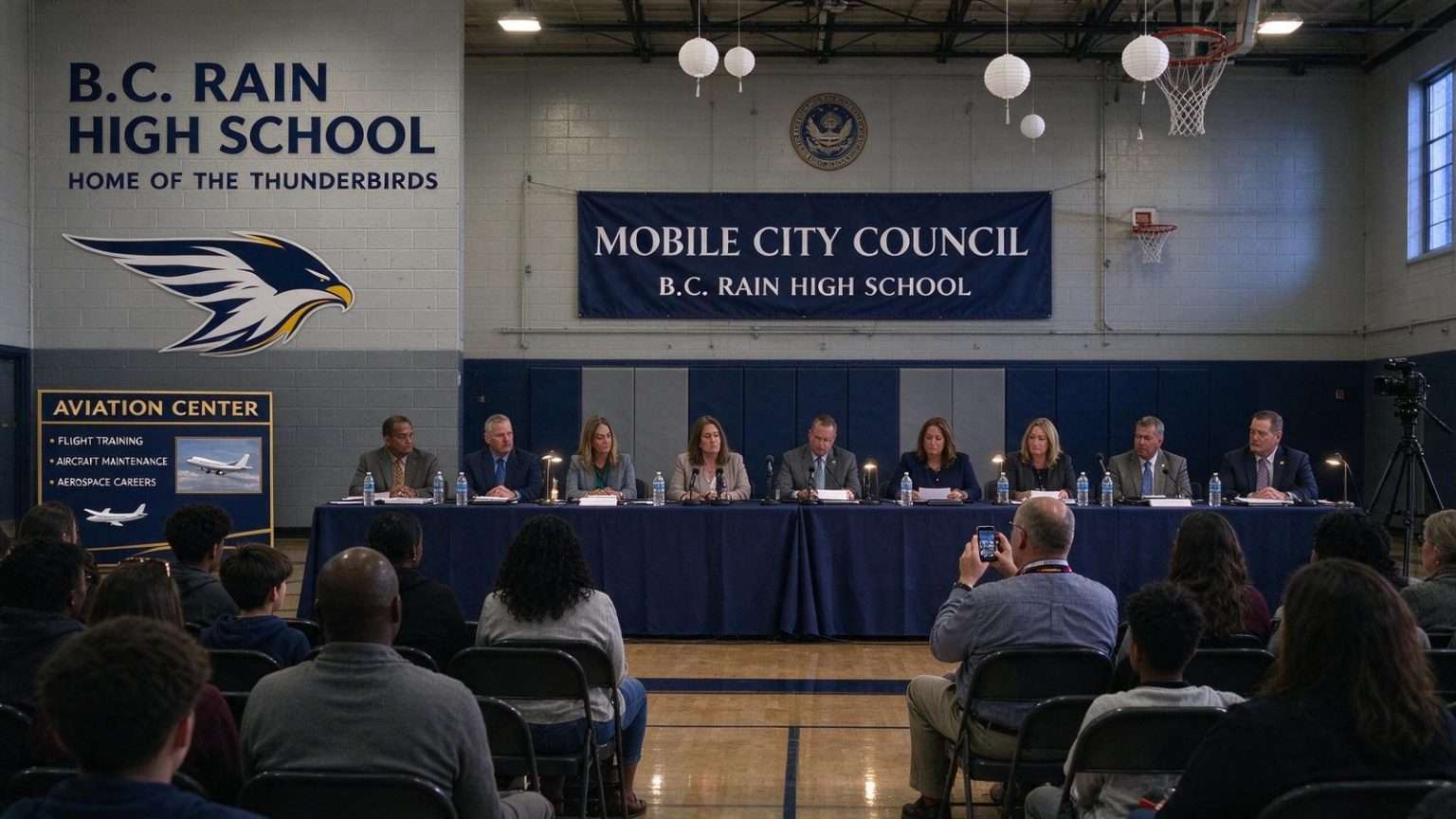
The Mobile City Council swapped its usual Government Plaza chambers for a high school gymnasium this week, holding its regular Tuesday evening session at B.C. Rain High School on Dauphin Island Parkway as part of an occasional effort to bring council meetings directly into the city’s neighborhoods. The move is more than a change of scenery — it is one of the few recurring gestures the council makes toward residents for whom a trip downtown, with its parking garages and work-hour traffic, is a genuine obstacle to participating in city government.
The 6 p.m. session marked one of the council’s periodic off-site meetings, a practice intended to make it easier for residents in different parts of Mobile to attend a council meeting without traveling downtown. Evening timing is itself the point: the council’s regular sessions take place while many residents are at work, and the off-site format pairs the relocated meeting with the kinds of community programming that give families a second reason to show up.
Councilman C.J. Small, whose district includes the school, said the format is designed with working residents in mind. “The meeting is designed to give working citizens a chance to attend a meeting and to bring the meetings to the community,” Small said. For the neighborhoods along the Dauphin Island Parkway corridor, the meeting brought city government within a short drive of thousands of households that otherwise watch council business from a distance — or not at all.
The council’s last off-site meeting, held earlier in the year at the Mobile Museum of Art, drew a large crowd and produced heated debate over the hiring of a fire chief and the appointment of Barbara Drummond to the Mobile Area Water and Sewer System’s board of directors. That session demonstrated both the promise and the unpredictability of the format: when a relocated meeting lands on a night with contested appointments on the agenda, the community room fills fast and the comment period runs long.
Whether the B.C. Rain session would generate similarly high turnout or contentious discussion was not yet clear heading into the meeting. Unlike the museum gathering, this week’s agenda was not anchored by a single controversial personnel decision, but off-site meetings in Mobile have repeatedly shown that residents use them to raise neighborhood-level issues — streets, drainage, code enforcement and public safety — that rarely draw speakers in the downtown chambers.
An Aviation Center Showcase
Ahead of the regular session, council members and attendees were invited to a 5 p.m. tour of the school’s newly built aviation center, giving residents a firsthand look at one of B.C. Rain’s newer academic programs. The facility represents a deliberate investment in career and technical education at a school whose name has long been associated with the city’s aerospace ambitions, tying classroom instruction to the aviation and aerospace employers that operate around Mobile.
Students were also scheduled to give a presentation to council members during the meeting itself, offering a local showcase alongside the standard council business. For the school, the evening doubled as an audition of sorts — a chance to demonstrate in front of the city’s governing body that the aviation program and the students moving through it are worth continued attention and investment. Programs of this kind depend on partnerships with local industry, and a council meeting in the gymnasium is one of the few occasions when the school’s work is presented directly to the officials who control city spending.
Because the meeting doubled as a community outreach event, the Mobile County Public School Board arranged to stream the session live on Comcast Channel 15 and U-verse Channel 99, giving residents who couldn’t attend in person a way to follow along from home. The school system’s cable channels regularly carry public meetings and school programming to households across the county, and the arrangement ensured the off-site meeting reached the same broadcast audience as a session held in Government Plaza.
The council’s standard pre-conference meeting was still held earlier that morning at Government Plaza before the evening session moved to the school. The split schedule keeps the council’s administrative routine intact — agendas, committee items and logistics are still worked through in the morning — while the evening session carries the formal votes and the public’s view of city business. Residents attending only the evening meeting therefore see the council at its most public, with the day’s preliminary work already done.
Why Off-Site Meetings Matter
Off-site council meetings have become one of the more visible ways Mobile’s government has tried to counter the sense that City Hall operates at a distance from the neighborhoods it serves. Mobile’s council districts stretch from the urban core out to the city’s industrial fringes and rapidly developing western suburbs, and a trip to Government Plaza from some of those areas can take the better part of an evening between driving, parking and waiting for an item to reach the floor.
The format also changes the tone of the meeting itself. Sessions held in school gymnasiums and community spaces tend to draw speakers who address the council conversationally about their own streets and neighborhoods rather than about ordinance language, and council members — who each represent a district — have used the gatherings to spotlight institutions in their territory, as Small did by staging this meeting at B.C. Rain.
For the school district, hosting the meeting offered its own benefits beyond the aviation center tour. B.C. Rain serves the communities along and off Dauphin Island Parkway, and a council meeting in its gymnasium puts the school in front of residents who may know it only by name. The live broadcast on the school system’s channels extended that visibility further, showcasing the campus to households across Mobile County.
The city’s practice of rotating meetings into community venues remains occasional rather than routine — the council meets most weeks in Government Plaza — but each off-site session is treated as a civic event in its own right, with host institutions, district council members and neighborhood associations working in advance to turn out residents. This week’s edition followed that template, combining the tour, the student presentation and the broadcast arrangement with the regular business of a Mobile City Council session.
What happens after an off-site meeting matters as much as the meeting itself. Residents who speak at a relocated session are, in effect, filing their concerns in front of neighbors as much as council members, and the follow-through on drainage complaints, street repairs and public safety questions raised at these meetings tends to be watched closely by the community groups that helped organize turnout. Council members whose districts host the meetings typically spend the weeks afterward fielding the specific requests that surfaced in the gymnasium.
The earlier museum meeting offered a template for what a high-engagement off-site session can produce. The debate over the fire chief hiring and the MAWSS board appointment that night showed that relocated meetings are not ceremonial — with a full house in the room, contested decisions draw the same scrutiny they would downtown, and often more, because the audience is made up of residents who made a special trip to attend.
For residents of the B.C. Rain area, this week’s meeting was the rare occasion when the full council sat down within their part of the city, heard local presentations and conducted city business a few blocks from their homes. Whether the session produced the kind of spirited public comment that marked the museum meeting will be known in the council’s record, but the structural goals of the format were met before the first agenda item was called: residents attended without a trip downtown, a neighborhood school showcased its newest program, and the meeting reached cable audiences across the county.
Supporters of the format point to those practical results, and neighborhood associations across Mobile have echoed the argument in years past. A meeting held in the neighborhood it concerns compresses the distance between complaint and response — public works staff and council aides hear issues directly, and the speaker list itself becomes a record of where city services are falling short. That accountability loop, more than the change of venue alone, is what advocates of off-site meetings say justifies the logistical effort of moving a session out of Government Plaza.
The council is expected to continue sprinkling off-site sessions into its calendar as districts take turns hosting, a practice that costs little but serves as one of the city’s most direct forms of outreach. For one Tuesday evening, at least, the business of Mobile’s government was conducted not in the shadow of Government Plaza but under the lights of a high school gymnasium on Dauphin Island Parkway — with students, not lobbyists, holding the front rows.