Daphne Aerospace Engineer Trades Missile Defense for Homegrown Crafts and Algae Research
Daphne native Elizabeth Hayes moved from designing missile defense software to algae research while building a local crafters marketplace back home.
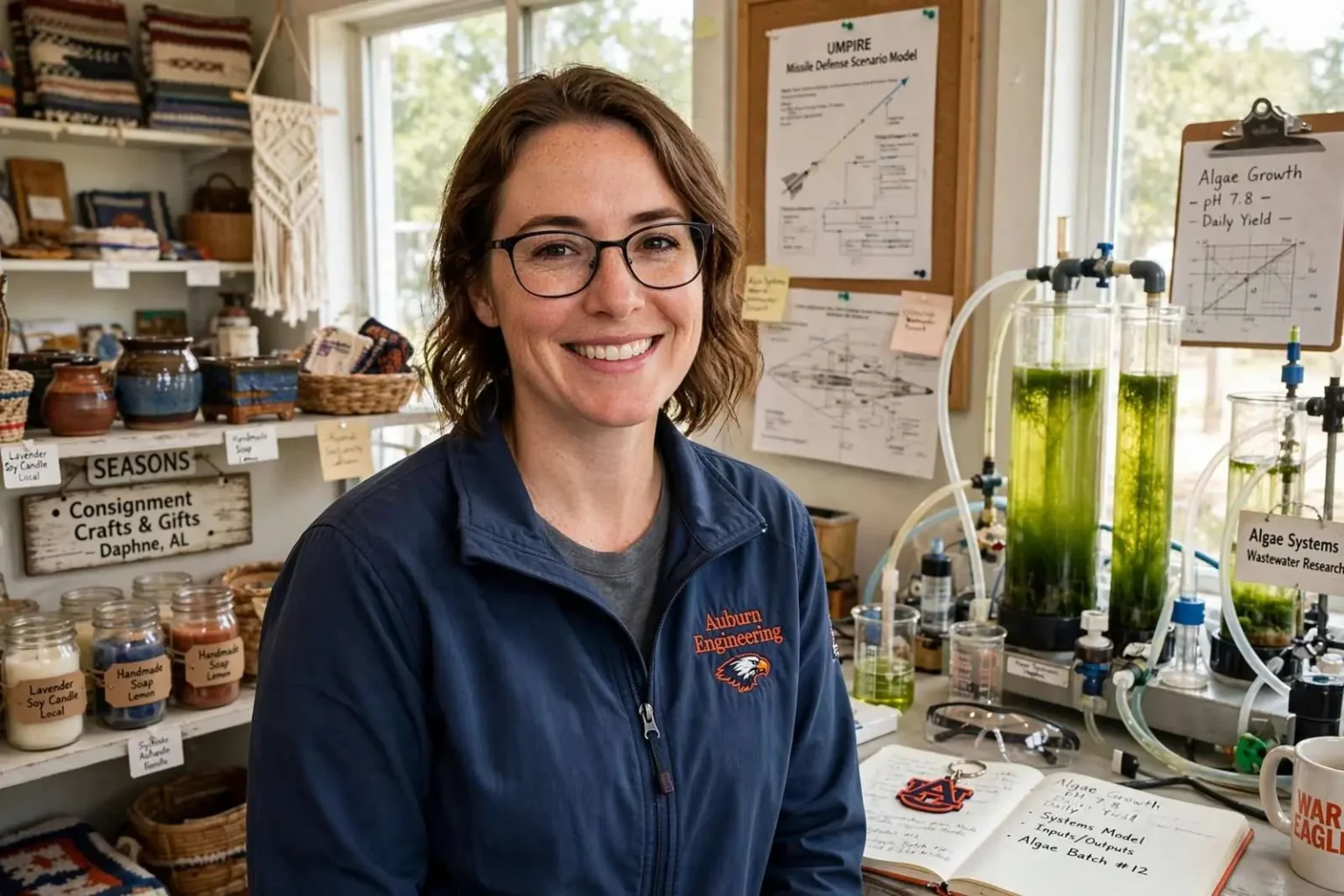
A Daphne native who once dreamed of being an astronaut has spent her career bouncing between two worlds most people would never think to connect: designing software used by the nation’s missile defense programs, and building a homegrown business celebrating local artists and crafters back in her hometown.
Elizabeth Hayes, 34, grew up in the Daphne area as part of the Volovecky family and graduated from Auburn University with a bachelor’s degree in aerospace engineering in 2002, followed by a master’s degree in aerospace engineering with a concentration in astrodynamics in 2007. She has said her path into the field was straightforward for anyone who loved math and science but couldn’t quite major in “astronaut.”
Astrodynamics — the study of how spacecraft and missiles move under gravity — is the kind of specialty that leads naturally to Huntsville, the north Alabama city where the state’s aerospace industry has been concentrated since the days of the Saturn V. What makes Hayes unusual is that she kept her career there while living back home on the Eastern Shore, splitting her working life between a defense contractor’s programs and a Daphne storefront.
From Auburn to missile defense
In 2004, Hayes began working for Science Applications International Corporation in Huntsville, joining a team of roughly 150 people doing Department of Defense work supporting the missile defense agency in Washington, D.C. SAIC, one of the country’s largest defense contractors, has long maintained a major presence in Huntsville, where engineers support the Pentagon’s missile defense programs with modeling, simulation and software development.
She worked with both Army and Navy customers, including partners based in Virginia, and helped develop the software behind a program called Umpire, which allows users to input missile attack scenarios and model the likely outcomes using real defense data. The Umpire program, still in use today, was made available free of charge to government employees — a distribution model that made the tool available across the defense community rather than locking it inside a single contractor’s shop.
The work was demanding and, by any measure, serious. Scenario-modeling software gives military planners and analysts a way to test ideas before committing resources, and the programs Hayes helped build had to stand up to scrutiny from some of the most exacting customers in the federal government. It is a long way, on its face, from the crafts-and-gifts trade — but Hayes would come to see the two as branches of the same instinct.
Hayes moved back to Daphne in 2006 but continued working for the Huntsville-based company remotely, still traveling frequently for her job. The arrangement let her build a life on the Eastern Shore without walking away from a career she had spent a decade preparing for — a balance that held until the defense budget cycle caught up with her employer.
A career takes a turn
Her career took a turn in 2012, when defense budget cuts hit her employer and Hayes, who by then was managing the Umpire program, chose to shift to part-time work so the rest of her team could keep more hours. The decision said something about how she managed a career: facing a squeeze, she distributed the pain rather than protecting her own position, accepting reduced hours in order to keep colleagues fully employed.
That same year, her father’s business, Belforest Small Engine and Marine Repair, burned to the ground. The fire took out a family enterprise in the Belforest community, and it landed on Hayes at precisely the moment her professional future was most uncertain.
Roughly three weeks after the fire, Hayes said she had an idea: build something the community could rent out, which quickly evolved into a business promoting local artists and crafters. As she weighed her uncertain future with a company in the middle of splitting into two separate corporate entities, Hayes began laying the groundwork for what would become a consignment shop for local makers.
The shop gave her a second career that ran in the opposite direction from the first. Missile defense software is classified, abstract and written for institutional customers; consignment crafts are handmade, physical and sold one customer at a time. But both, she found, reward the same discipline — taking raw material, applying careful process, and producing something that works. The business, Seasons consignment crafts and gifts, opened locally around the same time her new research job began, giving Daphne a marketplace for the work of area artists while Hayes ran two careers in parallel.
An unexpected call into algae
Her path changed again in October 2013, when she learned about Algae Systems, a research company, during a Lake Forest Garden Club meeting she attended with her grandmother. Curious despite not job-hunting, she reached out to the company for more information, and by that November, Algae Systems had offered her a position.
She now serves as an operations manager and research engineer there, applying her aerospace background to an entirely different scientific field. Algae Systems works on ways to use algae to treat wastewater and produce useful byproducts, including biofuels — an emerging field where rigorous engineering, systems thinking and comfort with modeling data are exactly the skills an astrodynamics-trained engineer brings to the table.
Rob McElroy, Algae Systems’ vice president of operations and market development, said Hayes has quickly proven herself an asset to the company. He noted that the engineering field remains heavily male-dominated, and praised Hayes not as a standout among women in the industry, but simply as a standout engineer, period.
For Hayes, the move from missile scenarios to algae research was less a leap than it might appear. Both fields live and die by the quality of their process: inputs, conditions, outputs, and the patience to model a system until its behavior is predictable. Her aerospace training taught her to think in systems — and systems, it turns out, do not care whether their working fluid is a missile trajectory or a tank of algae.
One drive, two careers
Hayes has said she sees no real conflict between designing missile-scenario software and stitching together a handmade nap mat for her son’s preschool bag: both come from the same underlying drive to build something from nothing, whether it serves the country’s defense needs or simply helps a Daphne neighbor find a market for their crafts.
Her story is also a small portrait of the Eastern Shore’s economy, where defense contracting, small business and research startups coexist within a few miles of each other. The same community that produced a family small-engine repair shop in Belforest also feeds Huntsville’s aerospace corridor and supports the research companies scattered along the coast. Hayes has simply worked on all three fronts at once — engineer, small-business owner, researcher — without ever leaving Daphne behind.
The astronaut dream of her childhood never arrived as a job title. What arrived instead was something rarer: a career that keeps building things, in three different fields at once, all of them rooted in the town where she grew up.
The Auburn pipeline
Auburn University’s aerospace engineering program has long been one of the Southeast’s reliable feeders into the defense and space industry, and its graduates fan out across Huntsville’s contractor community, the Marshall Space Flight Center and the Gulf Coast’s own aerospace corridor along I-10. Hayes followed that well-worn path but with a twist: instead of relocating permanently to the industry’s hubs, she carried the work home with her. Remote technical work was unusual in the mid-2000s, and making it succeed required an engineer who could operate without daily face time — managing customers in Washington, Virginia and Huntsville from a home office on the Eastern Shore.
The concentration of her team — roughly 150 people in Huntsville supporting an agency headquartered in the nation’s capital — illustrates how Alabama’s aerospace economy actually functions. The state hosts some of the country’s most sophisticated engineering work, but much of it is performed for customers elsewhere: Army program offices, Navy laboratories and the Pentagon agencies that set requirements and sign the checks. Engineers like Hayes became the connective tissue between Alabama’s technical workforce and the nation’s defense priorities.
Programs like Umpire occupy a specific niche in that world. Modeling and simulation tools let analysts test scenarios repeatedly and cheaply, without live tests or real-world risk. Making such a tool free to government employees encouraged its spread across agencies, standardizing how scenarios were run and building a common analytical language between offices that otherwise might never share methods. For the engineers who built it, the payoff was seeing their software become part of the everyday toolkit of a national program.
Rebuilding after the fire
The loss of Belforest Small Engine and Marine Repair also marked Hayes’ story in ways a resume cannot show. Family businesses are fixtures of the small communities along U.S. 98 and the Eastern Shore — engine repair, marine services, welding shops that serve Baldwin County’s boating and property economy. When one burns down, the family loses not only income but a local institution. That the fire pushed Hayes toward creating a marketplace for other people’s handmade work — rather than away from business entirely — says something about how she processes setbacks.
Her consignment model also fit a real gap in the local market. Baldwin County’s craft fairs and seasonal markets give artists bursts of exposure a few weekends a year, but steady retail space for local makers is scarce in a commercial landscape dominated by national chains and tourist shops. A consignment shop lowers the risk on both sides: makers keep ownership of their work until it sells, and the shop offers customers a rotating inventory of genuinely local goods. Seasons’ opening gave Daphne’s creative community a standing venue at the same time Hayes’ own professional life was diversifying.
Three careers in a dozen years — defense software, retail and research — might look scattered on paper. In practice, each one fed the next: the program management skills from Umpire shaped how she ran a small business, and the systems discipline from both carried into algae research. The common thread, Hayes suggests, is the builder’s habit itself.