Jones Abandons Pay Cut, Asks Council for a Penny Sales Tax Increase
With city workers descending on City Hall, Mayor Sam Jones dropped his 10-percent pay cut and took a one-cent sales tax increase to the council's finance committee instead.
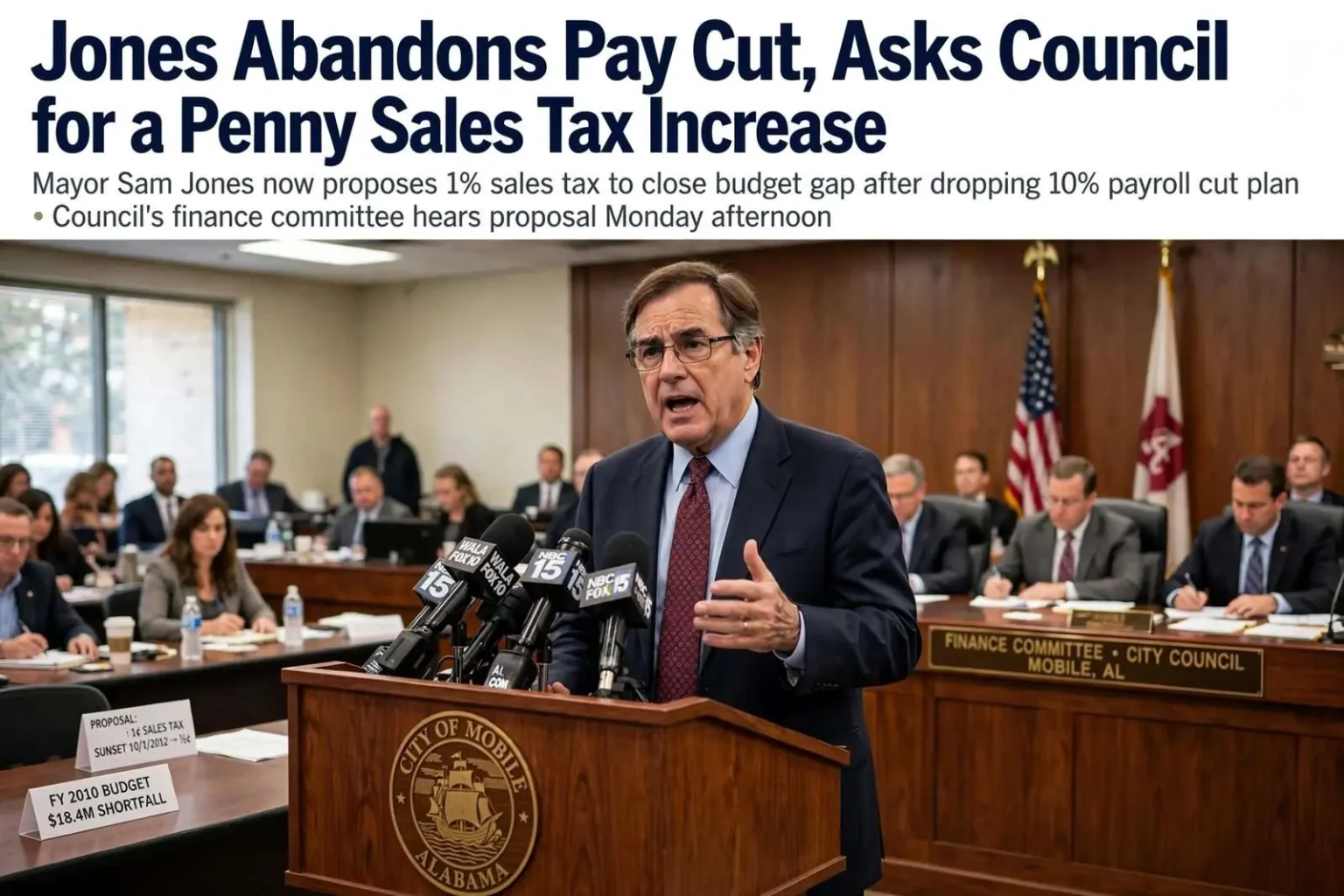
Mayor Sam Jones made his case Monday afternoon for a one-percent sales tax increase to close the city of Mobile’s budget wound, taking the proposal to the City Council’s finance committee after abandoning the plan he had been pushing for weeks. The pivot from payroll reductions to a tax increase marked the sharpest turn yet in the administration’s fight to balance a budget gutted by the recession, and it set up the kind of public debate that Mobile’s fiscal crises have always produced: who pays, how much, and for how long.
From pay cuts to tax increase
Until now, the centerpiece of the Jones administration’s answer to an $18.4 million hole in the fiscal 2010 budget was a 10-percent across-the-board pay cut for city employees. That plan produced exactly the reaction anyone might have predicted: restless city workers descending on City Hall, arguing that a citywide problem was being solved on their paychecks alone. Firefighters, police officers, clerks and maintenance workers — the entire municipal workforce — faced the same double-digit reduction in take-home pay, in a year when the private economy offered little room for anyone to absorb it.
The administration reconsidered. In place of the pay cut, Jones now proposes raising the city sales tax by a penny on the dollar as the key to balancing this year’s budget. The reversal traded a concentrated pain borne by a few thousand households of municipal employees for a diffuse one borne by everyone who shops in Mobile — a classic redistribution of budgetary burden that tax scholars describe as choosing between a visible tax on a few and an invisible tax on all.
The numbers the mayor is selling
Among the points Jones is expected to press as he works the council and the public:
A one-percent increase would generate roughly $7 million for the remainder of this fiscal year and about $28 million in fiscal 2011. The proposal carries a sunset clause: the increase would automatically be reduced to a half-percent — half a penny on the dollar — after the end of fiscal year 2012 on Oct. 1, 2012. Mobile’s combined sales tax rate would be equal to that of several other Alabama municipalities, including Birmingham, Montgomery, Prichard, Bayou La Batre, Gulf Shores and Orange Beach. City departments have already cut $21 million in costs since the beginning of the current fiscal year.
Each number is doing political work. The $7 million and $28 million figures translate the abstract “penny” into the dollars that close an $18.4 million gap. The sunset clause is the answer to the obvious fear that temporary taxes never die — the rate falls automatically, by the ordinance’s own terms, without requiring a future council to vote. The comparison to Birmingham, Montgomery and the beach cities is the answer to the competitiveness objection: Mobile would simply be joining the rate every other major Alabama municipality already charges, not setting a new high-water mark. And the $21 million in cuts is the administration’s answer to the most damaging accusation a tax-increase proposal faces — that City Hall is reaching into taxpayers’ pockets before it has finished tightening its own belt.
That last figure is the administration’s answer to the obvious objection — that City Hall is reaching into taxpayers’ pockets before it has finished tightening its own belt. Twenty-one million dollars in reductions is not trimming: it touches operations across every department, and it will be visible in service levels the public actually notices, from park maintenance to vehicle replacement to the response times of the public safety agencies that consume the largest share of any city budget.
The politics of a penny
The sales tax has long been the instrument of choice for Southern governments in a squeeze, for the simple reason that it arrives in small increments and no one receives a bill. It is also, in a recession, the shakiest of foundations: Mobile’s sales tax collections rise and fall with the retail economy, and the same downturn that gutted the city’s budget is the environment in which the tax must now produce its forecast. A dollar spent in Mobile carries the penny; a dollar spent online, or in a neighboring jurisdiction, does not.
The fairness question comes with it. Sales taxes are regressive by design — they take a larger share of a working family’s income than of a wealthy household’s, because lower-income families spend nearly everything they earn on taxed goods while higher-income families save a portion. Defenders answer with Alabama’s structural reality: the state constitution shackles property taxes among the lowest in the nation, leaving municipalities with few levers other than sales taxes when revenue collapses. A city that wants to fund police, fire and sanitation with an adequate budget has, in practice, one broad tax to turn.
The council’s role will determine the outcome. Under Mobile’s form of government, the mayor proposes and the seven-member City Council disposes — every penny of the increase requires a council ordinance, and each member will answer to a district whose residents and businesses will pay it. The finance committee hearing is the first test; the full council’s votes will decide whether the proposal, its sunset clause and its half-penny step-down survive contact with politics.
What the hole looks like
The $18.4 million shortfall did not appear out of nowhere. Mobile’s general fund depends on two volatile pillars — sales taxes and a share of state-shared revenues — and both fell as the national recession cut into consumer spending, employment and the economic activity around the port and its industries. Compounding the decline, the city’s fixed costs refuse to fall in a recession: debt service on bonds, pension contributions, health insurance premiums and fuel contracts all climb regardless of the economy.
The payroll plan was the shortfall’s most direct fix — salaries and benefits are the largest slice of any municipal budget — which is why the administration had pursued it for weeks despite the obvious backlash. A 10-percent cut across the workforce produced the arithmetic the city needed. It also produced the political arithmetic it could not survive: a workforce that floods City Hall’s chambers, that mobilizes its unions and associations, and that reminds the council that firefighters and police officers are the residents most exposed to the city’s problems.
The retreat from the pay cut also reframed the debate for the council. A vote for the sales tax is now not a choice between a tax and no tax; it is a choice between a tax and the return of the pay cut plan — or the deeper service cuts that the administration has already demonstrated, at $21 million, it is willing and able to make.
The sunset clause and the future rate
The proposal’s step-down schedule — a full penny now, a half-penny after the close of fiscal 2012 on Oct. 1, 2012 — is the feature the administration will lean on hardest with skeptical council members. Sunset clauses in tax policy serve two purposes: they reassure voters that an emergency measure has an expiration date, and they give future elected officials a mechanism they need not defend, since the reduction happens by law rather than by vote.
The fiscal 2011 estimate of $28 million is also the number to watch in the city’s long-term planning. If the full penny generates $28 million in a full year, the half-penny that remains after the sunset still yields roughly half that — a permanent addition to a general fund that the recession demonstrated to be too thin. Whether that money funds the restoration of the $21 million in cuts, replenishes depleted reserves or pays down deferred maintenance will be the story of the budgets that follow this one.
What the money buys
The budget the tax increase protects is not an abstraction for Mobile residents. It is the staffing level of the fire stations whose response times the city’s insurance ratings depend on; the police precinct staffing that shapes every neighborhood’s sense of security; the mowing crews, traffic signals, street lights and garbage collection that define how the city looks and works. A shortfall of $18.4 million in a general fund of the city’s size is the equivalent of several hundred employees — the kind of reduction that, if made entirely through layoffs, would be visible within weeks.
The $21 million in departmental cuts already taken has its own costs, some of them deferred. Fleets that go unreplaced age into higher repair bills; facilities that go unimproved deteriorate; and services trimmed in a downturn rarely return to their prior level quickly. Every dollar the sales tax raises is a dollar that reduces how much deeper those cuts would have to go.
The council’s decision
The finance committee’s review is where the mayor’s case meets its first organized scrutiny. Committee members will probe the revenue projections — whether $7 million for the remainder of the fiscal year is realistic given the recession’s grip on retail sales — and the sunset’s enforceability. They will hear from merchants worried about the effect on border competition, from residents wary of any increase, and from the employee associations whose members narrowly escaped the pay cut only to watch the city seek the same money elsewhere.
The political map favors the proposal in one respect: the comparison cities. Birmingham, Montgomery, Prichard, Bayou La Batre, Gulf Shores and Orange Beach already operate at the combined rate Mobile would reach under the proposal, which frames the question not as whether Mobile taxes more than its peers but whether it taxes equally with them. For a city council member, voting to match the rate every other major Alabama city already charges is a defensible position; voting to impose a rate no one else has is a different matter.
What happens after the council acts will shape Mobile’s finances for years. If the penny passes, the city exits its worst fiscal crisis of the recession with its workforce intact and its reserves recovering; the half-penny that survives the sunset becomes a permanent fixture of the tax base. If it fails, the administration returns to the payroll and service reductions it has already begun — and the $21 million figure the mayor cites will grow, at whatever pace the budget requires, until the city’s spending again matches its shrinking means.
The mayor’s argument, in the end, is a simple one delivered in four numbers: $18.4 million the city is short, $21 million it has already cut, $28 million a penny would raise, and a sunset that halves the tax when the emergency ends. Whether that arithmetic persuades the council — and the public watching the finance committee’s deliberations — will decide how Mobile pays its way out of the recession.