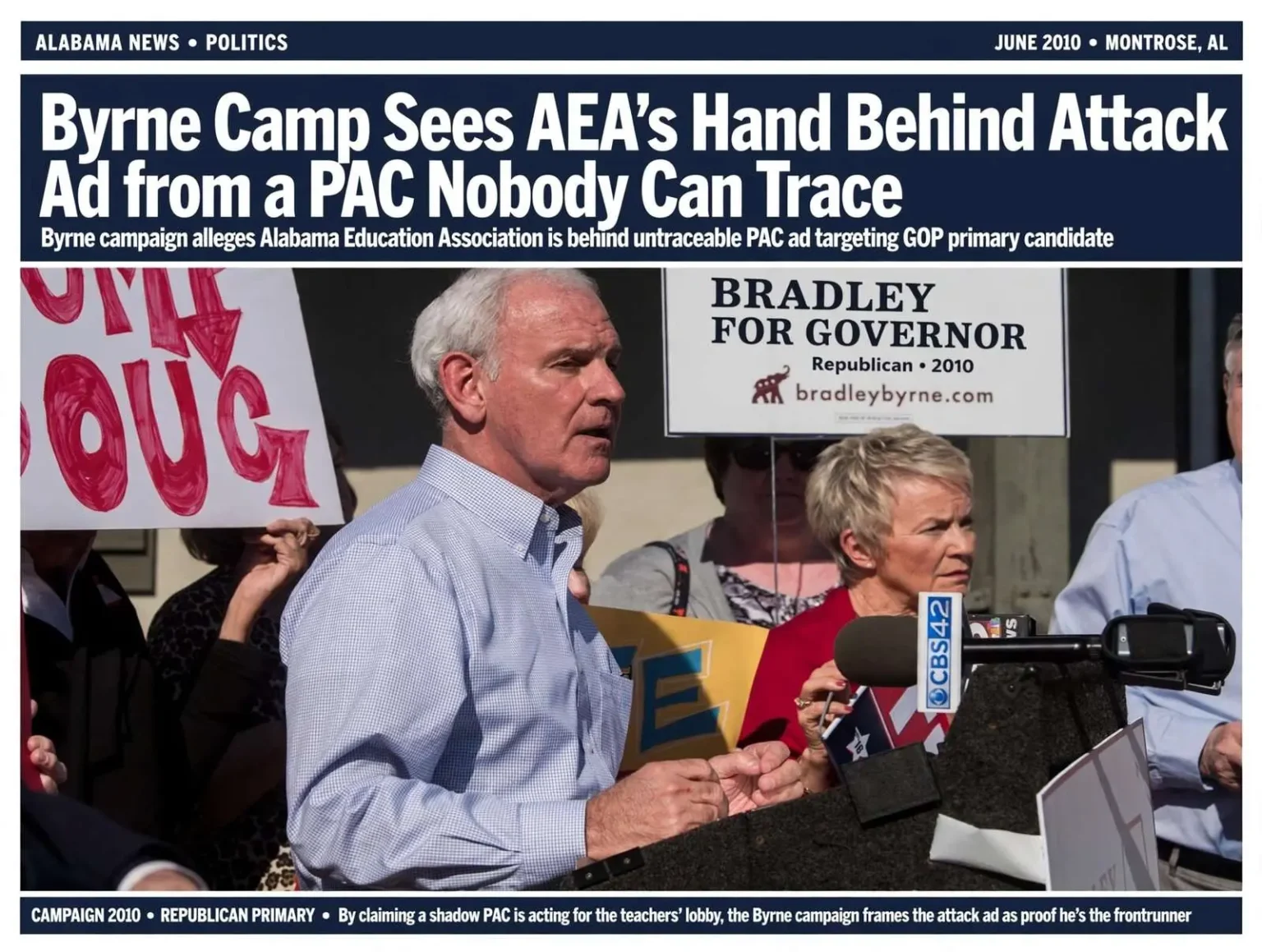
In a political campaign, an attack ad can be the sincerest form of flattery — and that is very nearly how the Bradley Byrne campaign says it is taking a television spot now running against him in the Republican primary for governor.
The ad seeks to blow away Byrne’s credentials as a conservative reformer by reaching back into his Democratic past. The Montrose Republican’s campaign, rather than pretending the spot does not sting, is treating it as evidence that its candidate is the man to beat.
Attack advertising is never random. A shadow group spends its money against the candidate it fears most, and in the final stretch of a crowded primary, a televised assault on one contender functions as a compliment from whoever is paying for it — a confirmation that polling, focus groups and internal numbers have all pointed the same direction. The Byrne campaign’s posture is built on exactly that reading.
Who is paying for it?
The ad is paid for by an organization calling itself True Republican PAC, whose funding sources are not yet publicly known, according to the Byrne campaign. Marengo County Republican Party chairman Andy Renner reportedly also chairs the PAC.
The air time was purchased by Media Strategies and Research of Denver, Colorado, the Byrne campaign says — a firm that has previously worked for Hillary Clinton’s 2008 presidential campaign and for organizations attacking John McCain and George Bush.
The Byrne camp offers that detail as its central argument: a media buyer with that client list, working for a group with an untraceable donor base, is not a natural fit for a genuinely Republican effort. The campaign sees the hand of the Alabama Education Association, the state’s powerful teachers’ lobby, behind the assault.
The accusation carries a specific history. Byrne, as chancellor of the state’s two-year college system, had waged a public fight to strip AEA-aligned dual-officeholding arrangements out of the colleges before resigning the post himself, and the union’s leadership had made no secret of its dislike for him. A PAC with hidden donors running ads against Byrne fits, in the campaign’s telling, the AEA’s long-demonstrated style of influencing Republican primaries without leaving fingerprints.
Why the money is untraceable
Under Alabama law at the time, PAC-to-PAC transfers make it possible for money to change hands several times before it reaches a television station, and the practice has made tracing the origin of campaign money notoriously difficult.
The mechanics are simple and long documented: a donor gives to one PAC, that PAC wires the money to another, the second to a third, and the final recipient — often one that exists only long enough to buy the ad — reports only the last transfer. Each link in the chain files the disclosure Alabama law requires; the original source disappears somewhere along the way. Reformers had campaigned for a ban on the transfers for years, arguing that they converted disclosure law into a legal laundering machine, and the practice remained lawful through the 2010 cycle.
The party switch at the heart of the ad
Byrne’s Democratic past is not a secret. A former Democrat and member of the state school board, he switched parties more than 13 years ago, and he did it publicly and pointedly.
“I want to be a member of a party which rejects the failed political leadership of the past, and which is producing fresh and energetic leaders with a new vision for our state,” Byrne said at the time.
In January 1997, speaking at the Radisson-Admiral Semmes Hotel in downtown Mobile, Byrne complained that Alabama’s Democratic Party “seems to me to be satisfied with the status quo” and too comfortable with the “stranglehold that special-interest groups have on education.” With the acquiescence of Democratic leadership, he said, the AEA had had “its way” with education policy in Alabama.
“I’m looking for a party that doesn’t just talk the talk, but walks the walk” on education reform, Byrne said on Jan. 9, 1997.
The records of that period make the switch’s motive unusually easy to document. Byrne did not leave the Democrats over abortion, guns or taxes — the standard fault lines of party realignment — but over education governance and the union’s influence over it. He had served on the State Board of Education while the accountability fights of the 1990s played out, and he concluded that the state’s largest obstacle to reform sat inside the party he belonged to.
In other words, the ad now attacking Byrne for having once been a Democrat is attacking a man whose stated reason for leaving the Democrats was his opposition to the very organization his campaign now blames for the ad.
That irony is the spine of the campaign’s response. The spot’s message — that Byrne cannot be trusted because he was once a Democrat — collides with a public record in which he announced his departure on the record, in a hotel ballroom, citing the special-interest influence that his supporters say has now followed him into the Republican primary from the shadows of an untraceable PAC.
What the 1997 switch looked like
Party-switching carried real costs in 1997. The Democratic Party still held most of the state’s constitutional offices, both Senate seats and large majorities in the Legislature, and local officeholders changed parties by the dozens as the realignment rolled through Alabama’s courthouse counties. A switch announced from a Mobile hotel podium, with a stated policy grievance rather than an election calculated to the moment, marked Byrne as part of the wave that would, within a generation, make Alabama’s Republican Party the state’s default — and make a Democratic past, not a Republican one, the liability in a statewide primary.
Company he keeps
Byrne’s switch raised the number of Republicans on the nine-member state board of education to four. Among them was then-Gov. Fob James, himself a former Democrat — and the father of Tim James, one of Byrne’s rivals for the 2010 Republican nomination.
Byrne’s chief fundraiser, Steve Windom, made the same jump to the GOP a few months after Byrne did.
Party-switching, in short, is not exactly disqualifying in Alabama Republican circles.
The geography of that board history is worth noticing. Fob James — elected governor twice, once as a Democrat — sat alongside Byrne as the board’s Republican bloc formed, and his son Tim was simultaneously building the business career he would later convert into his own candidacy for governor. Windom, a former lieutenant governor from Mobile who had run statewide as a Democrat-aligned figure before his own switch, became Byrne’s finance chairman — meaning the two most consequential money-and-machinery men in Byrne’s 2010 campaign had made the same journey he did, on the same rationale, within months of one another.
The campaign deploys all of it against the ad’s implication. If a Democratic past disqualifies a Republican in Alabama, then the party’s own leaders, board members, governors and fundraisers — nearly all of them former Democrats in a state that realigned wholesale within living memory — carry the same taint. The ad’s argument, applied consistently, would empty the primary of half its field.
The timing game
Whether primary voters agree — with less than two months to go before the June 1 vote — is the question the ad is designed to test.
The timing tells its own story. A spot attacking a candidate’s 13-year-old party switch arrives when early voting is distant, ballots are printing and the campaigns’ remaining money decides who gets the last word. Shadow groups time their buys to this window precisely because the target’s response options are limited: the candidate can buy response ads, hold press conferences and argue — as Byrne’s campaign is doing — that the attack itself reveals the attacker. None of it guarantees that a voter watching television that evening learns anything about the PAC, the media buyer or the money behind the message.
For the Byrne campaign, the strategy is to turn the ad into a referendum on its unknown sponsor. For the sponsor, whoever it is, the arithmetic is simpler: any doubt planted in the final weeks about the frontrunner’s conservatism is worth the buy, and the denials of the man being attacked cost nothing to incur. That is the logic of the untraceable ad — and with June 1 approaching, both sides are now playing it out in front of Alabama’s Republican electorate.
The episode has also become part of a larger argument that reform groups have been making about Alabama’s campaign finance laws. Every cycle produces a fresh set of advertisements that no one will claim and no disclosure form explains, and each one strengthens the case of the legislators who have pushed, session after session, to ban PAC-to-PAC transfers outright. Their argument is that a state which requires candidates to report every contribution while letting independent groups launder theirs has not regulated campaign money but simply divided it into two classes — the traceable and the useful.
Until the law changes, the True Republican PAC spot will remain exactly what it is now: a television message about Bradley Byrne’s past, funded by nobody in particular, delivered through a buyer whose client list the Byrne campaign is happy to recite. Voters have less than two months to decide what any of it says about the man on the screen.