Cotton, Shipyards and Brookley: One Mobilian’s Blunt Accounting of the City’s Fortunes
Mark Berson placed Mobile's golden age between 1830 and 1860, traced its long decline through the loss of Brookley Field, and argued in 2005 that the city was poised to grow again.
MOBILE — Asked in the spring of 2005 to name Mobile’s golden age, Mark Berson gave a date range and then, with evident relish, delivered a candid tour of everything that happened afterward. His answer: 1830 to 1860.
“I think that Mobile’s golden age was around 1830-1860, when we received cotton from central Alabama and the local cotton brokers and ancillary businesses were very prominent and profitable,” said Berson, then president of the Alabama Gulf Coast Chamber of Commerce, a former state tourism director and the former owner of the Mobile restaurant Raphael’s.
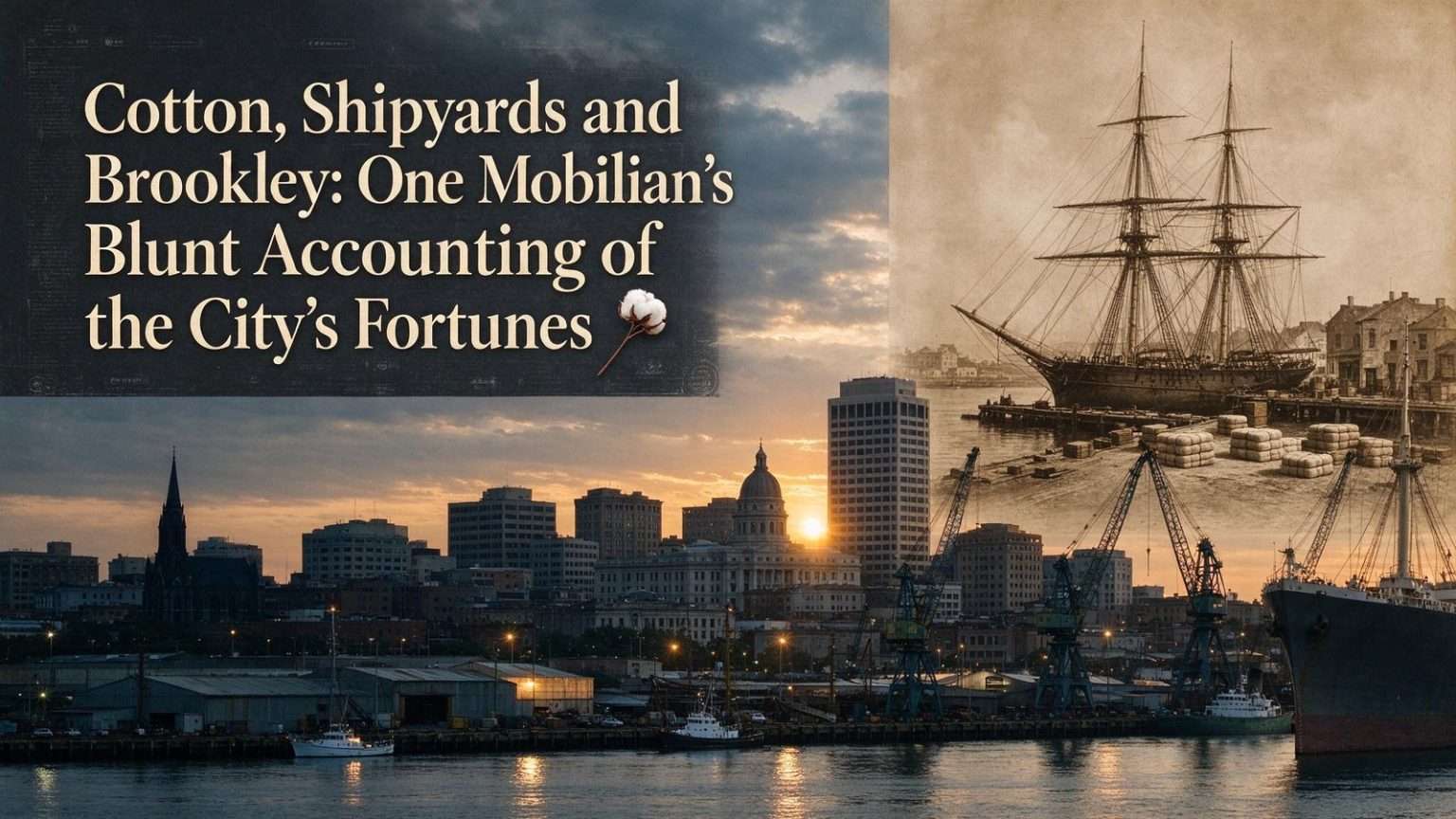
Those were the decades when Mobile functioned as the funnel through which the Black Belt’s cotton crop reached the world. The brokers, the factors, the warehouses, the shipping agents, the banks — all of it clustered along the river, and all of it prospered. Cotton grown across a swath of central Alabama moved downriver to Mobile’s wharves and out through the bay to markets in Europe and New England, and the men who financed, insured and shipped it built the antebellum city’s grandest homes and its earliest fortunes.
The long slide
After the Civil War — which Berson noted some of his more steeped-in-the-South friends still called the War of the Northern Invasion — the city began what he described as a steady decline.
The interruption came with the Second World War. Only with the wartime buildup and the shipbuilding at ADDSCO from 1941 to 1945 did Mobile appear to have a bright future again. The yards drew tens of thousands of workers to the city and transformed it almost overnight, as Alabama Dry Dock and Shipbuilding Company turned out Liberty ships and tankers for the war effort and Mobile became, for a few frenzied years, one of the busiest shipbuilding centers in America. Workers poured in from farms across the state, remaking the city’s demographics and testing its housing, its schools and its race relations all at once.
Afterward, Brookley Air Force Base kept Mobile’s economic head above water. The base anchored thousands of military and civilian jobs on the east side of the city, sustaining through the 1950s the sense that Mobile had found a stable postwar footing.
Then, in Berson’s blunt telling, politics intervened: the area went overwhelmingly for Barry Goldwater in the 1964 presidential election, and President Lyndon Johnson pulled the plug on Brookley soon afterward. The closure, announced in 1964 and carried out over the following years, cost the region thousands of jobs and remains one of the defining economic traumas in modern Mobile history.
What was left, he said, were the chemical and pulp industries — and he was not sorry to see them go.
“Thank goodness they’re memories now,” he said.
A bottom, and a turn
Berson’s assessment of 2005 was that Mobile had recently passed through about the worst economic stretch in living memory, in the wake of those industrial closures, and that it might now be poised for substantial growth over the following decade.
Credit for the turn, in his view, belonged in significant part to David Bronner, head of the Retirement Systems of Alabama, whose pension-fund investments had put money into downtown Mobile at a scale no private developer was offering.
“The citizens of Mobile should emote hosannas that Dr. Bronner decided to invest so heavily in the city,” he said. “Fruit will be borne from RSA’s investments.”
The RSA’s presence in downtown Mobile was by 2005 impossible to miss. The retirement system’s tower projects had changed the city’s skyline when little private capital was willing to, and Berson’s argument was that the pension fund’s patience — its willingness to invest for decades rather than quarters — was exactly what a city recovering from Brookley needed.
A defense of the outgoing mayor
Berson then turned to Mayor Mike Dow, who had announced that he would not seek a fifth term, and who was taking his share of criticism as the campaign to succeed him got underway.
“It also pains me that Mike Dow is ripped apart by some people,” he said. “He’s done almost 16 years of hard labor for Mobile when he could have been working at any number of other high-paying jobs in the private sector. Only after he’s gone will the people realize what they had in him.”
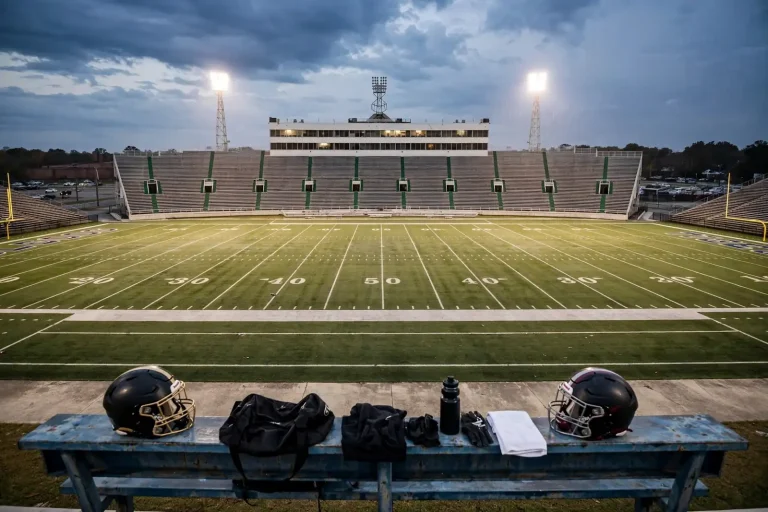
He was particularly exercised about the thinness of the mayor’s commemoration — an amphitheater, and that was about it. Ladd-Peebles Stadium, he argued, ought to be renamed Ladd-Dow Stadium. Dow had pushed for the city funds that improved the stadium, and he had recognized the value of the idea, floated by a local newspaper editor and the ESPN college football commentator Mike Gottfried, that became the GMAC Bowl — the postseason game that brought national television to Mobile each winter.
The bowl game was, in Berson’s telling, emblematic of what Dow understood about the city: that Mobile’s future lay in events and attractions that put the city on national screens, not in chasing the smokestack industries that had left. A December football game on ESPN did what no industrial recruitment brochure could — it showed a national audience a Mobile that was alive, warm in winter and eager to host.
The screed, cheerfully acknowledged Berson knew perfectly well he had wandered off the question, and said so.
“As you can see, I’ve started on a screed,” he wrote, “when all you asked was to name the city’s golden age.”
Then he returned to his answer, unchanged: 1830-1860.
What the digression revealed
What the digression revealed, though, was the shape of the argument Mobilians were having with themselves in 2005. The city’s greatest prosperity lay a century and a half in the past. Its most recent boom had been a wartime accident. Its worst wound had been political. And its immediate future, as far as anyone could tell, rested on the willingness of a state pension fund to keep betting on downtown.
That framing captures why Mobile’s self-image has always run through its history rather than around it. Cities that have never declined do not measure themselves against a cotton-era golden age; Mobile, which has, does. Every boom since 1860 — the shipyards, the base, the petrochemical plants — arrived from outside, carried by war or federal spending, and every one departed the same way. Berson’s catalog of losses was not nostalgia for its own sake; it was an accounting of why Mobilians in 2005 found it hard to believe any new promise of growth would last.
The Bronner exception is what made his optimism notable. The RSA’s investments were the first major bets on downtown Mobile in decades that had not arrived because of a war or a base, and their visible results — towers rising on the skyline where warehouses once stood — gave the argument something concrete to point to. If a pension fund could see profit in downtown Mobile, Berson’s reasoning went, private developers could not be far behind.
His defense of Dow fit the same logic. A mayor willing to spend city money on a stadium and to champion a bowl game was, in that view, doing the slow cultural work of recovery — building the occasions on which a city learns to see itself as somewhere worth visiting, worth investing in, worth staying for. The amphitheater struck Berson as a thin monument for sixteen years of that work, and he said as much while the campaign to replace Dow was still taking shape.
Whether Mobile’s next golden age would arrive in his lifetime, Berson did not claim to know. But his reading of 2005 was that the city had finally stopped sliding — that the bottom was behind it, the pension fund was in front of it, and the habit of measuring Mobile against 1860 might, at last, be ready for an update.
The cotton years, remembered
The era Berson named still defines downtown Mobile’s architecture. The Italianate mansions built by cotton factors and shipping magnates along Government Street and in the old district near the river date from precisely those decades, and the city’s earliest banks and insurance houses trace their charters to the same cotton money. When Mobilians point to a golden age, they are pointing at buildings they walk past every day — which is part of why the period dominates the city’s sense of itself.
The economics of that age were brutal and narrow, resting on enslaved labor across the Black Belt plantations whose crop passed through the port, and the prosperity it produced was concentrated in a small commercial class. But as a description of when Mobile mattered most to the world’s economy, Berson’s dates are hard to argue with: for a generation, the cotton trade made the city one of the busiest ports on the Gulf, and the brokers’ row along Royal Street was where the crop’s financing was arranged before a bale ever reached a ship.
Mobile between the wars
Between the cotton collapse and the Second World War, Mobile sputtered through periods of timber and port traffic, never again commanding the position the cotton trade had given it. The ADDSCO years briefly made the city feel essential again — the scale of wartime shipbuilding remade whole neighborhoods and pulled the port into the twentieth century — but the yards’ postwar contraction returned the city to its pattern of booms that arrive and depart with forces decided elsewhere.
Brookley’s closure followed that pattern with a cruel twist: it was not a market decision but a political one, arriving within reach of an election in which the region had opposed the president doing the deciding. That lesson — that federal installations can be moved by politics as easily as markets move factories — shaped how Mobile leaders approached economic development for decades afterward, pushing the city toward diversified recruitment rather than dependence on any single employer, federal or private.
The chemical and pulp mills that absorbed some of the lost jobs kept paychecks flowing through the 1970s and 1980s, but Berson’s relief at their passing reflected the other side of that ledger: the environmental cost and the boom-bust exposure of commodity manufacturing, industries that left the city with cleanup burdens whenever they left at all.
Reading 2005 from the ground
What a visitor to downtown Mobile in the spring of 2005 would have seen matched Berson’s account — cranes where the RSA projects were rising, a stadium preparing for another nationally televised bowl game, and a mayoral race already underway to succeed a man who had held the office longer than anyone then in city hall could remember a predecessor holding it. The city was smaller than its Gulf Coast momentum suggested, still carrying the losses of Brookley in its institutional memory, but it was no longer shrinking.
Berson’s interview, delivered with the confidence of a man who had watched tourism, restaurants and civic promotion from several angles, amounted to a bet that the newest turn would hold. The dates he offered as Mobile’s golden age were safe — no one would contest 1830-1860. The more daring claim was the unstated one: that 2005 might someday look, in retrospect, like the moment the slide stopped.