Three Finalist Routes for I-10 Mobile River Bridge Stir Waterfront Worry
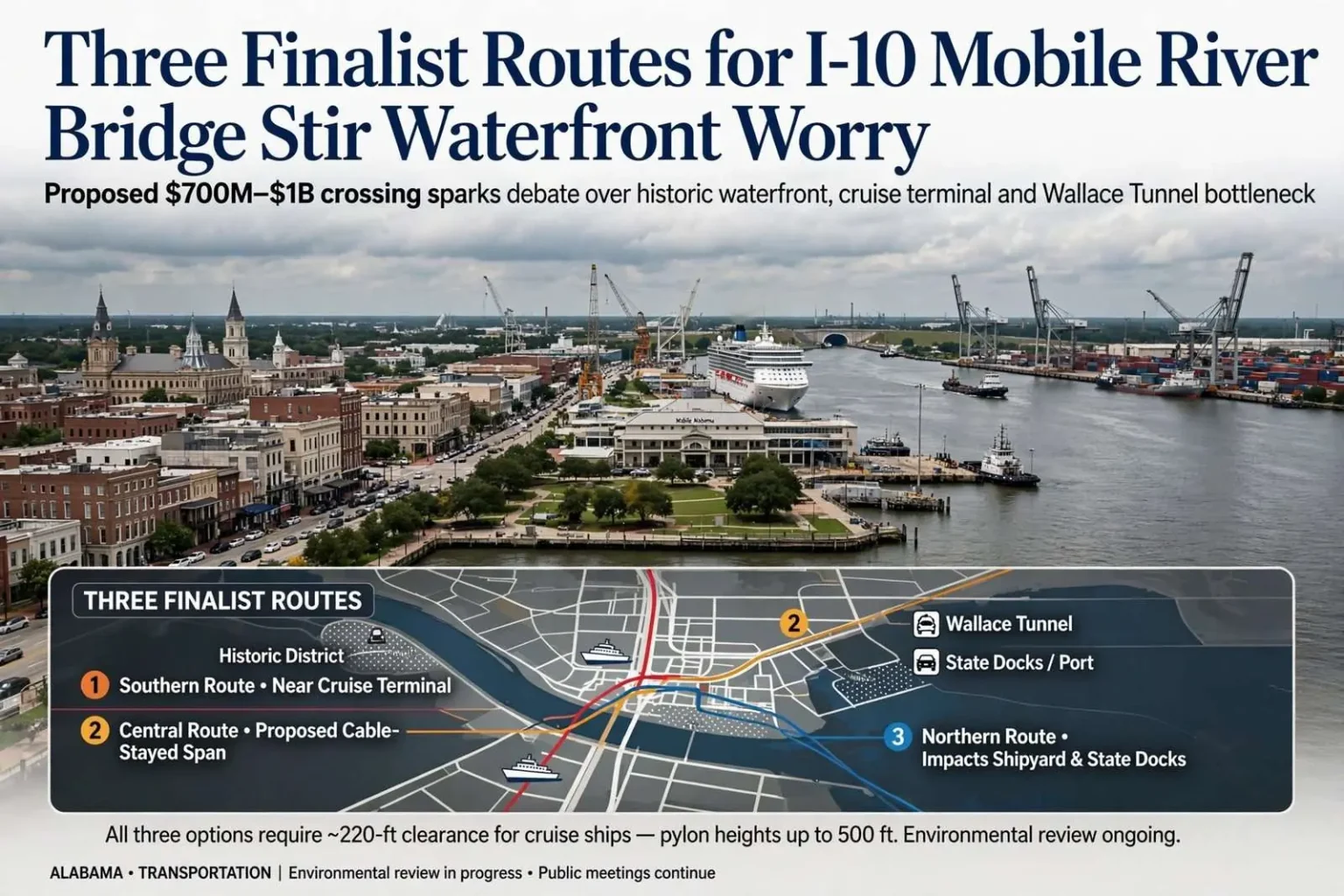
State highway planners narrowed 14 possible crossings of the Mobile River to just three, none of them the northern route favored by preservationists, reviving a fight that echoed the 1980s expressway battle.
A proposal to build a towering new Interstate 10 crossing of the Mobile River set off a rising storm along the downtown waterfront, with critics warning that the fight could rival the public uproar that scuttled an elevated downtown expressway two decades earlier. The comparison was a loaded one for Mobilians of a certain age: a previous generation had watched a planned downtown viaduct die under the weight of civic opposition, and waterfront interests warned that the new bridge fight was lining up the same way.
At the heart of the dispute lay the Wallace Tunnel, long regarded by state and federal engineers as one of the most troublesome bottlenecks on the interstate system. Stalled motorists, accident victims and state troopers all felt the strain of funneling interstate traffic through the aging tubes, and highway officials argued that a new span was overdue. The tunnel had been built for a city and a highway volume that had both long outgrown it; its two tubes choke to a stop daily on beach-bound traffic in summer and commute traffic year-round, and every wreck inside the tubes backs interstate vehicles into downtown streets within minutes.
From fourteen routes to three
Planners had drafted as many as 14 alternate routes to unravel the congestion. In recent weeks the list was whittled to three finalists, an outcome that alarmed preservationists and maritime interests because none of the surviving options followed the northern alignment they preferred. The winnowing process — the standard diet of a major highway study — left the factions that had organized around one eliminated route with the choice of fighting the survivors or absorbing the loss.
The Alabama Department of Transportation continued an environmental impact study of the remaining routes, with the price of the project estimated at somewhere between $700 million and $1 billion. Either figure would rank the crossing among the most expensive single transportation projects ever attempted in Alabama, and the financing question — federal dollars, tolls, or some combination — shadowed every other debate about the design.
ALDOT engineers described the span in soaring terms, suggesting it could become Mobile’s answer to the Golden Gate Bridge. Opponents saw the matter very differently, and the publication canvassed a wide range of interested parties — preservationists, port officials, shipyard operators, downtown investors — whose answers described a waterfront that could not agree on what a new crossing should be.
Preservation and downtown worries
Leaders of the Historic Mobile Preservation Society argued that pylons rising some 500 feet and a roadbed at least 200 feet high would literally overshadow the city’s historic core. They favored routes that would upgrade existing highway alignments, or as a last resort, a return to the idea of additional tunnels — the option that would keep the skyline clean but at a cost and engineering complexity that highway officials had long resisted.
Public participation meetings, one critic complained, had offered little genuine discussion — the familiar grievance of citizens who attend a study open house, study the maps on easels, and leave without believing their comments changed a decision already made. Downtown investors and preservationists including representatives of Oakleigh House and the Renaissance effort insisted that a bridge looming over the cruise terminal, the new maritime museum and nearby historic districts would smother the very redevelopment the city had worked for years to nurture. Several pointed to New Orleans and other cities where property beneath elevated spans had languished — unused land under permanent shadow that no tenant wanted and no developer would touch.
The redevelopment argument had particular force in 2008-era Mobile, a city then in the middle of a downtown revival built on the cruise terminal, the convention center and a slowly recovering retail core. Civic leaders had spent a decade and hundreds of millions of dollars persuading private investors that downtown Mobile was coming back; the critics’ case was that a 500-foot bridge over the front porch of that revival could undo the pitch overnight.
Port and cruise interests weigh in
Officials tied to the cruise trade cautioned that all three routes would affect the Mobile Alabama Cruise Terminal to some degree, and that the two northern-most options could take part of the terminal site outright. They stressed that any span would need to clear roughly 220 feet to accommodate the newer, taller cruise ships — the air-draft requirement that made a low-rise crossing impossible and pushed every design toward the towering cable-stayed profiles that preservationists feared.
Alabama State Port Authority director Jimmy Lyons said the route just south of the cruise terminal appeared to carry the least impact and urged that the badly needed project move forward soon. Lyons’ position carried weight because it came from the man running the port — the institution with the most at stake in any waterfront disruption — and because he paired his caution about siting with an argument for speed: the tunnel problem would not wait for a consensus that might never come.
Airport authority and shipyard representatives, meanwhile, warned that severing access between the interstate and the State Docks, container terminal and Brookley could damage the region’s chief competitive advantage. The working waterfront depends on trucks moving cargo between the docks and the interstate on tight schedules; a highway alignment that would wall off the industrial waterfront from its interstate connection would tax every container and every shipyard load that crossed it.
Not everyone accepted the premise. One family shipyard operator, whose business dated to 1895, said the northern-most route under study would wipe out the company entirely, and he pressed instead for a plan pairing a northern bypass with a crossing alongside the Cochrane Bridge. That alternative, he and others argued, would relieve the tunnel, spur growth in Prichard and open the wider trade area to development — an argument that reframed the project from a downtown structure into a regional one, serving the historically Black city north of Mobile that the existing interstate had bypassed rather than served.
The shipyard’s survival carried its own historical weight: a company that had worked the Mobile waterfront since 1895 had outlasted wars, depressions and hurricanes, and its owners argued that a single highway alignment could accomplish what a century of economic upheaval had not.
A decision still years away
Baldwin County lawmaker Bradley Byrne said each remaining route carried problems, and he worried aloud that the cost could crowd out badly needed hurricane evacuation and four-laning projects on the Eastern Shore. The concern came from the legislator whose district lived with the other side of the problem: thousands of Baldwin Countians cross the bay daily, and the same highway trust fund that would feed a $1 billion bridge had a long list of competing projects — evacuation routes, four-lane connectors, interchange improvements — already queued behind it.
U.S. Sen. Jeff Sessions, for his part, counseled patience, saying the choice rightly belonged to the transportation department and its engineers in concert with local leaders, and deserved careful study and much discussion. The senator’s posture was the federal one in miniature: the money for any crossing of that scale would flow through Washington, the environmental review would be judged by federal standards, and a project that advanced ahead of local consensus risked the lawsuits that stall such projects for a decade.
For all the passion on display, the outcome remained unsettled. The environmental review had yet to be completed, and residents on both sides braced for a debate that promised to shape the look of the waterfront for a generation.
The long shadow of the Wallace Tunnel
What made the debate so durable was that both sides were right about the problem. The Wallace Tunnel bottleneck was real, worsening and economically costly; everyone who had sat in the summer beach crawl or been diverted off the interstate by a tunnel wreck understood the case for a new crossing. The stakes for the historic waterfront were real too: a structure tall enough to clear cruise ships is, by physical necessity, the tallest thing on Mobile’s skyline, and it would stand over a downtown that had staked its revival on its historic character.
The disagreement was never about whether something should be done about I-10’s bottleneck. It was about where the region put the fix — over the historic riverfront, alongside the existing Cochrane crossing, or back beneath the river in a new tunnel — and who bore the cost of each choice. Those questions would outlast the news cycle, the environmental study and, eventually, the officials weighing in on them, because the route chosen would be on the map for a century.
In the meantime, the traffic kept backing up in the tubes, the ships kept calling at the terminal, the shipyards kept working under the flight paths of the study helicopters, and Mobile settled in for the long argument that big infrastructure projects always demand — an argument about what kind of city the Port City intended to be, conducted one public meeting at a time.