Highway Officials Cool to ‘Northern Route’ as Answer to Wallace Tunnel Gridlock
State and federal highway officials told supporters of a Cochrane-Africatown bridge route that it likely could not meet the purpose of relieving Interstate 10 congestion at the Wallace Tunnel.
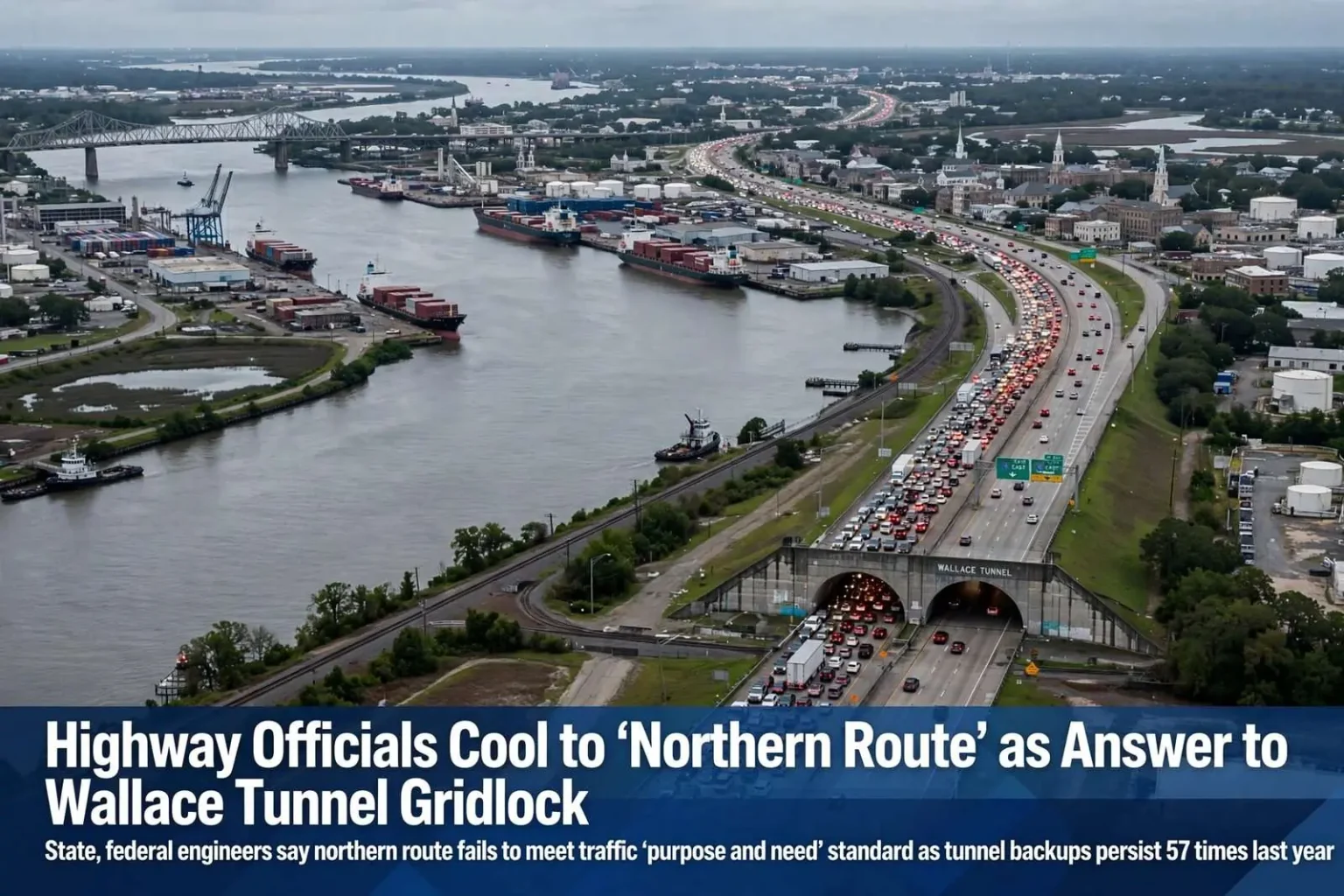
Supporters of a “northern route” solution to the chronic traffic congestion at the George Wallace Tunnel did not hear what they wanted from state and federal highway officials in a meeting this week. While officials stopped short of formally eliminating the Cochrane-Africatown Bridge route favored by maritime, civic and historic preservation interests, they left little doubt that no realistic reshuffling of traffic patterns would allow it to meet “the purpose and needs” of the project — the legal standard that governs which alternatives survive into an environmental impact statement.
The meeting was the latest turn in a study that has divided Mobile over how, and where, to relieve the bottleneck at the Interstate 10 tunnel under the Mobile River. The twin tubes of the Wallace Tunnel have carried eastbound and westbound traffic beneath the river just south of downtown since the early 1970s, and the older Bankhead Tunnel nearby still moves local vehicles through the same soft riverbank soils. But traffic volumes on I-10 have long since outgrown what the tunnels were built to handle, and backups at the tunnel portals have become a routine feature of life for commuters, freight haulers and visitors alike — a daily reminder that the region’s single busiest highway corridor depends on a choke point that cannot be widened where it sits.
The alternatives on the table
Three other alternate routes under study all crossed the river at mid-river and featured a new bridge rising 190 feet or higher. Any of the three, officials said, would relieve the Interstate 10 bottleneck and serve traffic projections for the next 25 years or so. The height is not a designer’s whim. The river channel must stay open for the cargo ships, cruise vessels and workboats that call on the Port of Mobile, so a new downtown crossing would have to climb high enough to pass over the tallest vessels afloat — a requirement that shapes not only the bridge itself but the miles of elevated approach ramps that would carry traffic up to it through some of the city’s most historic blocks.
Opponents of the mid-river crossings warned of harm to Mobile’s new cruise terminal, its downtown revitalization, its shipbuilding and port activity and its historic properties — costs they argued were not fully appreciated by bureaucrats, road builders and traffic engineers. The alignments under consideration, they said, would thread enormous elevated structures through some of the oldest and most economically sensitive parts of the city, from the working waterfront and the shipyards to neighborhoods whose historic buildings anchor the tourism economy.
Representatives of Keep Mobile Moving, the civic group organized to press for an alternative, urged that the northern route remain among the alternatives carried forward for study. Their consultants, Street Smarts of Atlanta, argued that technology, rerouting 8,000 long-haul trucks, upgrades to the Cochrane-Africatown bridge and its approaches, and interchange modifications could hold tunnel traffic within reasonable limits. The northern route would cross farther up the Mobile River, near the Cochrane-Africatown USA Bridge — a crossing tied to the Africatown community north of downtown, founded by the survivors of the Clotilda, the last known slave ship to bring captive Africans to the United States, and a district whose residents have watched heavy industry press against their historic streets for generations.
Under federal law, an environmental impact statement must carry forward a range of reasonable alternatives, and only those that meet a project’s stated purpose and need. If a candidate route cannot handle projected traffic and relieve the congestion the project exists to fix, the Federal Highway Administration can screen it out before the most expensive analysis begins — which is exactly the test the northern route’s backers were trying to pass, and exactly the test the engineers said it failed.
The K factor
The engineers disagreed, and their objection came down to a number. The “K factor” is a calculation applied to average daily per-hour traffic flow — generally .10 in traffic engineering practice, or the slightly more lenient .08 used in the Street Smarts approach. It is applied to the 30th-highest hour of traffic flow in a year to find a reasonable design target. In plain terms, a highway is not built for the quiet average day. It is built for the busy hours that arrive again and again across the year, and the 30th-highest hour is the conventional yardstick for how bad a road’s busiest recurring days get.
Street Smarts also ran the numbers using perhaps the 100th-highest hour, and the results were still unacceptable, according to Don Arkle, ALDOT assistant chief engineer for policy and planning. “It is not our standard practice to design for a number that will be exceeded 100 times in a year,” Arkle said. His point was blunt: a crossing that only works on the calm days is not a crossing that works. Traffic planners measure a facility by how it performs when demand is at its recurrent worst, and by that measure the rerouted flows would still queue up somewhere — if not at the tunnel, then at the interchanges and bridges a northern route would feed instead.
To make the northern route satisfy the project’s purpose, officials said, might require eliminating local traffic on I-10 between Tillmans Corner and Spanish Fort — a change no one was proposing seriously, and one offered mainly to illustrate the limits of the idea. The stretch between those two points is not some little-used link. Tillmans Corner is one of the most densely populated commercial districts in southern Mobile County, and Spanish Fort is the fast-growing Eastern Shore city in Baldwin County where commuter and retail traffic funnels toward the bay bridges every day. Cutting local vehicles off that segment would strand thousands of routine trips — school runs, store errands, commutes — in order to make the arithmetic work for a single alternative.
That, the officials suggested, is the problem with reshuffling traffic patterns on paper. Each adjustment that relieves pressure at one point simply transfers it to another, and the network as a whole still has to absorb the same peak demand. A detour around the Wallace Tunnel does not make the traffic disappear; it moves the queue to a new location, and if the new location has less capacity — as the engineers believed the northern route and its connections would — the region ends up trading one bottleneck for two.
Fifty-seven times a year
The scale of the problem was not in dispute. In the previous year, traffic in the tunnel had backed up 57 times to the point that it took an hour of stop-and-go driving for a vehicle to get through. That figure describes a recurring failure, not an occasional bad day — more than once a week on average, the crossing that carries the bulk of the region’s east-west highway traffic degrades into a parking lot.
County Engineer Joe Ruffer, whose Government Plaza office overlooks the eastbound tunnel entrance, was not surprised. “Fifty-seven times (almost) perfectly matches every Friday,” Ruffer said. “Sometimes it’s backed up to Virginia Street.” His vantage point makes the pattern hard to ignore: from his window he can watch the queue form each week as weekend travelers and end-of-week freight runs converge on the tunnel at once.
District Engineer Ronnie Poiroux noted that additional backups occur because of wrecks — many of which, another ALDOT official added, are themselves caused by congestion. That feedback loop is one of the least visible costs of the bottleneck. Stop-and-go traffic compresses vehicles into tight platoons, raises rear-end collision rates, and every crash then closes a lane in a tube that has no shoulder and no room to maneuver, turning a routine fender-bender into an hour-long closure that ripples back through the street grid of downtown Mobile.
Officials also pointed out that the northern route would require added lanes on an already burdened Interstate 65, at a cost of $50 million for one lane or $244 million for two, because of significantly greater engineering difficulty. I-65 already carries a heavy mix of commuter traffic and through freight as it loops around the city’s northern and western sides, and widening it near the river would mean threading new lanes across difficult ground while keeping an interstate that never closes open to traffic while the work proceeds.
‘If you don’t include a northern route, there’s not going to be any consensus’
Tom Bender of Bender Shipbuilding argued the northern route had earned further study, saying Keep Mobile Moving had met the officials’ earlier charge to produce a workable alternative to the mid-river crossings. “This could do tremendous harm to the port,” Bender said. “And the only way to serve that purpose, to find that out, is to get it (the proposed northern route) in the study. There is so much at stake.” His company works on the river the new bridge would span, and like other waterfront businesses he feared the elevated approaches and clearance requirements of a mid-river crossing would press directly against yards, berths and operations that cannot simply move.
“If you don’t include a northern route, there’s not going to be any (community) consensus,” said Bruce Croushore of Bender. His argument was political as much as technical: a project of this size — a bridge across a working harbor, through a historic city — would need years of public support to survive funding fights, environmental review and construction, and a study that writes off one side’s preferred alternative at the start risks producing a plan the community never accepts.
Arkle held the line. “They must each serve the purpose,” he said. “It has to relieve congestion in the tunnel. If it doesn’t, then it doesn’t belong in the study.” For the state’s engineers, sympathy for the port’s concerns could not change the arithmetic. The study exists to fix a specific, measured problem, and every alternative that survives into detailed review has to demonstrate — with numbers, not intentions — that it would actually fix it.
Ultimately, Arkle said, the Federal Highway Administration would decide which routes entered the environmental impact statement, approval of which was probably a year or more away. That means the fight over which alternatives advance is not necessarily over — federal reviewers weigh the state’s screening decisions, public comment can reshape an environmental document, and the formal record of decision remains the final word on what gets built. For residents of Mobile and the Eastern Shore, the timeline matters as much as the outcome: years of study and construction would pass before any new crossing carries its first vehicle, while the tunnel congestion that started the process continues to worsen in the meantime.
Steve Perry noted that even the seemingly astronomical cost of a $1 billion bridge might pale, over the life of the structure, against the potential commercial harm to Mobile. His argument inverted the usual debate over megaproject price tags: a bridge is measured in decades of service, and if its design throttles the port traffic, shipbuilding work and downtown investment that pay the city’s bills, the cumulative economic loss could eventually dwarf the construction cost that everyone was arguing about.
Mayor Sam Jones framed the stakes plainly. “I do know this,” he said. “This thing is getting worse and if we don’t do something, we will feel (a seriously negative) effect in the community. Our growth depends on a transportation system that works and we’ve got one that’s broken right now.” For a city courting aerospace employers, port expansion and cruise visitors, the daily tunnel queue is more than an inconvenience — it is a visible argument for businesses deciding whether to locate in Mobile at all.
“It’s coming down to where it’s time to make a decision,” said ALDOT Chief Engineer and Deputy Director Don Vaughn, who gave the northern route’s backers two or three weeks to produce any new information supporting their case. The deadline was narrow but real: any fresh traffic data, modeling or engineering work that could change the route’s showing would be considered before the alternatives list went forward, and after that, the study would move on without it.