Bayou La Batre Sets Its Sights on a Comeback Blessing of the Fleet
After hard years marked by the Gulf oil spill, organizers of Bayou La Batre's 62nd annual Blessing of the Fleet aimed to make the day a family celebration and a sign of the seafood community's resilience.
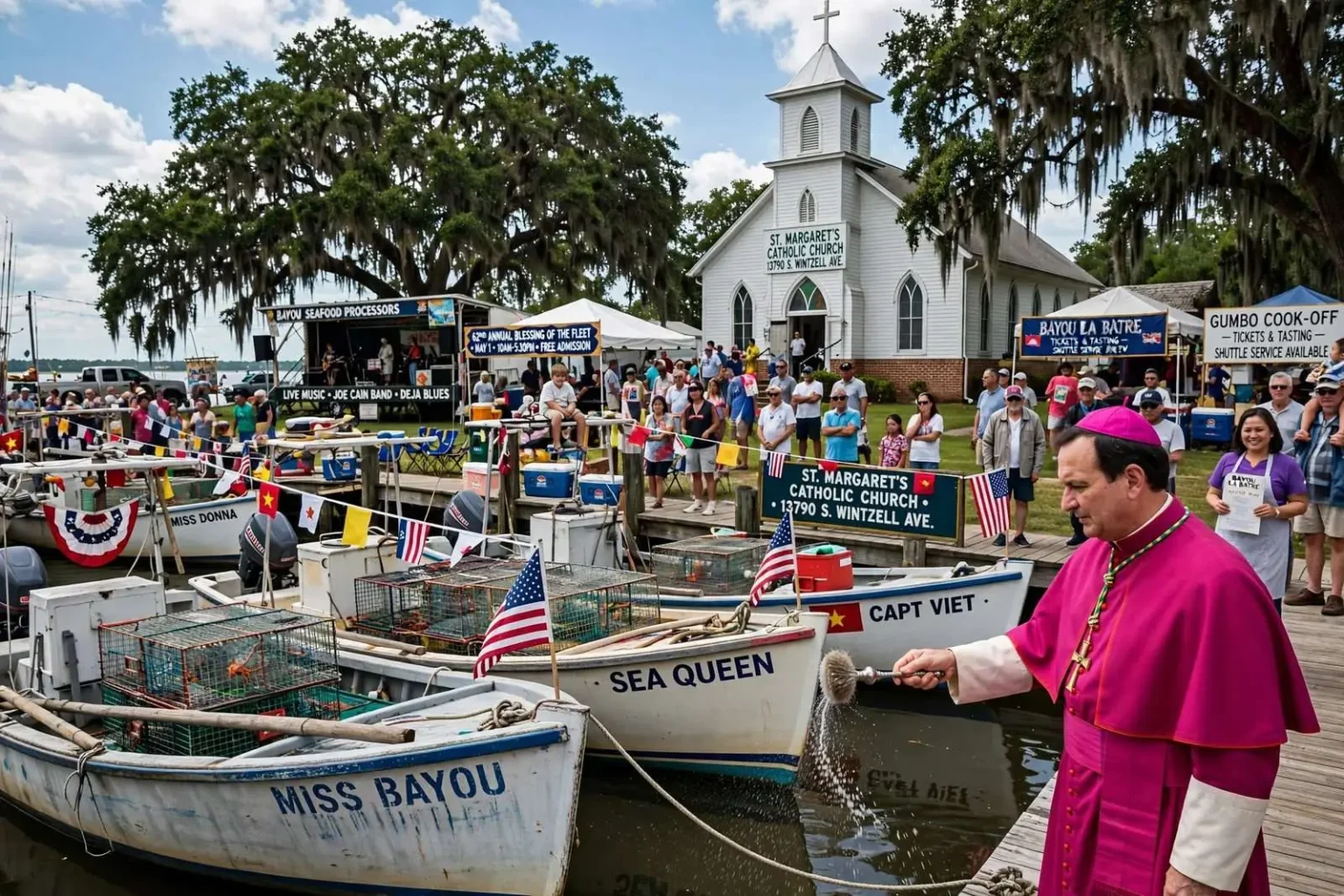
Organizers of Bayou La Batre’s 62nd annual Blessing of the Fleet set out to make the event a comeback year, planning a day of festivities aimed at drawing families back to the working waterfront after a stretch of hardship for the seafood town. The celebration was scheduled for Sunday, May 1, at St. Margaret’s Catholic Church, running from 10 a.m. until 5:30 p.m. Admission and parking were free, with shuttle service to and from the church grounds, and tickets sold on site for boat tours, the gumbo cook-off and other activities.
For a town of barely more than two thousand residents at the bottom of Mobile County, the Blessing of the Fleet is the calendar’s biggest day — a homecoming, a fundraiser and a public act of faith rolled into one. The event draws visitors from across the Gulf Coast to a community whose shrimp boats, processing houses and shipyards line the banks of the bayou, and whose identity has been shaped by more than a century of harvesting the waters where Mobile Bay meets the Gulf.
A day built for families
The program packed in a full slate of attractions, including an arts and crafts festival, a gumbo cook-off, an antique car exhibition, live music, fresh Gulf seafood dinners, bayou boat tours, a land parade and a boat parade. The centerpiece remained the formal blessing of the fleet, conducted by Archbishop Thomas J. Rodi of Mobile. The archbishop’s participation underscores the event’s dual character as civic festival and religious observance: Rodi leads the Archdiocese of Mobile, whose jurisdiction covers the southern half of Alabama, and the blessing he offers from the church grounds is the ritual moment the entire day is built around.
Live music ran throughout the day, with a lineup that featured the Kim Carson Band, Fishergreen, Rickie Castrillo and Friends, the Joe Cain Band, the Dave Streiffer Band and Deja Blues. The bill leaned on Gulf Coast favorites spanning country, swamp pop and blues — the working soundtrack of the region’s bars and festivals — with the Joe Cain Band’s name a nod to the folk figure whose annual procession still opens Mobile’s Mardi Gras season. Children’s activities and ongoing exhibitions rounded out the schedule, keeping the church grounds busy between the afternoon parades.
The gumbo cook-off has become a competition of its own, with teams of shrimpers, church volunteers and local businesses vying for bragging rights while raising money for parish programs. The boat tours offer the day’s best view of the fleet itself, carrying visitors up and down the bayou past working vessels, oyster boats and the shipyards that build and repair them — a floating tour of an economy most visitors know only from the seafood counter.
Recovery and resilience
The comeback theme carried real weight for a community that had absorbed one blow after another. Father Nguyen, pastor of St. Margaret’s, acknowledged that the town had been hit hard by the previous year’s Gulf oil spill, yet he pointed with pride to a celebration that continued to grow. Their spirit was high, he said, and with God’s blessing the community would recover and get back on its feet.
The spill’s shadow over the bayou was hard to overstate. Fishing grounds were closed for months, boats were idled or tied up in cleanup work, and the town’s seafood processors — the heart of an industry that brands Bayou La Batre the seafood capital of Alabama — watched orders stall as consumers elsewhere questioned whether Gulf shrimp was safe. For a community that had already rebuilt from Hurricane Katrina’s devastation only a few years earlier, the festival’s return in force was framed by organizers as a statement: the fleet would sail, the season would open, and the town would carry on.
Every dish at the festival carries the same provenance. The seafood dinners are sourced from the town’s own docks, the gumbo is built on local shrimp and crab, and the boat tours pass the very vessels whose catch fills the freezers of processors that ship Bayou La Batre product nationwide. Organizers have long used that connection as the event’s selling point — nowhere else on the Gulf Coast can a visitor eat lunch beside the fleet that caught it, watch the boats being blessed and tour a working shipyard in the same afternoon.
For generations the Blessing of the Fleet had marked the start of the shrimping season and offered a public prayer for the safety and prosperity of those who made their living on the water. In a place where the seafood industry defined both the economy and the culture, the ritual took on added meaning during years of struggle. The tradition of blessing fishing fleets is centuries old, carried across the Atlantic by Mediterranean and Southeast Asian fishing communities alike — and Bayou La Batre, whose waterfront has long been home to families of Cambodian, Vietnamese and Filipino heritage alongside its founding fishing families, may be the one Alabama town where all of those traditions meet on the same docks.
The shrimping season the festival ushers in is the town’s economic engine. Boats leave the bayou for the inshore bays and the federal waters beyond, working nets around the clock during the height of the run, and the town’s processing houses freeze, pack and ship the catch to markets across the country. Every boat that rounds the bend after the blessing carries not just a crew but a web of dockhands, net makers, welders and truck drivers whose livelihoods ride on the season’s success.
A working town gathers
St. Margaret’s Catholic Church, located at 13790 S. Wintzell Ave. in Bayou La Batre, anchored the day’s events. The parish has long been the spiritual center of the town’s fishing community, and its grounds transform for the festival into a fairground of food tents, craft booths and music stages, with shuttle buses ferrying visitors from outlying parking areas to keep the narrow streets around the church passable. Organizers emphasized the free admission and expanded activities as a way to welcome visitors from across the region, with tickets required only for the gumbo cook-off, the fresh Gulf seafood dinners and the bayou boat tours.
The layout is practical as much as ceremonial. Bayou La Batre sits at the end of a spur off Highway 188, hemmed in by water on three sides, and festival crowds strain the town’s road grid in a way few other events do. The shuttle system, the free parking and the on-site ticket sales reflect decades of trial and error by parish volunteers who stage the event each spring while the fleet’s captains prepare their boats for the season.
The land parade and boat parade bookend the afternoon, with decorated vehicles rolling through town before the decorated vessels file past the church for the blessing itself. Captains dress their boats in flags and banners, crews wave from the decks, and the crowd lines the banks of the bayou to cheer each vessel by name — a roll call, in effect, of the town’s working fleet. The parade route gives the town’s children a front-row seat to the season’s opening, a passing of the pageant from one generation of fishing families to the next that organizers cite as the reason the event has survived into its seventh decade.
The craft and antique car exhibitions fill the church grounds between the parades, drawing vendors and collectors from across south Alabama and adding a non-fishing dimension that broadens the festival’s appeal. The mix is deliberate: parish volunteers have long balanced the event’s maritime core with attractions that give non-fishing families a full day’s outing, a strategy that keeps attendance high enough to fund the parish’s outreach programs for the year.
The formal blessing, the parades and the shared meals all pointed toward a single message: that a community rooted in fishing and shrimping intended to endure. As the fleet gathered and the archbishop prepared to offer the traditional blessing, Bayou La Batre framed the occasion not merely as a festival but as an affirmation that its way of life would carry on.
That affirmation has deep roots. A blessing of the fleet has marked the town’s spring for more than six decades, surviving hurricanes, oil spills, import competition and the slow attrition that has shrunken fishing fleets across the Gulf. Each year the question is whether the tradition will hold; each year the boats gather, the archbishop lifts his voice over the water, and the town answers for another season.
For visitors, the day offers something increasingly rare on the Gulf Coast — an unfiltered look at a working waterfront, where the seafood on the festival plate came off a boat visible from the food tent. For the town, it is a chance to be seen at its best: a small city on the bayou, battered but unbowed, praying for safe seas and a full hold, and throwing a party while it waits for the season to begin.