Allstate Canceled His Policy Too: Byrne Makes Coastal Insurance a Campaign Issue
Gubernatorial candidate Bradley Byrne, whose own homeowners policy was canceled, argued the coastal insurance crisis is a statewide economic issue as Allstate and Alfa moved to drop wind coverage.
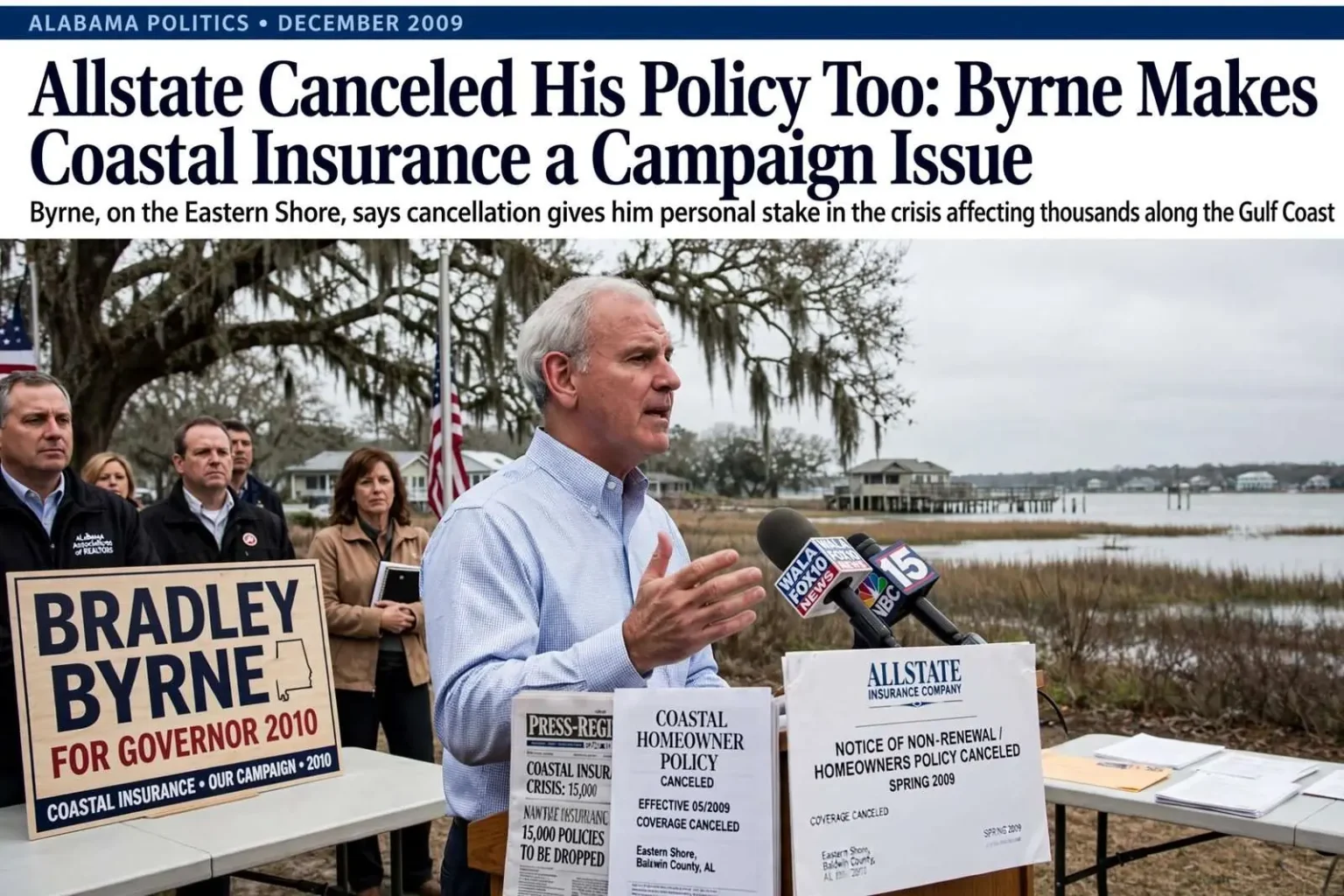
Of the Republicans running for governor in 2010, Bradley Byrne could claim a distinction none of his rivals wanted: he had received the letter himself. Byrne, whose home sits on the Eastern Shore south of Interstate 10, disclosed in December 2009 that Allstate had canceled his homeowners policy the previous spring — the same non-renewal notice that thousands of families in Mobile and Baldwin counties had come to dread in the years after Hurricane Katrina. For a gubernatorial field dominated by candidates from north Alabama and the Black Belt, the personal stake gave the coastal insurance crisis a spokesman with standing no policy paper could confer.
“I have been personally affected since Allstate canceled my homeowners (policy) in the spring,” Byrne said. “So I understand this issue in a way no other candidate for Governor can.”
The disclosure put a face on a problem that had been building along the Gulf Coast since 2005. After Katrina, national insurers began repricing and retreating from coastal markets across the Southeast, and Alabama’s two bay counties sat squarely in the withdrawal zone. Homeowners who had paid the same carrier for decades opened their mail to find policies they never chose to end.
The Retreat From the Coast
The disclosure came as Allstate and Alfa revealed plans to largely withdraw from wind coverage in Alabama’s two coastal counties, notifying the state insurance commission of their intention not to renew nearly 15,000 policies between them. Spokesmen for the companies framed the decisions as necessary to remain viable businesses: the claims that would follow a direct hit from a major hurricane could, quite simply, swamp them. The arithmetic behind that argument was straightforward — a carrier that concentrates too much exposure along one hurricane-prone corridor gambles its entire book on the path of a single storm.
For homeowners along the coast, the practical effect was a scramble for coverage in a shrinking market, at premiums that had in many cases doubled or worse, with the state’s insurance pool of last resort absorbing what the private carriers would no longer write. The pool exists to guarantee that no one is uninsurable, but it was never designed to be a permanent home for tens of thousands of policyholders, and its growth signaled a market that had stopped functioning in anything like a normal way.
The crisis had already reshaped real estate on the coast, where a buyer’s ability to close often turned on whether a policy could be found at any price. Contracts fell through at the closing table over insurance, appraisals sagged under the weight of premiums folded into affordability calculations, and wind coverage became the first question many buyers asked — before schools, before square footage, before the roof itself.
Byrne’s Framing
Byrne said his campaign was still formulating a detailed plan, but he offered two arguments in advance of it. The first was that the crisis is not a coastal problem to be indulged by the rest of the state. “The insurance carriers’ steady march north with their cancellations make that clear,” he said — a pointed rejoinder to officials above Mobile and Baldwin who had treated the issue as a local complaint. Every cancellation that landed in Montgomery or Birmingham inboxes undercut the notion that the market’s retreat would stop at the county line.
The second was that it should be understood as economic development. Because Alabama depends on the success of all of its regions, Byrne argued, coastal insurance “deserves state attention as surely as the BRAC in Huntsville has created a state need to address their transportation issues” and as surely as landing the C-Class Mercedes line at the Vance plant near Tuscaloosa had justified state incentives. In other words: the coast asks no more than the Tennessee Valley and the Black Belt have already received.
The analogy was deliberate. Huntsville’s BRAC expansion, bringing thousands of defense jobs to north Alabama, had been met with statewide commitments to road and infrastructure spending; Mercedes’s Vance plant had drawn incentive packages justified as investments in the state’s economic future. Byrne’s argument was that Alabama already accepted the premise of statewide investment in regional assets — the coast, with its port, its tourism economy and its shipbuilding workforce, was simply asking for the same treatment.
The Realtors Sign On
The same week, Byrne won the endorsement of the Alabama Association of REALTORS through its political action committee, ARPAC. With more than 15,000 members statewide, the association is the largest business trade group in Alabama. The endorsement fit the argument. No trade group had watched the insurance crisis at closer range than the Realtors, whose members in Baldwin and Mobile counties had spent several years explaining to prospective buyers why a modest house near the water might carry a wind premium larger than its mortgage payment.
For the association, the calculus behind the endorsement went beyond policy alignment. An organization with that many members, in every county, is also a formidable campaign asset in a primary decided by turnout. Realtor networks reach into every small town in the state, and an endorsement that activates them delivers both money and, more valuable in a crowded primary, credibility among the voters who vote every time.
The insurance crisis had also made the Realtors themselves into reluctant experts. Agents on the Eastern Shore and along Mobile Bay had learned to quote wind deductibles alongside listing prices, to pre-screen properties for insurability, and to talk buyers through the difference between standard homeowners coverage and the separate wind policies the shrinking market demanded. An entire profession had absorbed the cost of the market’s retreat, and its PAC endorsement signaled that the industry intended to make the issue central to the 2010 campaign.
The Politics of the Coast
Coastal insurance had by 2009 become the defining kitchen-table issue of south Alabama politics, cutting across party lines in a way few others did. Legislators from Mobile and Baldwin had pressed for years for measures to expand the market, from mitigation credits for fortified roofs to greater transparency in how carriers set rates, with limited success against opposition from insurers and indifference from inland colleagues.
The mitigation-credit idea reflected the one lever the state genuinely controlled: rewarding homeowners who fortified their roofs and openings against wind damage, thereby reducing the losses carriers would face in the next storm. The logic was sound — less damage means smaller claims means more tolerable premiums — but the scale of the problem, tens of thousands of existing homes built before modern wind codes, meant market repair would take years of retrofits, not one legislative session.
For a Republican candidate from the Eastern Shore, seizing the issue was both natural and necessary. It gave him something to say to the voters closest to home — and, in an eight-candidate scramble for a primary electorate that stretched from Dothan to Decatur, it gave him a reason to be taken seriously as the coast’s candidate.
The 2010 gubernatorial race would ultimately be decided far from Mobile Bay, but Byrne’s December 2009 disclosure ensured the coast’s crisis would not be absent from the campaign. A candidate who had received the same letter as his neighbors could not be dismissed as an outsider visiting their grievance — and the issue he carried with him was one no governor, from whatever part of the state, could afford to leave unaddressed.
Why the Crisis Persisted
The roots of the coastal insurance problem reached back through more than a single hurricane. Alabama’s coastal counties sat in the path of every Gulf storm, but for years before Katrina, the market had priced wind risk in a way that kept coverage broadly affordable. Katrina changed the industry’s national balance sheet overnight: record losses from a single event forced carriers worldwide to reprice catastrophe risk, and the Gulf Coast — where the next landfall was always a matter of when, not if — absorbed some of the steepest corrections.
State regulators, meanwhile, had limited tools. Insurance rates in Alabama require approval from the state insurance department, but regulators cannot force a company to keep writing policies it wants to drop, and pressing too hard risks accelerating the withdrawal. That structural constraint left coastal legislators with persuasion, incentive programs and state-backed backstops — instruments that helped at the margins but could not rebuild a private market that had made a business decision to leave.
The pool of last resort carried its own complications. Policies written through it typically cost more and covered less than private coverage, and every policy it absorbed represented a carrier that had walked away. Economists and industry analysts warned that a state whose coastal property could only be insured through a government backstop was carrying a hidden tax on every transaction — one paid in depressed property values and slowed growth rather than in appropriations.
What Was at Stake for the Campaign
The 2010 Republican primary field was crowded and geographically diverse, and every candidate would spend the campaign introducing himself to an electorate that spanned the state. Byrne’s insurance argument served that introduction: it packaged a south Alabama grievance in the state’s favorite economic-development vocabulary, complete with references to Huntsville and Tuscaloosa that inland voters recognized instantly.
The framing also gave the coast a test every future candidate would have to answer. If insurance was an economic development issue, then the question in a debate or a forum was no longer whether a candidate sympathized with coastal homeowners — it was whether he was prepared to spend state resources, political capital and legislative effort on the region’s behalf. Sympathy costs nothing; the Byrne formulation demanded a commitment.
For the homeowners opening non-renewal letters that winter, the politics were more immediate than any campaign strategy. Their question was practical: whether the state would act before the market’s retreat reached them. The 2010 campaign, with a coastal candidate carrying the issue and the state’s largest trade group behind him, marked the moment that question moved from the courthouse steps in Bay Minette to the statewide stage.