Prichard Councilwoman Plans Town Hall After Business Owners Demand Answers
Prichard Councilwoman Severia Campbell-Morris scheduled a town hall meeting after business owners criticized the council over city services and infighting.
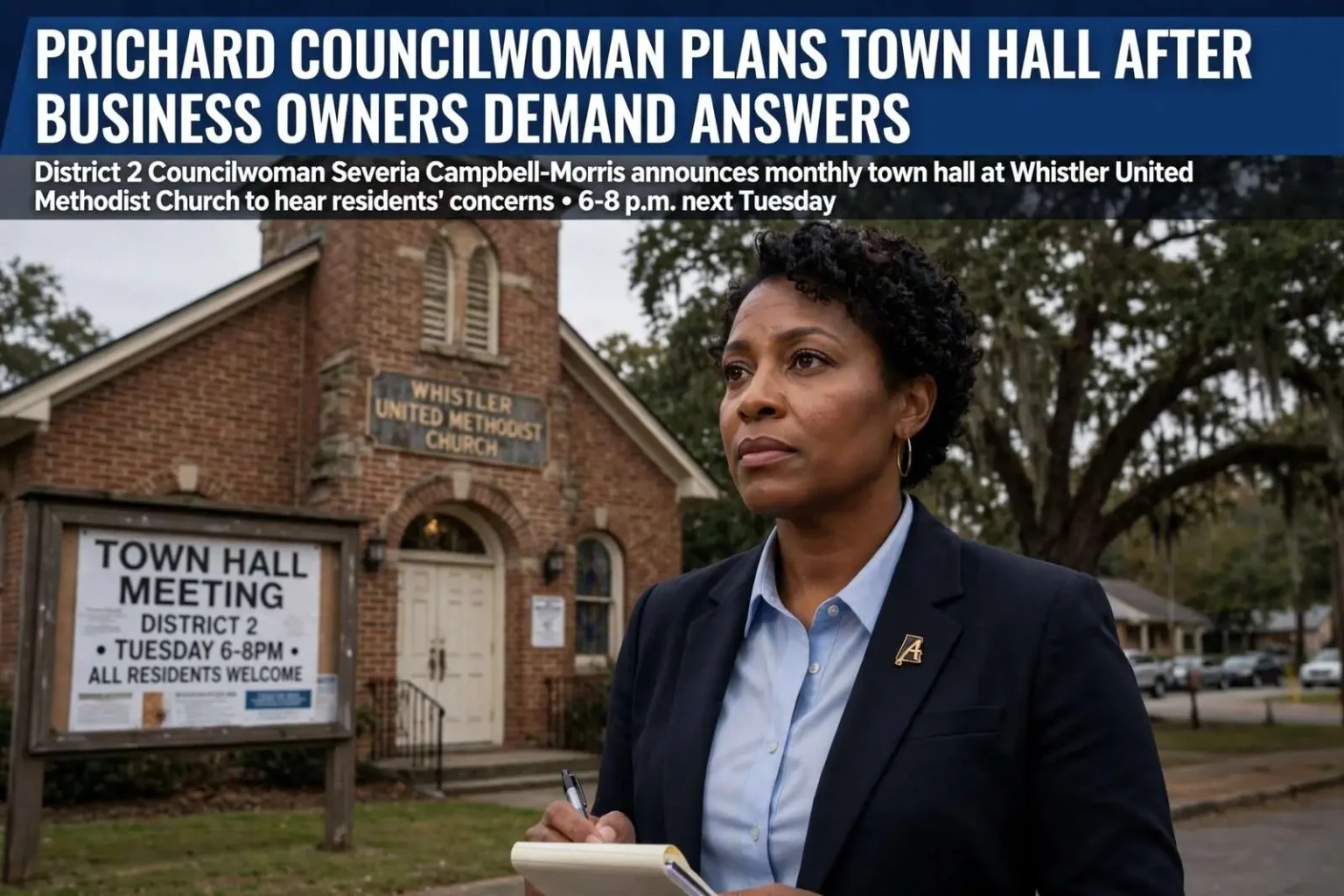
A Prichard city councilwoman announced plans for a town hall meeting to hear directly from residents about issues facing the city, an announcement that came shortly after two local business owners publicly criticized council members over the state of city services during a regular council meeting.
District 2 Councilwoman Severia Campbell-Morris told fellow council members she intended to work on plans and systems to help run the city more effectively, framing the upcoming gathering as part informational session and part working workshop. She said she planned to hold similar town hall meetings on a monthly basis going forward, giving Prichard residents a recurring forum to raise concerns directly with their representative rather than waiting for the public comment periods of formal council meetings.
The announcement followed pointed remarks from two Prichard business owners who addressed the council during the same meeting. One owner, who runs both an auto sales business and a used auto parts business in the city, told council members that providing a stable environment for the police, fire and public works departments, along with paying employees adequately, would go a long way toward turning the city around. He also criticized what he described as ongoing infighting among council members, saying it had made productivity difficult to achieve, and pointed to the absence of a five-year plan for the city.
A second business owner, who operates a local restaurant, echoed those concerns, questioning why council members weren’t working together toward shared solutions if they were, as he put it, all on the same side. The exchange, between residents who employ local workers and the elected officials responsible for the city’s direction, was unusually direct for a council session, and it set the stage for the councilwoman’s announcement minutes later.
A Town Hall in Whistler
Campbell-Morris said she would be available at Whistler United Methodist Church from 6 to 8 p.m. the following Tuesday to hear directly from constituents about their concerns. The venue, located within her district, was chosen to give residents an accessible, familiar setting for the discussion, an approach council members in small cities often use when they want turnout beyond the regular crowd that follows council business.
Whistler, one of Prichard’s oldest communities, grew up around the rail lines and industrial plants that anchored the northern edge of Mobile County for most of the twentieth century. Its church buildings and neighborhood institutions have long served as gathering points for civic conversation, making the Methodist church a natural choice for a meeting intended to draw ordinary residents rather than the city hall regulars.
The monthly format Campbell-Morris described would be unusual for a district council member in a city Prichard’s size. Recurring town halls create a standing channel between constituents and their representative, and they carry an implicit commitment: whatever gets raised in one session gets answered, or at least updated, in the next. For a city where trust in municipal government has been strained by years of financial difficulty, that consistency is often cited by civic groups as the first step toward rebuilding confidence.
The councilwoman’s promise to work on plans and systems speaks to the concrete complaints her constituents have raised. A five-year plan, the document the business owner said the city lacked, is the standard tool through which municipalities set capital priorities, budget roadmaps and service standards; its absence leaves departments reacting year to year. Paying employees adequately, the same speaker’s other demand, addresses the turnover that hollows out police, fire and public works crews when neighboring jurisdictions offer more.
The Challenges Behind the Exchange
The exchange reflects broader, longstanding challenges facing Prichard, a small city in Mobile County that has grappled with structural financial strain for years. Once a thriving industrial suburb whose factories and rail yards employed generations of families, the city lost much of its employment base as heavy industry pulled out of the region in the closing decades of the twentieth century, leaving behind a declining tax base and infrastructure that aged faster than revenues could maintain it.
The city’s pension obligations became a nationally known cautionary tale when Prichard could no longer meet its promised retirement payments, forcing benefit cuts to retired employees and a decade of litigation and fiscal oversight. The episode left the city operating under tight constraints that shape every budget cycle, and it explains why business owners who watch the city’s finances closely press so hard on stability, planning and retention of skilled employees.
Public safety staffing has been a recurring flashpoint in that context. Prichard’s police and fire departments have worked for years with pay scales below those of larger neighboring agencies, and officers who train in Prichard have often moved on to better-funded departments across Mobile County. Each departure costs the city its training investment and leaves residents with less experienced coverage, the dynamic the auto sales owner was pointing at when he called for a stable environment for the city’s departments.
Council infighting compounds those structural problems in ways residents see directly. When a city’s governing body divides into factions, routine business, contracts, appointments, budget amendments, slows or stalls, and department heads receive mixed direction. Business owners are often the first to feel the effects, since permits, inspections and infrastructure decisions pass through city hall on schedules their operations depend on.
What Residents Can Expect
For District 2 residents, the town hall format offers a chance to put specific, local questions to their representative: street repairs in named blocks, response times in particular neighborhoods, code enforcement on vacant properties. District-based meetings tend to surface hyperlocal concerns that never make it onto a council agenda, and the workshop framing Campbell-Morris used suggests she intends to log and act on what she hears rather than simply receive it.
The monthly cadence also creates a public record of follow-through. Residents who attend regularly can track whether concerns raised in one session produce visible results by the next, and business owners looking for a functioning five-year plan have a standing forum in which to press for one. In cities working to rebuild confidence in local government, that kind of repeated, verifiable engagement is usually what turns skepticism into participation.
The announcement itself marked a shift in how the district’s concerns are being channeled. Public comment at council meetings is limited to the agenda’s margins, speakers get a few minutes, and there is no mechanism for follow-up. A workshop-style town hall inverts that arrangement: residents set the agenda, the discussion runs for two hours, and the councilwoman’s stated intent to return every month creates accountability that a single meeting cannot.
Whether the town halls become an institution or fade after a few sessions will depend partly on turnout and partly on whether the council’s internal dynamics improve enough to give the meetings real answers to deliver. The two business owners who sparked the exchange made clear they measure the city by its ability to keep departments staffed and plans on paper, and the councilwoman’s response, a standing date in a neighborhood church, is at minimum an acknowledgment that those measures are the right ones.
Prichard’s recent history gives the town hall effort its urgency. The city’s population has declined from its mid-century peak as families followed jobs out of the area, and its commercial corridors have thinned accordingly. Yet the city retains assets its leaders point to when arguing for a turnaround: proximity to Mobile’s port and downtown, industrial land along the rail corridors, and neighborhoods of modest, durable housing stock within minutes of the region’s largest employment centers.
Regional economic development efforts in Mobile County have occasionally included Prichard in industrial recruitment pitches, and city officials have long argued that investment along its corridor positions could restore employment close to home. Those arguments gain credibility when the city can demonstrate functioning services and a stable government, which is why the business owners’ testimony about infighting and planning cut where it did. Companies weighing a location look first at whether the local government can process approvals predictably and keep its workforce commitments.
Campbell-Morris’s District 2 stretches across a section of the city where those stakes are lived daily, from the Whistler area’s older streets to the residential neighborhoods nearby. Her decision to hold the first session at a church rather than at city hall signals an attempt to reach residents who have tuned out municipal government, the population whose disengagement is itself both a symptom and a cause of the city’s difficulties.
The following Tuesday’s session, from 6 to 8 p.m., will be the first test of whether the recurring format draws the audience the announcement seeks. If the business owners’ willingness to speak bluntly to the council is any measure, Prichard residents have no shortage of things to say; what remains to be seen is whether the monthly meetings give them a channel that produces the plans, systems and stable departments they told the council the city needs.