50 Young Women Compete for $155,000 in Scholarships at Mobile Civic Center Finals
Fifty finalists competed in talent, fitness and self-expression at the Mobile Civic Center ahead of the national finals.
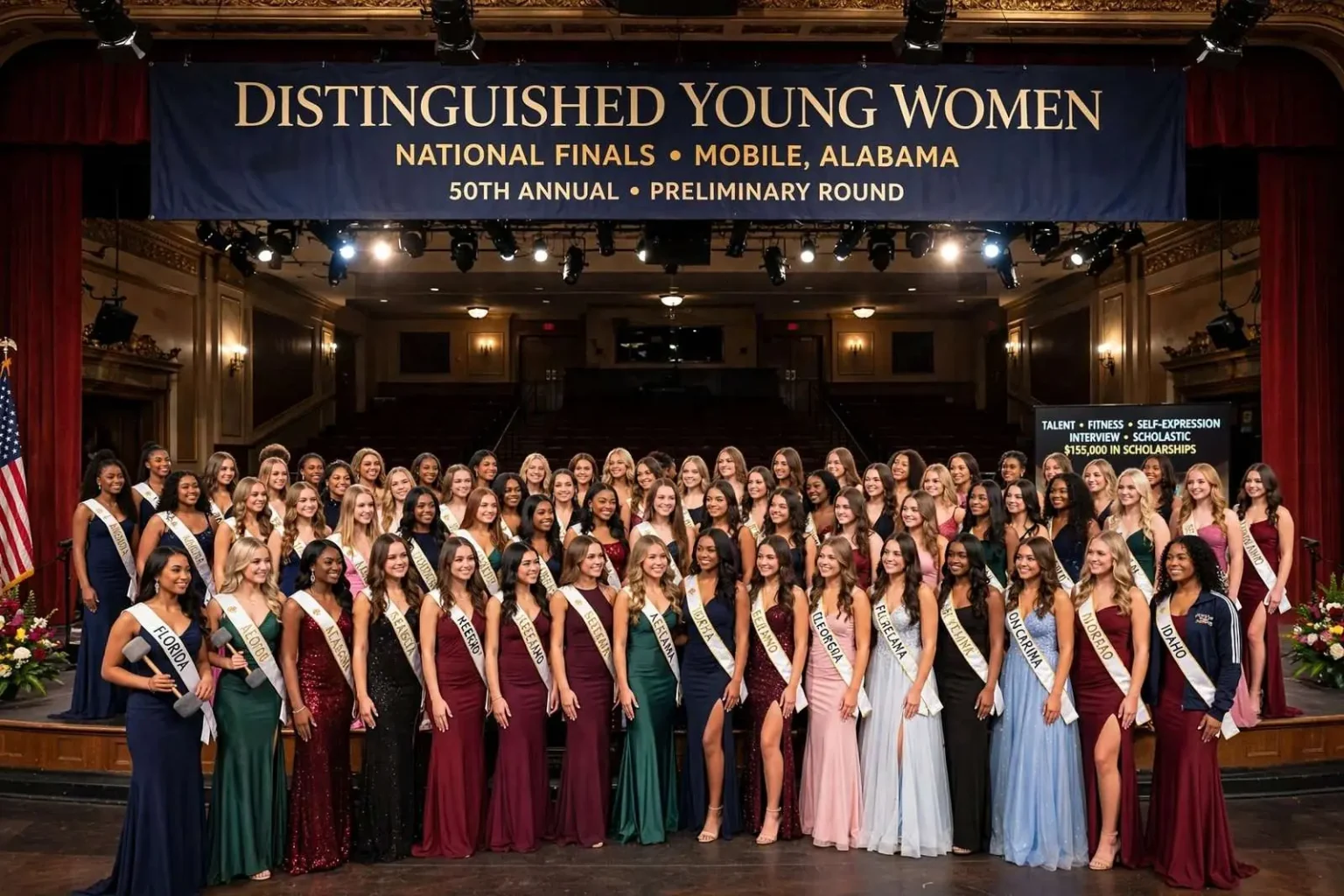
MOBILE, Alabama — Fifty young women representing states across the country took the stage at the Mobile Civic Center Theater on a Friday night, competing in talent, fitness and self-expression as part of the preliminary round of the national Distinguished Young Women program. Ten finalists were set to be announced the following evening, with $155,000 in scholarships on the line.
The competition brought participants from every region of the country to Mobile, the permanent home of a program that has been handing out college scholarships to high school seniors for decades. Contestants spend more than a week in the city before the televised finals, rehearsing at local venues, touring the area and taking part in community events before the preliminary rounds determine who advances.
A rotating format keeps things fresh
Half of the fifty competitors performed talent routines on the first preliminary night, while the other half competed in fitness and self-expression; the groups then swapped for the second night. The structure means every contestant performs in every category across the two nights while giving audiences a varied show each evening — vocalists, dancers and instrumentalists one night, then the athletic and poise categories the next.
Natalie Lawson, representing Florida, played steel drums for her talent performance and said she hoped the audience danced along as much as she did on stage. Miiko Toussaint of Idaho, who competed in fitness and self-expression, described the emotional swing between the high-energy fitness routine and the more composed, poised feel of self-expression as a roller coaster. The contrast between categories is a defining feature of the program, which deliberately tests a range of abilities rather than a single skill.
Self-expression, a category unique to Distinguished Young Women among major scholarship programs, asks contestants to answer an on-stage question and demonstrate composure and articulateness in front of a live audience. Judges score the category on clarity of thought and genuine delivery rather than rehearsed answers, a standard that former participants consistently describe as the most nerve-wracking part of the week.
Category scholarships handed out
Before the finalists were named, the program awarded $1,000 category scholarships across several disciplines. Fitness scholarships went to representatives from Idaho, Florida, Rhode Island and Utah. Self-expression honors went to competitors from Georgia, Florida, Arizona and Alabama’s own contestant, Madeline Powell. Scholastic scholarships were awarded to young women from Alaska, New Jersey, Arizona and again Alabama’s Powell, while the interview category recognized finalists from South Carolina, Mississippi, Oregon and Alabama.
The category awards are decided across the full preliminary week — the interview category takes place in sessions with judges before the stage shows begin, and scholastic honors reflect contestants’ academic records — so the Friday night announcements represented a cumulative verdict on each contestant’s performance across the program’s four judging areas. Powell’s double recognition made the Alabama representative one of the week’s early standouts in front of a hometown audience.
A local host with a growing bond
Closing out the evening, 2013’s national Distinguished Young Woman, Nicole Renard, performed a tap routine and spoke about balancing her freshman year of college with her responsibilities representing the program nationally. Renard’s appearance gave the fifty contestants a preview of the year that awaits the winner — a schedule of appearances, travel and speaking engagements layered on top of a full course load — and a reminder that the program’s relationships with its participants continue long after the finals end.
Jennifer Tolbert, the program’s national field director, said all fifty competitors — not just the ten finalists — would appear on stage for the final round, adding that the full-company format is part of what distinguishes the Mobile event from other national competitions. Every contestant finishes the week having performed in the finale before the television audience and the Civic Center crowd, regardless of how the preliminary scoring broke.
The program’s deep Mobile roots
Distinguished Young Women began in Mobile in 1958 as America’s Junior Miss and has been headquartered in the city ever since, making it one of the oldest and largest scholarship programs for high school senior girls in the United States. The organization changed its name to Distinguished Young Women in 2010, but the essentials have remained constant: participants first compete at the local and state levels, and state winners converge on Mobile each summer for two weeks of competition, rehearsals and community activities funded largely by local volunteers and host families.
The economic and civic footprint of finals week is substantial for downtown Mobile. Contestants stay with host families across the area, local businesses host events, and the Civic Center Theater fills for both preliminary nights and the finals. Former participants now work in broadcast journalism, medicine, law, education, business and the military, and the program counts among its alumni figures recognizable across national media, politics and public service.
Alumni of the program frequently describe the Mobile experience — living with a host family, performing on the Civic Center stage and forming friendships with competitors from other states — as the most memorable part of the process, which is precisely what the organization hopes to preserve as it evaluates changes to its format and national presence.
What the scholarship money means
The $155,000 in scholarships at stake across the national finals is supplemented by the college-offered scholarships and tuition awards that contestants earn at every level of competition, making the program’s total annual impact significantly larger than the finals-week figure alone. For the fifty young women on the Civic Center stage, the awards represent real tuition relief at colleges across the country, and the program has long emphasized that every participant leaves Mobile with scholarship money earned, not just the winner.
For Mobile, the program’s continued choice of the city as its national home is a point of civic pride that local leaders cite whenever the conversation turns to attracting signature events downtown. Fifty families, dozens of volunteers and a national television audience converge on the Civic Center each summer — a tradition that has now spanned more than half a century and shows no sign of leaving the city that built it.
How the week unfolded
The preliminary rounds represent the culmination of months of preparation for the contestants, most of whom won their state titles the previous summer or fall. Between arrival in Mobile and the first preliminary night, the fifty participants rehearse daily under the program’s production staff, learn group numbers for the finale, and fit appearances around the community into a schedule that veterans of the program describe as the most demanding week of the year.
The host-family tradition remains a centerpiece of that experience. Each contestant is paired with a Mobile-area family for the duration of the stay, an arrangement that dates to the program’s earliest years and that organizers credit with keeping costs manageable while rooting the event in the community. Host families attend the shows, cheer for their assigned contestant and often stay in touch for years afterward — a network of relationships that stretches across all fifty states.
Looking toward finals night
With the preliminary performances complete and the category scholarships distributed, attention turned to the following evening’s finals, where the ten finalists selected from the week’s cumulative scores would compete once more before the national winner was named. The judges’ task was a demanding one: weighing talent routines against fitness performances, interview sessions, scholastic records and self-expression answers to arrive at a single composite ranking from a field of fifty.
For the forty-five contestants whose week would end with the finale rather than a finalist berth, the program’s message was deliberately consistent — the scholarships already earned, the relationships formed and the experience itself are the point, and the full-company finale guarantees every one of them a final moment on the Civic Center stage. That philosophy has kept the program’s alumni network unusually loyal, with former contestants returning to Mobile as volunteers, state program organizers and, in some cases, national staff.
The Civic Center stage and its history
The Mobile Civic Center Theater itself is part of the program’s story. The downtown complex on Civic Center Street has hosted the national finals for most of the competition’s modern history, and generations of contestants have described stepping onto its stage as the moment the year of local and state competition finally becomes real. The theater’s scale — large enough for a national television production yet intimate enough for contestants to hear the audience react — has made it a fixture of the event’s identity, appearing in broadcast footage that airs across the country each summer.
As the Friday night curtain came down on the first preliminary round, the Mobile Civic Center Theater had once again done what it has done every summer for more than five decades: turned the national spotlight, briefly but brightly, on fifty of the country’s most accomplished high school seniors — and on the city that has made their showcase its own signature summer tradition. The ten names announced the next evening would decide a winner, but the week’s larger outcome — scholarships awarded, friendships made and a Mobile tradition renewed — was already secure.