Prichard Council Orders Demolition of Nine Blighted Homes
Prichard's City Council passed a resolution to demolish nine vacant, decaying homes as part of the city's ongoing fight against neighborhood blight.
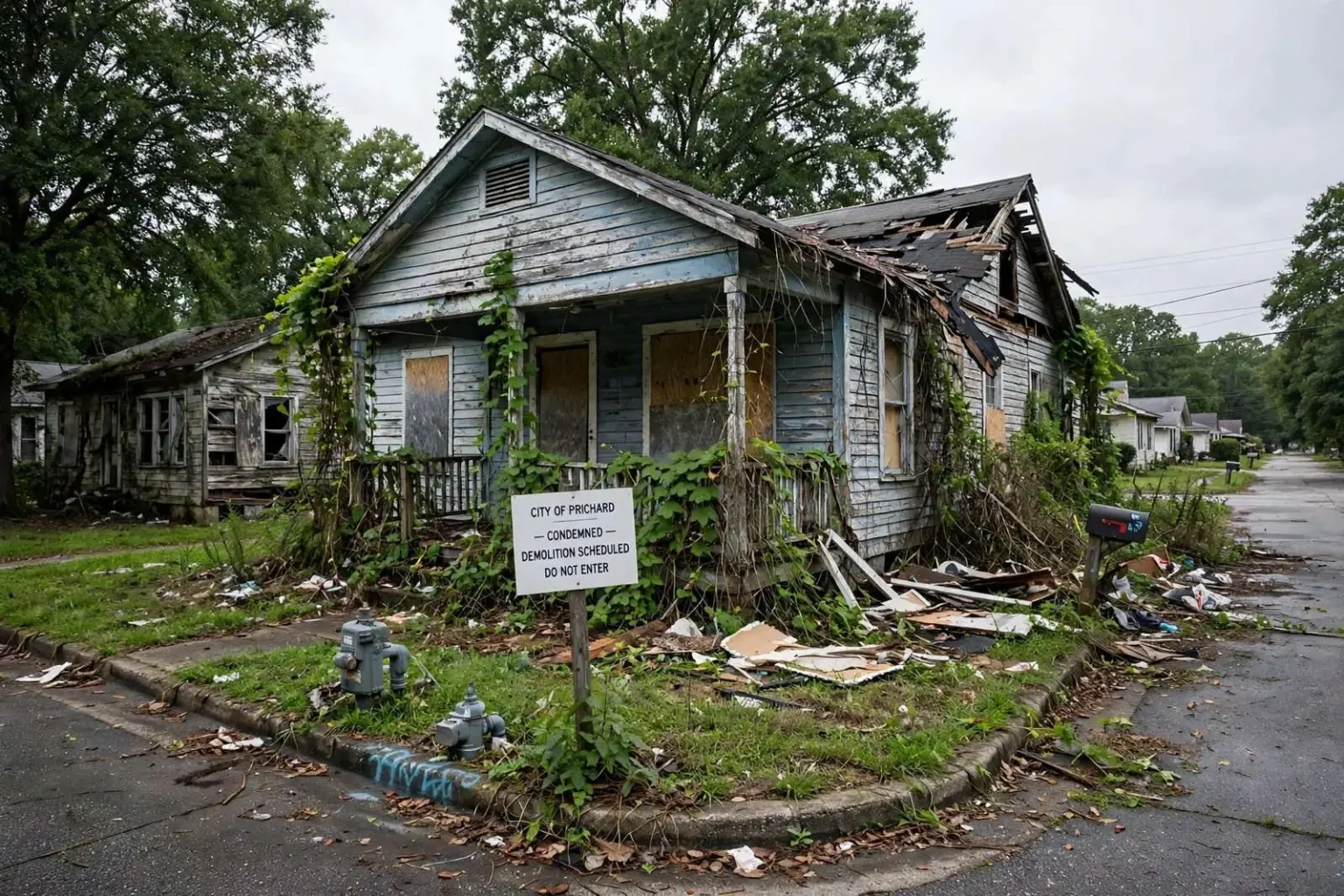
Prichard officials continued their long-running fight against blight this month when the City Council passed a resolution to demolish nine vacant homes scattered across the city, many of them already showing signs of significant decay. The action adds nine structures to the growing list of properties the city has cleared from its neighborhoods as it works through a backlog of abandoned housing that has accumulated over decades.
The condemned properties ranged widely in condition. Some appeared to be already partially torn down, while at least one home showed visible fire damage. Others looked largely intact from the street but had been stripped inside, with holes torn through drywall where scrappers had removed copper wiring and other salvageable materials. Overgrown vegetation had swallowed several of the structures, making them barely visible from the road.
Neighbors living near some of the condemned homes welcomed the demolition order. Residents who have watched vacant, decaying houses sit for years described relief that the properties would finally come down, saying abandoned structures had become magnets for illegal dumping, scrapping and, in some cases, safety hazards for children playing nearby.
A Familiar Pattern of Abandonment
One of the homes slated for demolition had sat vacant since its owner died years earlier, with no clear heir stepping forward to maintain or sell the property — a common pattern in blight cases across Prichard and other older Mobile County communities, where absentee or deceased ownership complicates code enforcement efforts.
When a property owner dies without a will or without a probated estate, what lawyers call heirs’ property, title can end up scattered among multiple descendants, some of whom may live out of state or have lost touch with the land entirely. Nobody with clear authority can sign off on a sale, a demolition or even routine maintenance, and the house sits while taxes go unpaid. In Alabama, the problem is especially acute in older cities where much of the housing stock dates to the postwar decades, and it creates a legal maze that code enforcement officers must navigate before a single wall comes down. Each demolition on this month’s list represents months — sometimes years — of notice requirements, hearings and public postings designed to give any owner or lienholder a chance to come forward.
Prichard’s housing stock tells the story of the city’s economic history. Founded as a railroad and industrial suburb north of Mobile and incorporated in the 1920s, the city grew rapidly through the middle of the twentieth century as workers settled in modest, solid neighborhoods within reach of the shipyards, chemical plants and port facilities along the Mobile River. When industrial employment contracted in the later decades, the population followed, and thousands of homes were left behind.
Blight remains one of the most persistent challenges facing Prichard, a city that has weathered significant population decline and economic hardship over the past several decades. Vacant and abandoned homes not only pose safety risks but also drag down property values for neighboring homeowners and complicate efforts to attract new residents and investment.
Why Blight Spreads
The economics of blight are well understood by city officials across Mobile County. A single abandoned house lowers the appraised value of homes on its block, discourages buyers who might otherwise renovate nearby properties, and attracts the dumping and stripping that accelerate a neighborhood’s decline. Fire departments respond to vacant structure fires that endanger occupied homes next door; police answer calls about copper thieves and squatting; and the city loses tax revenue on properties that generate costs instead.
Demolition, while expensive — often running into the tens of thousands of dollars per structure once asbestos surveying, utilities disconnection, hauling and landfill fees are counted — is frequently the only way to break that cycle on a house that has gone too far. Once a lot is cleared and the property resolves through the tax process, it can return to the market, be side-lotted to a neighbor, or become a garden or green space under a community program.
City leaders across Mobile County have also pointed to the health dimension of blight. Overgrown lots harbor rodents and mosquitoes, open structures collect standing water and mold, and illegal dumping can introduce everything from household chemicals to construction debris into areas where children play. Public health researchers have documented that living near abandoned property is associated with higher rates of stress and injury for nearby residents, which is one reason demolition lists tend to prioritize structures that are both unsightly and physically accessible.
A Multi-Pronged Strategy
City officials have pursued a multi-pronged strategy to address the problem, combining code enforcement actions, demolition orders funded through city and county resources, and coordination with Mobile County land bank programs aimed at returning blighted properties to productive use.
The land bank approach became available after the Alabama Legislature authorized county land banks in 2012, allowing Mobile County to create an authority that can acquire tax-delinquent, abandoned property and clear its title before transferring it to responsible owners — adjacent homeowners, nonprofits or developers — at little or no cost in exchange for a commitment to restore it. For cities like Prichard, the land bank offers a way to break the heirs’ property logjam that leaves houses in limbo, putting parcels back on the tax rolls instead of letting them rot at public expense.
Code enforcement remains the front line. Prichard’s officers catalog deteriorating structures, post notice, and bring cases before the council, which votes on demolition resolutions property by property. The process is deliberately slow — due process for owners is built into state law — but each completed cycle removes one more hazard and signals to owners of other neglected properties that the city is keeping score.
The latest round of nine demolitions represents an incremental but visible step in that broader effort. Officials said the city plans to continue identifying additional blighted properties for potential demolition in the coming months, prioritizing homes that pose the most significant safety or environmental hazards — open structures accessible to children, fire-damaged buildings and those with collapsing roofs or floors rank at the top of the list.
What Comes After the Bulldozer
Clearing a house is only the first step in the city’s eyes. Officials have emphasized that the lots left behind should not simply sit empty, and the combination of land bank transfers, sales to adjoining owners and community reuse proposals gives each cleared parcel several possible futures. In other Alabama cities that have pursued similar campaigns — Birmingham and Montgomery among them — cleared lots have become infill housing sites, community gardens and side yards that expand the usable space of neighboring homes.
Prichard’s geography gives the strategy particular weight. The city stretches between Mobile’s Chickasabogue Park on the south and the industrial corridor along the Mobile River to the west, with long-established neighborhoods such as Whistler, Carlton and the areas around Bessemer Avenue and Main Street holding much of the older housing stock. Reversing decline in those core neighborhoods matters more to the city’s future than almost any single economic development deal, because families deciding where to live in Mobile County look first at whether the streets around them are cared for.
The demolition program also carries a fiscal logic for the city itself. Prichard has spent years working to stabilize its municipal finances after the lean decades that followed its industrial decline, and every dollar spent on mowing, boarding up and policing abandoned properties is a dollar unavailable for streets, drainage and public safety. Removing the worst structures cuts those recurring costs while returning parcels to ownership that pays taxes.
For the residents who live next to the nine structures coming down, the immediate benefit is simpler: no more dumping ground at the end of the street, fewer strange vehicles circling the block to strip metal, and one less place where a child chasing a ball could get hurt. City officials said that kind of neighborhood-level feedback is exactly what drives the program’s priorities, and they encouraged residents to keep reporting problem properties.
The council’s action this month adds to a growing list of vacant structures removed from Prichard’s landscape as part of the city’s ongoing revitalization push. With each round of demolitions, officials say, the map of problem properties gets shorter — and the goal, they stress, is a city where the next generation of notices goes out for fewer houses, not more.
Residents interested in reporting blighted or abandoned properties in their neighborhoods can contact Prichard’s code enforcement office, city officials said. Complaints can be made by phone or in person at city hall, and officials said specific addresses and descriptions help officers open a case file and begin the inspection and notice process that leads to a council vote.