Downfall of a Mobile homicide detective ends in tax evasion conviction
A veteran Mobile police homicide detective with a long trail of controversy resigned and pleaded guilty to income tax evasion, ending a decades-long career.
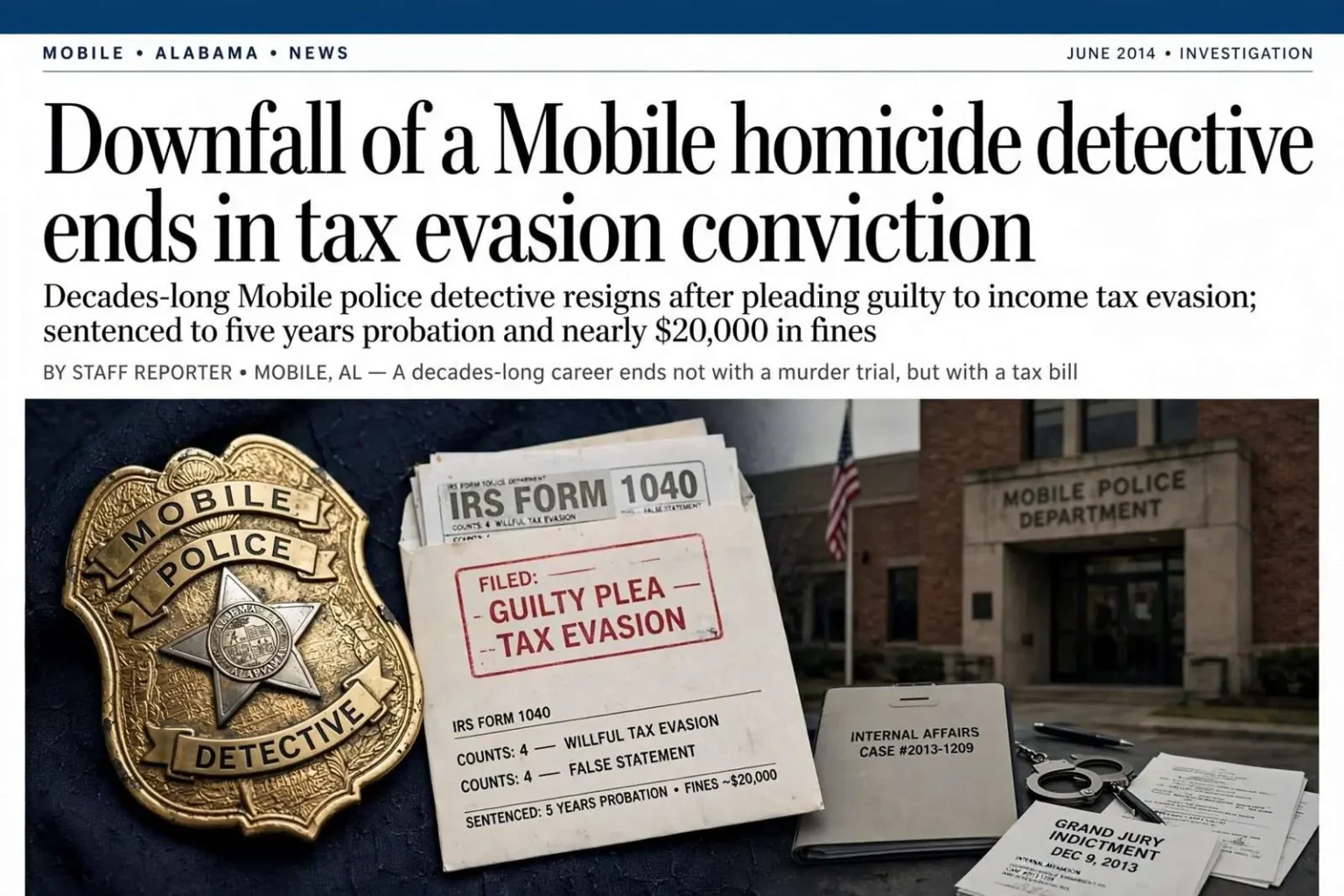
The career of a longtime Mobile police homicide detective ended not with a shootout or a courtroom drama over a murder case, but with a tax bill.
Cpl. Donald Pears, a decades-long veteran of the department, resigned in May 2014 and was later sentenced to five years of probation after pleading guilty to income tax evasion and filing false returns. By the time federal authorities caught up with him, Pears was already well known inside the department for a long trail of controversy.
According to personnel records reviewed at the time, the detective had been involved in two collisions in his squad car over a three-year span, had lost a department-issued digital recorder and a city pager, and had once been suspended after a search of his home and vehicle turned up drugs and firearms tied to crime scenes.
The sentence, handed down in June, also ordered him to pay close to $20,000 in fines. It marked the formal close of a law enforcement career that had spanned more than four decades on the Mobile force.
For a department that has policed Alabama’s largest city for generations, the case was an uncomfortable one: an officer with decades of institutional knowledge, working in the unit that handles the city’s most serious crimes, undone not by a controversial case or a public scandal in the street, but by the paperwork of his own income.
Mobile’s police force is one of the larger departments in Alabama, with a jurisdiction that covers the port city’s downtown, its historic neighborhoods and a sprawling suburban-style west side. Homicide detectives there carry some of the heaviest caseloads in the state, in a city where investigations can stretch across state lines and take years to resolve.
How the case unfolded
The tax case became public in December 2013, when the Alabama Attorney General’s office, then led by Luther Strange, announced an eight-count indictment against Pears following a Mobile County grand jury presentation on Dec. 9 of that year.
Pears was charged with four counts of willful attempt to evade or defeat tax and four counts of willful fraud and false statement — a pairing that traces the two halves of most tax prosecutions, the concealment of income and the false paperwork used to hide it.
Mobile police relieved him of his homicide detective duties the day the indictment was announced, reassigning him to administrative duty while the department’s Internal Affairs division opened its own review.
At the time of the indictment, prosecutors with the Attorney General’s Special Prosecutions Division said Pears faced up to five years in prison and a $100,000 fine on each of the tax evasion counts, and up to three years in prison and a $100,000 fine on each of the false-return counts, had the case gone to trial rather than ending in a guilty plea.
Strange credited Assistant Attorney General Bill Lisenby, Assistant Attorney General and Assistant Counsel Glen Powers, then-Alabama Revenue Commissioner Julie P. Magee and agents with the Alabama Department of Revenue for building the case.
The division that prosecuted him exists for exactly this kind of case. Alabama’s attorney general maintains special prosecutors for public corruption and financial crimes that cut across jurisdictions, and tax charges against a public employee are handled there precisely because local prosecutors and the local department are too close to the defendant.
Tax cases against public employees tend to be built patiently, from records rather than street work: revenue agents reconstructing income from payroll, property and business filings, then handing prosecutors a pattern that can be charged count by count. The eight counts against Pears reflected that structure, with the evasion counts aimed at the conduct and the false-statement counts aimed at the paperwork that concealed it.
The indictment landed amid a period of broader turmoil for the Mobile Police Department, which was separately investigating allegations of improper spending tied to trips taken through its Police Explorers youth program, as well as claims that a Third Precinct commander, Carla Longmire, had carried on a sexual relationship with a subordinate officer while on duty.
Those parallel inquiries meant that by the winter of 2013 and spring of 2014, the department was managing several internal investigations at once, each raising questions about different corners of the force. City officials faced pressure to demonstrate that accountability applied regardless of rank or tenure.
The Police Explorers questions were especially sensitive because the program is a youth pipeline — teenagers introduced to policing through supervised activities — and improper spending inside it strikes at both public money and public trust in the department’s outreach.
A pattern of trouble
Pears drew a 28-day suspension in 1998 after Mobile County sheriff’s deputies raided his home. During that search, investigators reported recovering several handguns, including a pistol they said had been linked to multiple armed robberies and an unsolved homicide, along with other weapons.
The episode was one of several that placed him in the disciplinary spotlight over the years, and the 1998 raid was particularly serious for an active officer: weapons surfacing in a criminal investigation, connected to violent crimes, was the kind of finding that could have ended careers at many departments.
The raid also raised questions about how such a record coexisted with decades of continued assignment to the department’s most sensitive investigative unit — a tension that internal-affairs reviews in agencies everywhere struggle with when senior personnel accumulate both value and liability over a long tenure.
Other incidents were less serious but no less memorable. In one write-up, records described how a police-issued recorder slipped from his pocket and fell into a toilet in a department restroom in 2012. Investigators noted the device was flushed beyond recovery before it could be retrieved from the plumbing, and Pears received a verbal warning.
The smaller episodes, taken alone, would have been the stuff of station-house humor. Taken together with collisions, lost equipment, a suspension and a criminal indictment, they traced a record that followed Pears through four decades — long enough for each incident to be weighed against the ones before it.
Personnel records of that length tell a story in themselves. An officer hired in an earlier era carries forward a file that documents not just his work but the standards of each decade he served under — and by 2014, the tolerance for repeated incidents that might once have ended in a warning had narrowed considerably in departments across the country.
A long career under scrutiny
Pears had spent much of his career working homicide cases, including investigations that remained open for years. His personnel file, accumulated over a lengthy tenure, documented a mix of casework and repeated disciplinary attention.
Homicide work is the most demanding assignment in a major-city detective division — cases that begin at crime scenes in the middle of the night and can run for years through warrants, interviews and trials. Detectives who survive decades in that unit carry both the weight of the cases they closed and the ones they never did, and their experience is difficult to replace when it leaves under a cloud.
When the tax case surfaced publicly, it drew renewed focus to a record that had long been a subject of quiet discussion within the department. What had been locker-room conversation became a matter of public record, with each past episode re-examined in light of the charges.
Asked to respond as the case wound down, Pears offered only a terse remark that reflected his frustration with how his story was being told.
The resolution of the federal charges brought a definitive end to his time in uniform, closing the book on one of the more turbulent law enforcement careers the city had seen in recent memory.
Probation, rather than prison, put the emphasis on restitution and supervision — a sentence that reflected both the seriousness of the plea and the circumstances the court weighed. The fines, close to $20,000, would follow him beyond the courthouse in a way no suspension ever had.
The plea structure also spared the county a trial that would have put a veteran detective’s finances and personnel history on public display for weeks — an outcome that suited a department already managing several reputational wounds at once.
For the Mobile Police Department, the case underscored the scrutiny that follows officers whose conduct repeatedly lands them in internal reviews, and it served as a reminder that accountability can arrive from an unexpected direction — in this case, the tax collector.
It also illustrated a structural truth about policing: departments are generally strong at documenting the misconduct they can see, and weaker at the financial and ethical issues that fall outside the uniform. Tax evasion by a veteran detective surfaced only through a state prosecution built by revenue agents and special prosecutors, not through any internal process — a gap that every agency, large or small, has to reckon with.
Nationwide, the lesson has been repeated often enough to become a planning assumption: the officer who seems beyond suspicion is sometimes the one whose off-duty life is least examined. Financial audits, disclosure requirements and cooperation between departments and tax authorities are the counterweights, and Mobile’s case showed how they work only when someone outside the department pulls the thread.
By the time Pears resigned, the department had already moved through a difficult season of internal investigations, personnel changes and public questions. His departure closed one of those files for good, and for the officers who had worked beside him for decades, it ended a story that had hovered over the homicide unit for longer than anyone involved wanted to remember.