Ashley Rich to Be Sworn In as Mobile County’s First Woman District Attorney
Veteran prosecutor Ashley Rich prepared to be sworn in as district attorney of Mobile County, becoming the first woman and the first Republican in more than 30 years to hold the office.
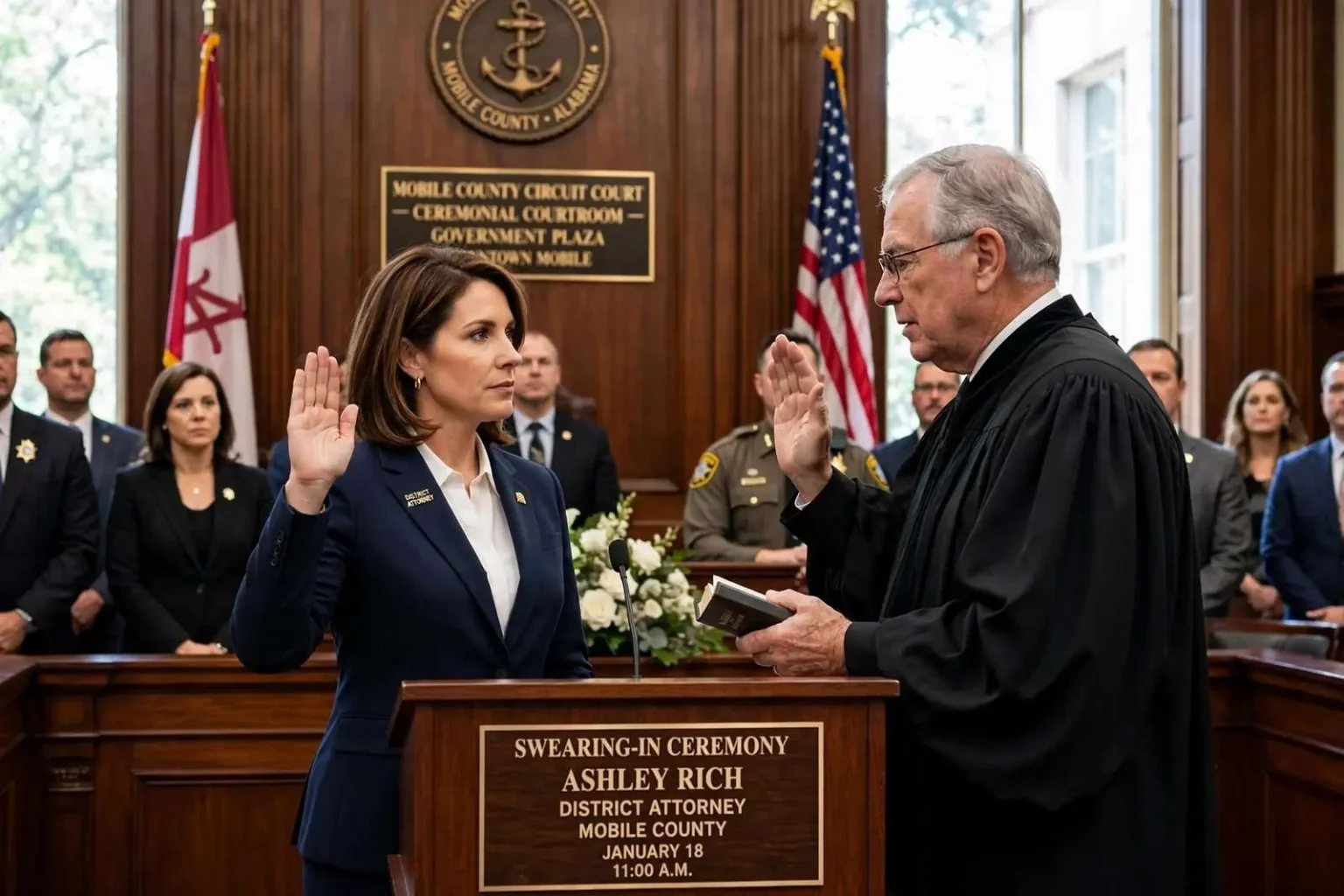
Veteran prosecutor Ashley Rich prepared to be sworn in as district attorney of Mobile County, set to take the oath at 11 a.m. Tuesday, Jan. 18, in the ceremonial courtroom at Government Plaza in downtown Mobile. The setting was fitting: Government Plaza houses the county’s courts and commission, and the ceremonial courtroom has hosted the investitures of generations of Mobile County officials. For the prosecutors, deputies, investigators and support staff who fill the district attorney’s office, the ceremony marked the formal start of a new administration — and for the county, a new chapter in the history of its top law enforcement post.
A pair of firsts
Rich’s ascent marked two milestones for the county’s top law enforcement office. She was poised to become the first woman to serve as district attorney of Mobile County, and her installation would also mark the first time in more than 30 years that a Republican held the post. The combination made her swearing-in a notable moment in the history of the office. Both firsts carried weight in different circles — one in the long record of women advancing in Alabama’s legal profession, the other in the county’s steadily shifting partisan map.
She reached it by winning decisively at every stage. Rich romped to victory in the Republican primary over Mark Erwin, then prevailed in the general election over Democratic nominee Don Foster. Those wins carried her from the ranks of career prosecutors to the office’s top job. The primary contest shaped up as the harder of the two, pitting Rich’s courtroom résumé against a well-known defense attorney, but she cleared it comfortably and carried that momentum into November.
The election results reflected the broader realignment of Mobile County politics. An office that Democrats had held for decades passed to a Republican without the cliffhanger many expected, evidence of how thoroughly the county’s electorate had turned. For the incoming administration, the margins mattered: a decisive mandate made it easier to take command of a large office filled with career staff who serve regardless of who signs the top of the letterhead.
Rooted in the courtroom
Rich was no newcomer to high-stakes prosecution. For several years she had headed the murder squad in the office of incumbent District Attorney John Tyson Jr., handling some of the most serious cases the county saw. That background gave her a reputation forged in the courtroom rather than on the campaign trail, and it framed the expectations for her tenure as she prepared to lead the office she had long served. Capital murder trials, gang-related shootings and domestic violence homicides had been her working week, not an abstraction.
Prosecutors across Alabama will say the murder squad assignment is among the most demanding in any district attorney’s office. Cases take months to build, witnesses are often reluctant, and the stakes for defendants and victims’ families could not be higher. Rich’s years at that post meant she assumed command knowing the office’s caseload from the inside — the trial calendars, the relationships with Mobile police and the county sheriff’s investigators, and the grinding pace of violent-crime prosecution in a metro area of more than 400,000 people.
A predecessor administers the oath
The ceremony carried its own symbolism. The oath of office was to be administered by Charlie Graddick, Rich’s Republican predecessor as Mobile County district attorney and a former state attorney general, who now served as the presiding judge over Mobile County Circuit Court. Having a former district attorney and attorney general swear in the new chief prosecutor underscored the continuity Rich represented, even as her election broke new ground. Graddick’s own path — from the district attorney’s office to the attorney general’s post to the circuit bench — has made him one of the most familiar figures in Mobile County’s legal community, and his presence linked Rich’s inauguration to the office’s earlier Republican era.
A reception was to follow the oath of office. For supporters, the event capped an election season in which Rich had moved methodically from primary to general election victory, and it opened a new era for an office that had not seen a Republican at its helm in three decades. The gathering at Government Plaza was expected to draw judges, law enforcement officers and the prosecutors Rich had worked alongside during her years in the murder squad.
The office she inherits
As she prepared to take charge, Rich inherited both the caseload and the responsibilities that come with being the county’s chief law enforcement figure, from violent crime prosecutions to the administration of a large office. The district attorney’s office prosecutes felony cases from municipalities across the county, advises grand juries, and coordinates with every police department in the jurisdiction. Budgeting, hiring and the endless scheduling of hundreds of active cases fall to the district attorney in addition to the courtroom work itself.
Her years leading the murder squad had placed her at the center of the county’s most consequential trials, and her election signaled that voters were comfortable entrusting the office to a prosecutor whose credentials were built inside the courtroom. That trial record also shaped relationships that matter to a new administration — with judges who had watched her try cases, with defense attorneys who had gone up against her, and with the victim advocates and investigators whose work undergirds every prosecution.
The Jan. 18 ceremony would formally complete the transition from Tyson’s tenure to Rich’s, installing a district attorney whose arrival represented both a break with the office’s recent partisan history and a first for women in one of Mobile County’s most powerful legal positions. Her win also reflected the broader shift in the county’s political landscape, which had trended steadily toward Republicans in recent years, and it placed a prosecutor with deep trial experience at the head of an office central to public safety across the region.
What it means for the county
For residents, the district attorney’s priorities set the tone for how justice is administered in Mobile County — which cases get charged, how plea negotiations are handled, and which specialty dockets receive attention. Rich’s background suggested a continuity of focus on violent crime, while her historic election gave the office a milestone that reached beyond law enforcement into the broader civic life of the county. As the oath was administered in the ceremonial courtroom, both meanings were on display: an office passing into new hands, and a barrier falling quietly in the process.
A milestone in Alabama’s courthouse ranks
Rich’s swearing-in also registered on a statewide scale. Women remained a small minority among Alabama’s district attorneys at the time, and Mobile County — the state’s second-most-populous county and home to one of its busiest judicial circuits — was among the larger jurisdictions never to have had a woman in the post. Her arrival put a career prosecutor at the head of an office whose decisions echo through the region’s courts, from Mobile’s municipal departments to the satellite offices serving communities like Citronelle and Bayou La Batre.
The office itself anchors the county’s criminal justice system. District attorneys in Alabama present felony cases to grand juries, prosecute them through the circuit and district courts, and handle appeals to the state’s higher courts. In a county the size of Mobile, that means thousands of cases a year moving through a system that depends on the cooperation of judges, clerks, jailers and dozens of law enforcement agencies. The transition between administrations is felt most in the weeks that follow, as policies on charging, diversion and trial preparation are set by the new leadership.
Government Plaza, where the oath was administered, is itself a landmark of the county’s civic life. The shared city-county building downtown houses the commission chambers and the courts, and its ceremonial courtroom has been the backdrop for the investitures of judges and other officials for decades. Holding the ceremony there, rather than in a private venue, put the occasion where the work would happen — steps from the courtrooms where Rich would now decide which cases the state would take to trial.
Looking ahead
For the prosecutors and staff, the change at the top brought both uncertainty and renewal. Career prosecutors serve through administrations of both parties, and each new district attorney arrives with the same core mandate: try the cases fairly, manage the office’s resources, and keep faith with the victims whose cases depend on the state’s follow-through. Rich’s trial-heavy résumé suggested she would expect the same standard from her lawyers that she had met herself in the murder squad.
Her inauguration closed one campaign and opened the longer test of governing. The election had settled who would hold the office; the calendars, caseloads and crime trends of the years ahead would settle how the tenure was remembered. On the day she raised her right hand before a judge who had once held the same job, the county’s top prosecutor’s office entered a new era with its history — and its firsts — very much in view.