Already Banned From the Store, a Mobile Woman Walked Back Into Walmart and Switched a Barcode at Self-Checkout, Police Say
Mobile police say a 23-year-old woman who had already been trespassed from a Walmart returned to the same store and switched a barcode on merchandise at self-checkout. She now faces a burglary charge.
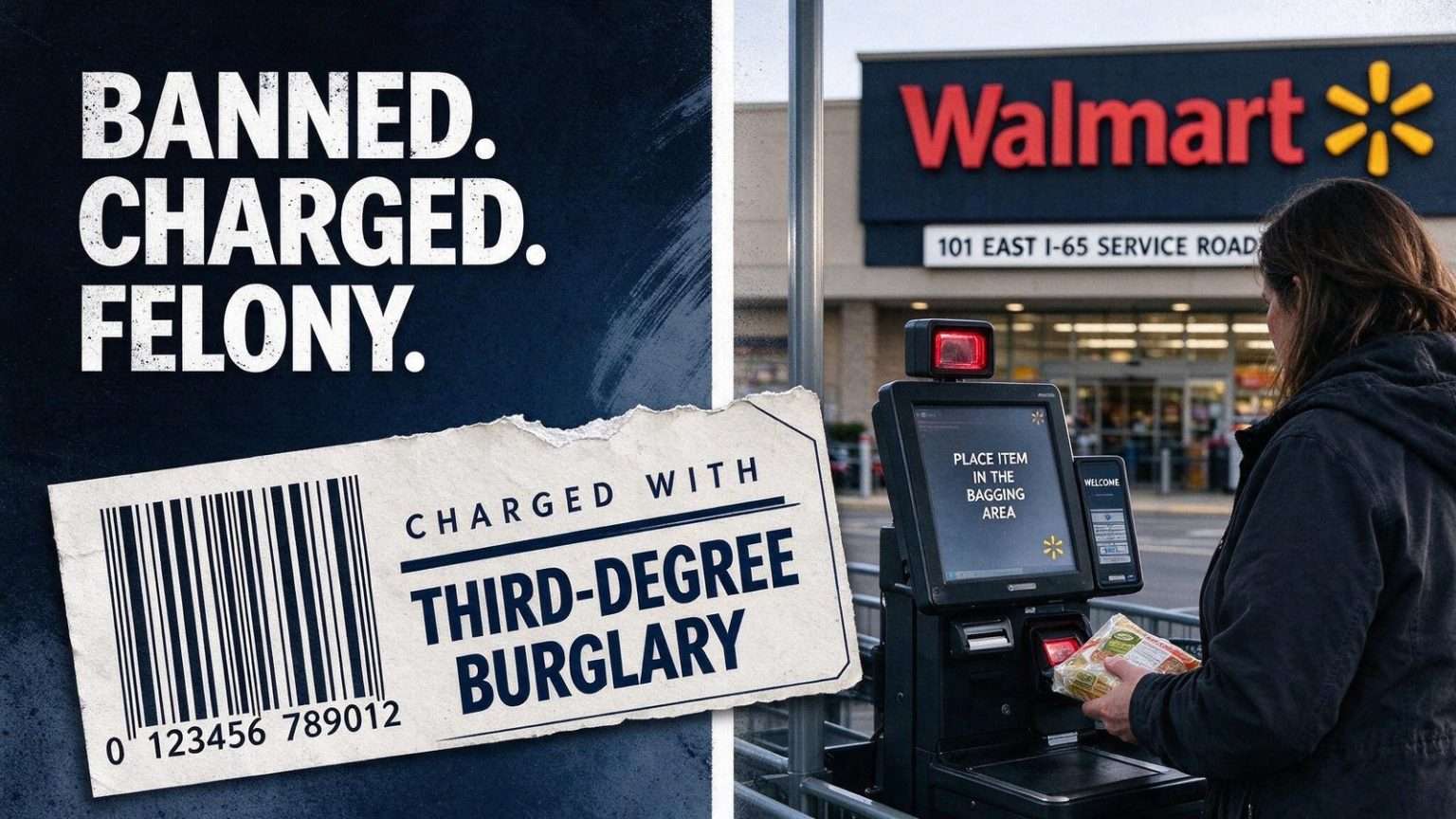
A trespass notice is a line drawn by a store: do not come back. Mobile police say a 23-year-old woman crossed it, and the charge she is now facing is heavier than most people would expect for a self-checkout theft. The case, filed in early July, has drawn attention precisely because of that escalation — a transaction at an automated kiosk that might otherwise have ended in a shoplifting citation instead produced a felony arrest, thanks to a piece of paper signed months earlier.
According to a Mobile Police Department news release, officers were called to the Walmart at 101 East I-65 Service Road around 5:45 p.m. on Friday, July 10, in reference to a theft. The store sits along one of the busiest retail corridors in west Mobile, near the interstate interchange that gives the service road its name, and the Walmart there — like the chain’s locations across the Gulf Coast — relies on a combination of camera systems, door greeters and loss-prevention staff to monitor its dozens of self-checkout terminals during peak afternoon hours.
When they arrived, they learned that the woman involved had already been trespassed from that same store. She had reportedly switched a barcode on merchandise while attempting to scan the item at self-checkout — a tactic that lets a shopper pay the price of a cheaper product for a more expensive one. The method has become familiar to loss-prevention officers across the country: a printed barcode from a low-cost item, carried in or lifted from another package and laid over the real label, defeats the scanner without triggering the weight sensors that catch many other forms of self-checkout misuse.
The charge: third-degree burglary
Erica Locke, 23, was arrested and charged with third-degree burglary. She was taken to Mobile County Metro Jail. The charge, one of the most serious available for a retail incident, stunned some readers when it was announced — burglary is the word most people associate with break-ins, not with a transaction at a checkout kiosk in a store that welcomes thousands of shoppers a day.
The burglary charge, rather than a simple theft charge, is the direct result of the existing trespass notice. Under Alabama law, burglary generally involves unlawfully entering or remaining in a building with the intent to commit a crime inside. Once a store has formally trespassed someone, that person has no lawful right to be on the premises — so walking back in with the intent to steal can elevate what would otherwise be a shoplifting case into a felony burglary case. The legal logic turns on consent: a store’s invitation to the public extends to everyone except the people it has formally excluded, and for those individuals, every subsequent visit is an unlawful entry.
Prosecutors pursuing the theory do not need to show forced entry or after-hours intrusion. What matters is the combination of the formal trespass notice, the return to the property and the intent formed at or before entry. If those elements hold, the conduct that would ordinarily be a theft offense becomes a burglary offense — carrying potential penalties and a felony record that follow a defendant long after a first shoplifting case would have been resolved with a fine or a diversion program.
Why retailers issue trespass notices
Trespass notices have become a common loss-prevention tool at large retailers precisely because of this legal escalation. They give police a stronger charge to work with when the same individual returns, and they give stores a way to formally document that a person is no longer welcome. The notices themselves are simple — a signed document identifying the individual, the store and the effective date — but their legal effect is durable, and loss-prevention departments treat them as the foundation for later prosecutions.
The documentation matters as much as the exclusion. When a loss-prevention officer stops a repeat offender, the trespass notice turns an argument about intent into a matter of record: the store warned the individual, the individual returned, and whatever happened next happened during an unlawful presence. Without that paperwork, prosecutors are often left with the harder task of proving the theft alone; with it, the entry itself becomes the crime.
For shoppers, the practical effect is that a second offense at the same location is treated very differently from a first one. A first incident typically results in a trespass notice alongside whatever theft charge or civil demand the store pursues. A second incident — even a minor one — can carry the burglary enhancement, and repeat offenders quickly accumulate charges that no diversion program can easily erase. Loss-prevention staff are trained to check returning suspects against their trespass records before deciding how to process a stop, and the check often determines the difference between a misdemeanor citation and a felony arrest.
How self-checkout changed retail theft
The barcode-switching tactic at the center of this case has grown alongside the self-checkout terminals that retailers rolled out to cut labor costs. Those machines trade a cashier’s judgment for a scanner’s, and the scanner reads only the barcode it is given — not whether the barcode matches the product, the weight or the price tag in the customer’s hands. Stores have responded with camera monitoring, weight-sensor alerts, receipt checks at the door and software that flags unusual scanning patterns, but the arms race between loss-prevention technology and theft tactics has continued at stores across the country.
Police and prosecutors have adapted as well. Cases that begin as self-checkout incidents routinely end as felony charges, either through the burglary theory used here when a prior trespass exists, or through statutes that treat the switching of price tags and barcodes as theft by deception. The value of the merchandise — not the elegance of the tactic — drives the charge level in most cases, but the prior trespass notice can override that arithmetic entirely, as the Locke case illustrates.
Walmart, like other major chains, has also pursued civil remedies against shoplifters in parallel with criminal charges, seeking restitution for merchandise and the costs of prevention. For defendants, the cumulative effect of a single self-checkout incident can therefore extend beyond the criminal case: a court date, possible jail time, a civil demand letter and the lifetime ban that the trespass notice imposes on one of the area’s largest retail locations.
What happens next in the case
Locke’s case now moves through the Mobile County court system, where the burglary charge will be tested against the facts police documented that evening: the trespass notice, the barcode switch, the presence in the store and the intent the law requires for the charge to hold. Defense attorneys in cases like this routinely challenge the linkage between the trespass notice and the intent at entry — arguing, for example, that a customer stopped in for an unrelated purchase without any plan to steal — and outcomes in similar cases across Alabama have varied with those details.
For the store and the police department, the case represents the working end of a strategy both have embraced publicly: aggressive documentation of repeat offenders and charging decisions that treat a violated trespass notice as seriously as the theft itself. Whether that strategy deters the conduct it targets is a question researchers continue to debate, but its practical effect on individual defendants is not subtle. A shopper who ignores a trespass notice walks past a line that most shoppers never see — and once across it, the consequences attach not to the items in the cart but to the decision to come back at all.
For everyday shoppers, the case is a reminder of how much legal weight rides on documents most people never think about. A self-checkout kiosk looks the same to a customer with a trespass notice as to one without, but the law treats the two visits as fundamentally different events, and the difference became a felony charge on a Friday evening in west Mobile.
The jail and the court process ahead
Booking into Mobile County Metro Jail starts the clock on a process that will unfold over weeks and months. Defendants charged with felonies in Mobile County appear first before a district court judge for an initial hearing, where bond is set and the charges are read, before the case moves toward a preliminary hearing or grand jury review. For a defendant with no prior felony record, attorneys typically argue for bond conditions that allow release pending trial; for those with prior contacts with the court, the calculus can be stricter, and the conditions of release — supervision, stay-away orders, surrender of identification — begin shaping daily life long before any verdict.
The felony label itself carries consequences that reach past sentencing. A burglary conviction under Alabama law strips a defendant of firearm rights, complicates employment applications and housing background checks, and counts as a strike in any future sentencing calculation. That is why defense attorneys fight the escalation from theft to burglary so consistently: the underlying conduct may involve a few hundred dollars of merchandise, but the conviction that follows can alter a life for decades.
Retail theft cases in Mobile County are prosecuted in volume, and outcomes vary widely with the facts and the defendant’s history. First offenders may qualify for pretrial diversion programs that eventually dismiss the charge; repeat offenders face the full range of sentencing. Where a trespass notice and a return to the store anchor the case, prosecutors rarely reduce the charge voluntarily, because the burglary theory is precisely what the documentation was designed to support.
For now, the case stands as a data point in an ongoing shift in how American retail crime is handled: stores document, police charge, and the kiosk where it all started becomes the scene of a felony. Shoppers passing through the self-checkout lanes on the I-65 service road — most of them scanning their groceries honestly — are unlikely to notice the legal architecture in the background. But it is there, written in trespass notices and charging decisions, waiting for the next person who walks back in after being told not to.