Eastern Shore Planners Study Fix for Baldwin County’s Stop-and-Go Traffic Lights
A new Baldwin County planning group is studying how to synchronize traffic lights along the Eastern Shore's busiest roads to ease stop-and-go congestion.
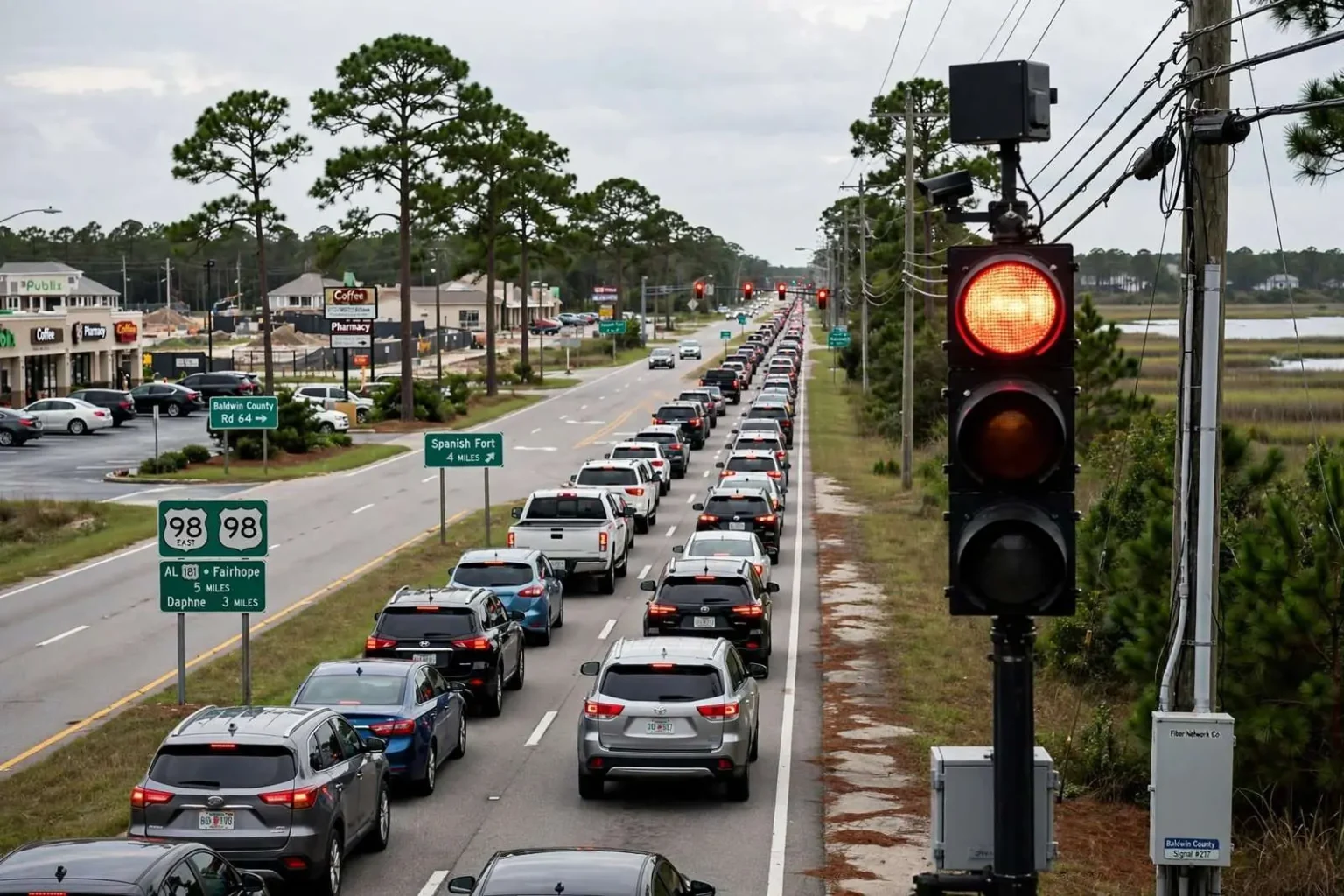
Anyone who has driven along Baldwin County’s busiest corridors toward the beach knows the rhythm: stop at a red light, creep forward a quarter mile, and stop again. County Commissioner Tucker Dorsey says he hits it nearly every time he drives east.
“They are not synchronized at all,” he said of the county’s traffic signals.
Relief may be on the way. The Eastern Shore Metropolitan Planning Organization, a regional transportation planning body formed in 2012, is preparing to release a study early in the new year examining how to synchronize traffic signals based on real-time traffic volumes at some of the Eastern Shore’s most congested intersections. The roughly $33,000 study marks the fledgling MPO’s first project funded with planning dollars from the federal government, supplemented by contributions from Baldwin County and the cities of Daphne, Fairhope and Spanish Fort.
The corridors under review include Alabama 181, U.S. 90, Baldwin County Road 64, U.S. 98 through Daphne and Fairhope, U.S. 31 in Spanish Fort, and Alabama 59 in Loxley. Those roads carry the daily weight of a county that has grown faster than its infrastructure: commuters crossing the bay to Mobile, shoppers moving between the Eastern Shore’s commercial centers, and — in season — the heavy tide of beach traffic that funnels toward the Gulf communities every summer weekend.
Notably, the project does not extend into South Baldwin County, where Gulf Shores has already pursued a similar signal-timing upgrade along Alabama 59, while Orange Beach and Foley considered comparable projects but shelved them over cost concerns. The South Baldwin cities face the same growth pressures as the Eastern Shore, but their geography — a single major highway serving barrier-island destinations — makes their traffic problems a different engineering problem, which their governments have addressed separately.
Why signals matter so much here
Traffic signal timing is among the least glamorous and most consequential pieces of transportation engineering. A poorly timed corridor forces every vehicle to stop repeatedly regardless of traffic volume, adding minutes to every trip, multiplying rear-end collisions at intersections and wasting fuel while engines idle. Multiply those minutes by the tens of thousands of vehicles that use U.S. 98 and U.S. 31 on a typical weekday, and signal timing becomes one of the largest levers a region can pull without pouring a yard of concrete.
The Eastern Shore’s problem is timing compounded by growth. The signalized intersections along its main corridors were spaced and programmed for a smaller population, and development since then — shopping centers, subdivisions, schools — has added turning movements the original patterns never anticipated. Each new traffic light added to manage a new development creates another point where a through-traveler can be stopped, and without coordination, each light operates on its own clock.
MPO coordinator Matthew Brown said the analysis, being conducted by engineering firm Sain Associates, is a required step before the region can pursue an estimated $2.5 million investment in adaptive traffic signal technology tied into a fiber optic network. The completed report will identify the best locations for the system and where existing fiber infrastructure could support it.
“It will analyze the Eastern Shore and tell us where the roads are at to put this in,” Brown said, adding that planners already have a good idea which corridors will make the list.
From study to smart signals
Adaptive signal technology is a step beyond conventional coordination. Traditional signal timing sets fixed patterns — green for so many seconds at such a time of day — that engineers calculate from historical counts. Adaptive systems read traffic in real time: sensors and cameras count the vehicles actually waiting in each lane, and the system adjusts phase lengths continuously to move the most cars through each cycle. When a corridor is tied into a fiber optic network, controllers communicate with each other, so a platoon of cars released at one intersection arrives at the next as the light turns — the “green wave” that drivers experience on well-tuned corridors.
That fiber connection is why the study matters beyond timing. Installing adaptive signals on corridors without the underlying communications infrastructure means the equipment cannot talk to itself, so the study’s mapping of existing fiber — belonging to the county, the cities, utilities and telecommunications carriers — will determine where the $2.5 million system can go first. Brown’s description of the report as telling the region “where the roads are at to put this in” captures that dual purpose: rank the intersections by need, then match them to the places the technology can actually be deployed.
The federal funding path also explains the study’s role. Metropolitan planning organizations receive federal planning dollars to prepare the projects that later compete for federal construction and implementation funding, and a documented study is the entry ticket. An MPO formed in 2012 — created when the region’s population crossed the federal threshold that requires urbanized-area transportation planning — needed a first project to establish how it operates, and the signal study gave it one with visible, local payoff.
The regional picture
County Commissioner Chris Elliott said the goal is to keep traffic moving efficiently not just on the main roads but across the connecting network that feeds them. Signal synchronization on a main highway accomplishes little if vehicles stack up a block away at an unsynchronized side-street light, and the Eastern Shore’s grid of county roads and city streets is exactly that kind of connected system.
The cities’ participation in funding the study reflects that shared interest. Daphne, Fairhope and Spanish Fort each control the signals within their limits, and the county controls others, so a regional approach — one analysis, one set of recommendations, coordinated implementation — is the only way a driver crossing jurisdiction lines experiences a continuous corridor. The MPO’s structure makes that coordination possible where, before its formation, each government planned in isolation.
Dorsey’s complaint captures the daily experience the study targets. The east-west drives between the bay and the growing population centers — trips along U.S. 98, Alabama 181 and the county roads between them — are the commutes and school runs and beach runs that residents make every day. Each unsynchronized light adds delay that no individual driver can avoid, which is why signal timing generates such consistent public frustration.
The study’s release early in the new year will give the MPO’s member governments a ranked list of locations, a map of usable fiber and an engineering basis for the adaptive signal investment. From there, the region can seek the construction and implementation funding that turns a $33,000 planning document into a $2.5 million system — the difference between knowing which lights are the problem and actually fixing them.
For Baldwin County, the project fits into a longer stretch of transportation catch-up. The county’s population growth through the 2000s and beyond consistently outpaced its road capacity, and the major improvements that respond to that growth — wider highways, new corridors, interchange reconstructions — take years of planning, environmental review and construction funding. Signal synchronization sits at the other end of that spectrum: relatively inexpensive, quick to deploy and immediately felt by every driver on the corridor.
That is why planners describe signal work as one of the highest-return investments available to a growing region. Widening U.S. 98 or rebuilding an interchange can take a decade from concept to ribbon-cutting. Retiming and interconnecting signals along the same corridor can be finished in months, at a small fraction of the cost, and studies across the country have found that well-executed signal coordination programs cut corridor travel times and stops dramatically without adding a single lane.
The adaptive systems under consideration extend that return over time. A fixed timing plan is obsolete the day traffic patterns shift; an adaptive network keeps re-optimizing as development adds traffic, which matters in a county where the next subdivision or shopping center can change turning counts at an intersection within a year of opening. The fiber backbone that links the controllers can also carry future expansions — additional intersections, new corridors, transit priority — so the initial investment becomes infrastructure rather than a one-time project.
What residents should expect
For daily commuters, the near-term changes from the study itself will be modest: the analysis will inform timing improvements that can be implemented relatively quickly on the corridors studied, even before the adaptive equipment is funded. Local traffic engineers can take the study’s recommendations and begin reprogramming controllers along U.S. 98, U.S. 31 and the other corridors, giving drivers some relief in the short term while the larger system is pursued.
The adaptive investment, when funded, would bring the more visible changes: equipment at intersections, fiber connections between them, and corridors where lights respond to actual traffic rather than the clock. The $2.5 million estimate gives the MPO and its member governments a target for the grant applications and federal funding cycles through which such systems are typically built.
The study also gives the Eastern Shore’s governments something they have lacked: a shared, documented picture of their signal network. Before the MPO’s formation, each city and the county managed its own intersections with its own data and priorities. A regional analysis creates the common baseline that lets Daphne, Fairhope, Spanish Fort and Baldwin County coordinate implementation across jurisdictional lines — the same corridors, after all, do not stop at the city limits.
For the MPO itself, the project carries institutional significance beyond traffic. A first federally funded study establishes the organization’s procedures, demonstrates its ability to deliver, and builds the track record that future transportation requests from the Eastern Shore will stand on. The region’s growing population now generates its share of federal transportation planning dollars; the signal study is how those dollars begin producing visible results at the intersections where residents actually sit waiting.
The study’s findings are expected early in the new year, after which the MPO’s member governments will have the blueprint for bringing coordinated, traffic-responsive signals to the Eastern Shore’s most congested corridors — and, eventually, an answer to the driver’s oldest complaint: one red light after another, all the way to the beach.