Mary G. Montgomery Student First in Alabama to Earn Microsoft Office 2013 Master Certification
A Mary G. Montgomery High School student became the first in Alabama to earn a master's certification in Microsoft Office 2013.
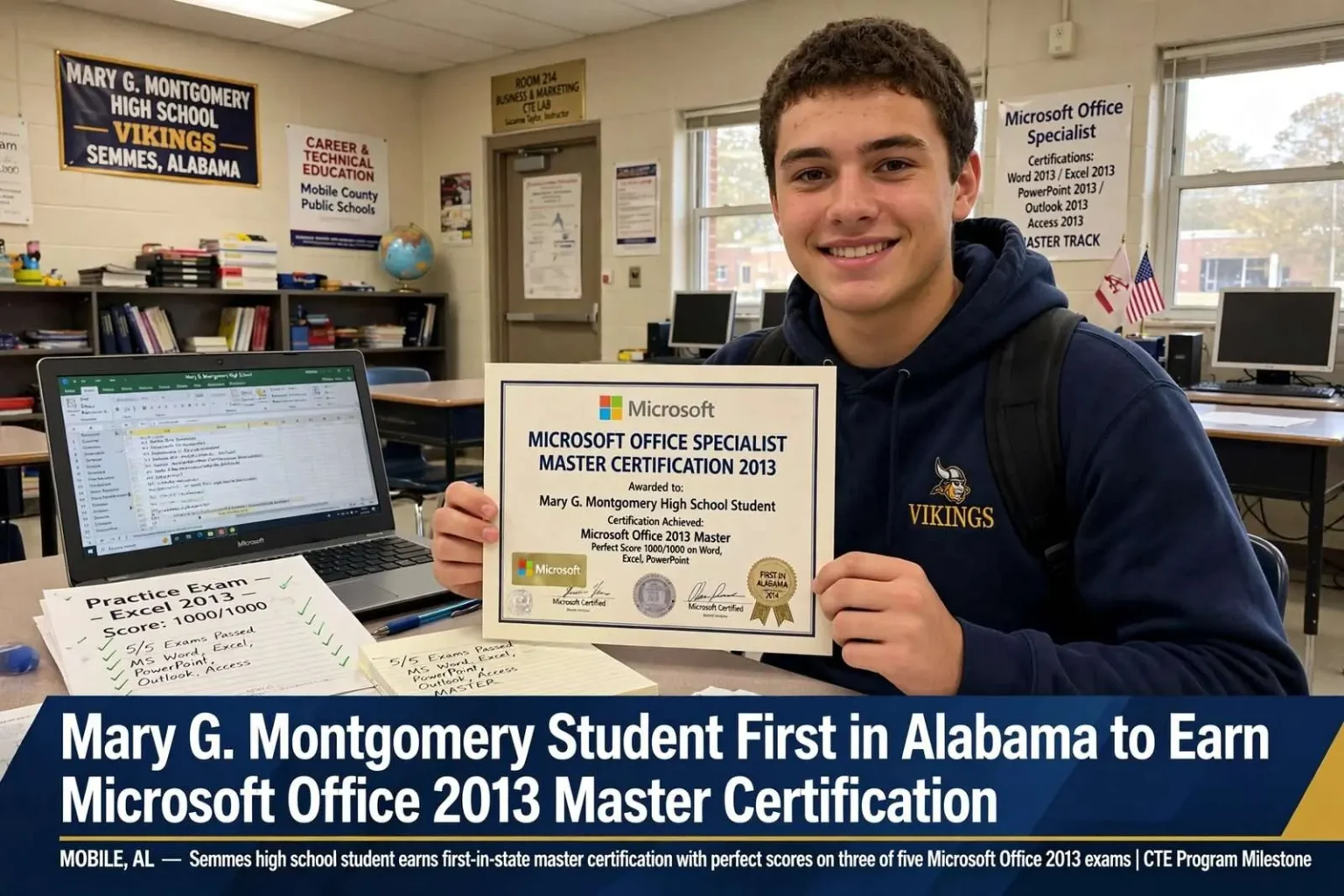
MOBILE, Alabama – A student at Mary G. Montgomery High School has become the first person in Alabama to earn a master’s certification in Microsoft Office 2013, one of the highest technical credentials the software company offers at the high school level.
The student, enrolled in a career and technical education class taught by Suzanne Taylor, achieved the master’s certification after passing five separate Microsoft Office Specialist exams covering different applications within the Office 2013 suite. According to a release from the Mobile County school system, the student earned a perfect score of 1,000 on three of the five required exams — an unusually strong performance on an already demanding, industry-recognized credential.
The achievement placed the Semmes campus at the front of a statewide race that had been building since Microsoft released the 2013 version of its Office suite, and it gave Mobile County’s career-technical programs a marquee example of the credentials students can now carry out of high school.
What a master certification requires
The Microsoft Office Specialist master certification is considered an adult-level, industry-recognized credential typically pursued by working professionals, making the achievement especially notable for a high school student. Earning it requires passing multiple specialist-level exams — covering the suite’s core applications, including word processing, spreadsheets, presentations and communications programs — and demonstrating fluency that goes well beyond routine computer use.
Each exam tests practical proficiency under timed conditions: building and formatting complex documents, constructing spreadsheets with formulas and functions, assembling presentations and managing email and scheduling tools. A perfect score of 1,000 indicates every tested skill demonstrated without error, a benchmark that even experienced office professionals rarely hit.
The certification falls under the broader umbrella of technical credentials offered through Mobile County Public Schools’ Career and Technical Education Department, which provides students with pathways to earn workforce-ready certifications before graduation. Those pathways span health care, construction, culinary arts, information technology, business and other fields, and each is built around exams or licensures that employers recognize.
A district-wide credential engine
School officials pointed to the achievement as part of a larger pattern of career-credential success across the district. During the 2013-14 school year, Mobile County students collectively earned more than 7,300 career credentials spanning a wide range of fields, including certified nursing assistant qualifications and welding-related safety certifications such as OSHA 10-hour cards, alongside various industry-recognized technology and trade credentials.
The volume matters to the district’s argument about what public schools can deliver. More than 7,300 credentials in a single year means thousands of students graduating with documentation that they have mastered a specific, testable skill — the kind of evidence that separates a resume from a transcript when students apply for their first jobs or interview for apprenticeships.
Mary G. Montgomery High School, serving the Semmes area in western Mobile County, has built its own reputation within the district for the strength of its career and technical offerings, and the Microsoft master certification gave that program its most visible validation yet.
Why industry credentials matter
Career and technical education programs like the one at Mary G. Montgomery High School are designed to give students hands-on, transferable skills that can lead directly to employment or give them a head start in relevant college coursework. Earning nationally recognized certifications such as the Microsoft Office Specialist credentials signals to employers and colleges alike that a student’s skills have been measured against an external standard, not just a classroom rubric.
The Microsoft master certification in particular carries weight in administrative and business careers, where spreadsheet fluency, document production and communications proficiency remain baseline requirements. For a high school student, holding the credential before graduation means entering the job market or a business program with proof of skills that many adults still lack.
Business educators across Alabama had watched the Office 2013 certification cycle closely, since the new exam suite reset the statewide leaderboard: the first student in the state to complete the master track would be the first anywhere in Alabama, regardless of how large or well-funded the school. The Semmes campus claimed that position through a classroom teacher’s preparation and one student’s test performance.
The district’s business and marketing programs have made Microsoft certification a staple of their curriculum in recent years, aligning coursework with the exam objectives and scheduling testing windows each semester. Students who pass individual application exams earn credentials recognized by the state’s career-technical reporting system, and those who complete the full set join the much smaller group of master-certified candidates statewide.
The classroom behind the credential
Suzanne Taylor’s career and technical class provided the pipeline: instruction in the Office applications, practice exams and the testing sessions in which each of the five specialist exams had to be passed. Teachers in these programs typically align their courses to the certification blueprint, drilling the exact skills Microsoft tests and timing students under exam conditions before the real attempt.
The model reflects a broader shift in career and technical education nationally. Where older vocational programs were often criticized as a track for students deemed unlikely to attend college, modern CTE programs position themselves as preparation for both — a student can graduate with a credential that leads to a job and still enroll in college coursework, often with credit or advanced standing attached.
Alabama education officials have pushed that dual purpose through statewide initiatives that reward districts for the number of students graduating with industry credentials, making certification counts a metric that school systems track and publicize.
Microsoft’s certification ladder
Microsoft structures its Office Specialist program as a ladder: individual exams certify proficiency in a single application, and the master certification — the level the Mary G. Montgomery student reached — requires multiple exams across the suite, demonstrating breadth as well as depth. The 2013 edition of the exams accompanied the release of Office 2013 and its new interface and cloud-connected features, requiring candidates to learn a version of the software many workplaces had only begun to adopt.
That timing raised the difficulty: the student was mastering not merely an established program but the newest release, often without the years of familiarity that working professionals leaning on older versions had accumulated.
A first for the state, a win for Semmes
Being first in Alabama matters for a school’s program beyond the certificate itself. The distinction draws attention from district administrators, business partners and other schools looking to replicate the result, and it signals to local employers that Mary G. Montgomery graduates arrive with tested office-technology skills.
Semmes, incorporated as a city in 2011, is one of the fastest-growing corners of Mobile County, and its high school has grown with the community. The campus serves a student population spread across the western edge of the county, and its career-technical offerings connect those students to the business, health care and skilled-trades employers that populate the surrounding corridor.
The Mobile County school system, the largest in Alabama by enrollment, operates career and technical centers and school-based programs across the county, and its department tracks certification counts as a headline measure of program quality. A statewide first from one of its campuses strengthens the argument that the district’s investment in CTE pays measurable dividends.
The students behind the numbers
Behind the district’s 7,300-plus credentials are individual stories like this one: hours of practice exams, retakes when an application’s shortcuts prove stubborn and a final session in which every tested skill lands. Educators note that the students who reach master-level certifications often do so on their own initiative, moving past the required coursework to attempt exams most candidates their age never schedule.
Certified nursing assistant credentials, OSHA 10-hour safety cards and the technology certifications share a common thread: each is granted by an external body, each has value in a specific labor market and each follows the student out of high school at no cost beyond the classroom effort required to earn it.
What comes next
For the student, the master certification joins a resume at an age when most peers are still assembling one — a credential that remains valid as Microsoft’s suite evolves and one that business programs, employers and scholarship committees can verify with a registry lookup. It also sets up the possibility of advanced placement in business coursework, where certified skills can translate into credit or skip-ahead standing.
For the district, the statewide first becomes a benchmark. Other campuses will aim to match it, the Career and Technical Education Department will continue expanding its exam offerings and the next Office release will reset the board again. Mobile County’s credential counts have climbed steadily as programs have expanded, and school officials expect the total to keep growing as more students discover that a high school classroom can end in an industry certification — and, in rare cases, in being the first in the state to earn one.