Mobile County Schools Post Mixed Results on First ACT Aspire Tests
Mobile County students scored below new benchmarks in reading and math but above average in English on the first ACT Aspire testing round.
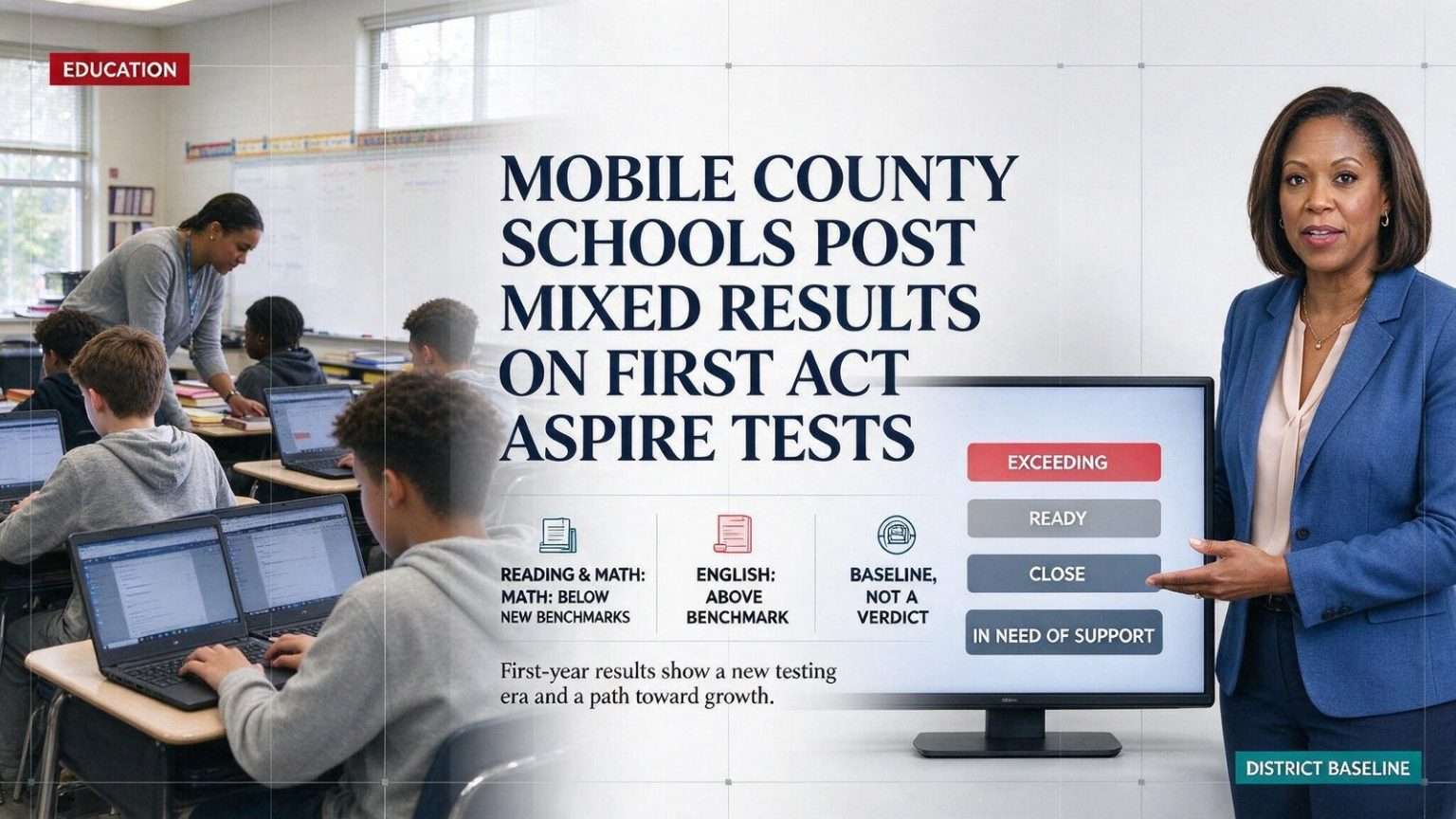
MOBILE, Alabama – Mobile County Public Schools has released results from the district’s first round of ACT Aspire testing, and the numbers present a mixed picture of student achievement across the state’s largest school system. Students in grades 3 through 8 scored below the newly established state benchmarks in reading and math, but they outperformed expectations on the English portion of the exam. The results mark the district’s first experience with an assessment that state leaders have billed as a far more demanding measure of college and career readiness than anything Alabama students have taken before.
The ACT Aspire exam was administered statewide for the first time last spring, replacing the long-standing Alabama Reading and Math Test, known to educators and parents as the ARMT. Where the ARMT measured whether students had mastered grade-level content under Alabama’s previous course-of-study standards, the Aspire is aligned to Alabama’s College and Career Ready standards and is designed to project whether students in elementary and middle school are on a trajectory to succeed in credit-bearing coursework after high school. Because the two tests measure different things on different scales, educators have repeatedly cautioned that scores from one cannot be meaningfully compared to the other.
Across all of the grades that took the exam in Mobile County, students scored below the new reading and math benchmarks that the state set for the assessment. The gap was not uniform across subjects, however. District scores in math came closer to the target levels than their reading scores did, a detail that suggests the earliest areas of focus for instructional support may include literacy instruction in the upper elementary and middle grades. In both subjects, the district’s average scores landed roughly in line with the national averages for the Aspire exam, a sign that the first-year results mirror patterns seen in other states where more rigorous, nationally normed assessments replaced older grade-level tests.
English proved to be the bright spot in the local results. On the optional English assessment, which was given at some schools within the district in addition to the required reading and math sections, Mobile County students in every tested grade scored above the readiness benchmark. District officials pointed to that performance as evidence that students are capable of meeting the demands of the new standards when the instructional groundwork is in place, and it gives the system at least one clear area of strength to build on as it digests the rest of the data.
A “trial run” that sets a baseline
Schools Superintendent Martha Peek cautioned against reading too much into the first-year numbers. She noted that the new Aspire test format cannot be directly compared to scores from the previous ARMT exam, and she described the inaugural testing round as “a trial run” that should serve mainly as a baseline for future spring assessments rather than a definitive measure of how much students learned during the year. In her view, the value of the 2015 administration lies less in any single score and more in the reference point it creates for measuring growth in the years ahead.
That framing reflects a broader debate that has played out in states across the country as tougher standardized tests have rolled out. When a new exam raises the bar, first-year scores typically drop, and education officials in many states have urged parents not to interpret the lower results as evidence of a decline in teaching or learning. Alabama’s experience with the Aspire followed that familiar pattern, and Peek’s message to the Mobile County community was consistent with it: the baseline is not the verdict.
The district’s release followed the Alabama State Department of Education’s own statewide results, which were published the previous week. The state report sorted student performance into four categories: exceeding, ready, close and in need of support. That four-tier structure was designed to give families a plain-language sense of where each child and each school stood relative to the new college-and-career readiness bar, replacing the older vocabulary of proficiency levels that accompanied the ARMT era.
Mobile County’s local report took a different approach. It focused on average scores that fell in the middle “ready” and “close” ranges of the state’s classification scheme, without breaking out the percentage of students who landed in the top “exceeding” band or the bottom “in need of support” category. District officials also opted not to present the results as percentages, the format used in the state’s own report, arguing that percentages would be misleading given the absence of historical comparison data from prior years. With no earlier Aspire results to measure against, they said, a percentage of students “at benchmark” could invite conclusions the data cannot yet support.
The decision highlighted a tension that has followed the transition to the new testing regime. State officials promoted percentage-based breakdowns as the clearest way to communicate how far Alabama students are from the readiness bar, while some local systems preferred average-score summaries that emphasize where the typical student stands. Both approaches describe the same underlying data, but they can shape public perception in different ways, and the district’s choice to emphasize averages underscores how carefully administrators in Mobile County are managing expectations during the transition year.
A massive testing operation
Logistically, the first Aspire administration was an enormous undertaking for the district. Roughly 26,000 Mobile County students sat for the reading and math portions of the exam, which are the components required of school systems across Alabama. On top of that, an additional 20,000 students took the optional English assessment, which the state permitted districts to offer at some or all of their schools. Coordinating schedules, materials and testing windows across more than 90 schools in a district that stretches from downtown Mobile to the rural communities near the Mississippi line required months of planning by campus and central-office staff.
The district also stood out statewide for how it delivered the test. Mobile County was notable as the only school system in Alabama to administer the entire test battery on computers rather than paper. That decision positioned the district ahead of the curve at a time when state and national assessment programs were steadily moving toward digital delivery, and it gave the system early experience with the technical demands of online testing, from device availability and bandwidth to scheduling computer labs for thousands of students in grades 3 through 8. It also meant district officials could draw on their own experience as they evaluate how the transition to computer-based assessment should proceed in future years.
The statewide context adds weight to the local numbers. Alabama adopted the Aspire as part of the broader shift to College and Career Ready standards, which were developed from the Common Core State Standards and adopted by the State Board of Education with the goal of ensuring that a high school diploma signals genuine readiness for college coursework or job training. The Aspire system is produced by ACT, the same organization behind the college-entrance exam that Alabama high school juniors take, and one of its central promises is continuity: a student’s Aspire scores in elementary and middle school sit on the same scale as the ACT benchmarks used for college admissions, making it possible to flag academic trouble long before senior year.
What happens next
For all the attention the first results have drawn, district officials emphasize that the analysis is just beginning. Mobile County administrators said they are still in the early stages of examining the new data and identifying which schools or grade levels may need additional instructional support heading into the next testing cycle. Turning a districtwide release into campus-level action requires drilling down to individual classrooms, comparing performance across demographic groups and aligning professional development with the specific skill gaps the exam exposed, work that unfolds over months rather than days.
Superintendent Peek indicated that more detailed guidance for teachers and campus administrators would follow as officials continue reviewing the results in the coming months. That guidance is expected to help principals interpret their schools’ scores, help teachers connect the results to classroom instruction, and give families a clearer picture of what the new benchmarks mean for their own children. District leaders have framed the coming academic year as the period in which the baseline data will be translated into concrete changes in curriculum emphasis, intervention programs and teacher support.
Parents in Mobile County will encounter the new reporting system as they review their children’s individual score reports. Under the Aspire framework, a student classified as “ready” is considered on track to graduate prepared for credit-bearing college courses, while “close” indicates a student who is near the benchmark and could reach it with targeted support, and “in need of support” signals that significant intervention is warranted. Educators stress that a single test is only one measure of a child’s progress, and they encourage families to look at the results alongside grades, classroom work and teacher evaluations.
The first-year results also arrive at a moment when Mobile County’s enrollment and demographics make the district a bellwether for the state. As Alabama’s largest school system, the county district educates a student population that is larger than that of many entire states’ metro areas, and its performance is closely watched by state officials and by other systems weighing their own transitions to the new standards. When Mobile County works through the challenges of a first-year testing transition, the lessons tend to travel.
For now, the district’s message is one of patience and persistence. Officials acknowledge that the reading and math scores fell short of the new benchmarks, they celebrate the English results as proof of what students can do, and they insist that the true measure of the Aspire era will come from year-over-year growth rather than from a single spring’s numbers. With a baseline now established, tens of thousands of students tested, and a computer-based delivery model already proven at scale, Mobile County enters the next testing cycle with more information about its students than it has ever had – and a clear sense of the work that lies ahead.