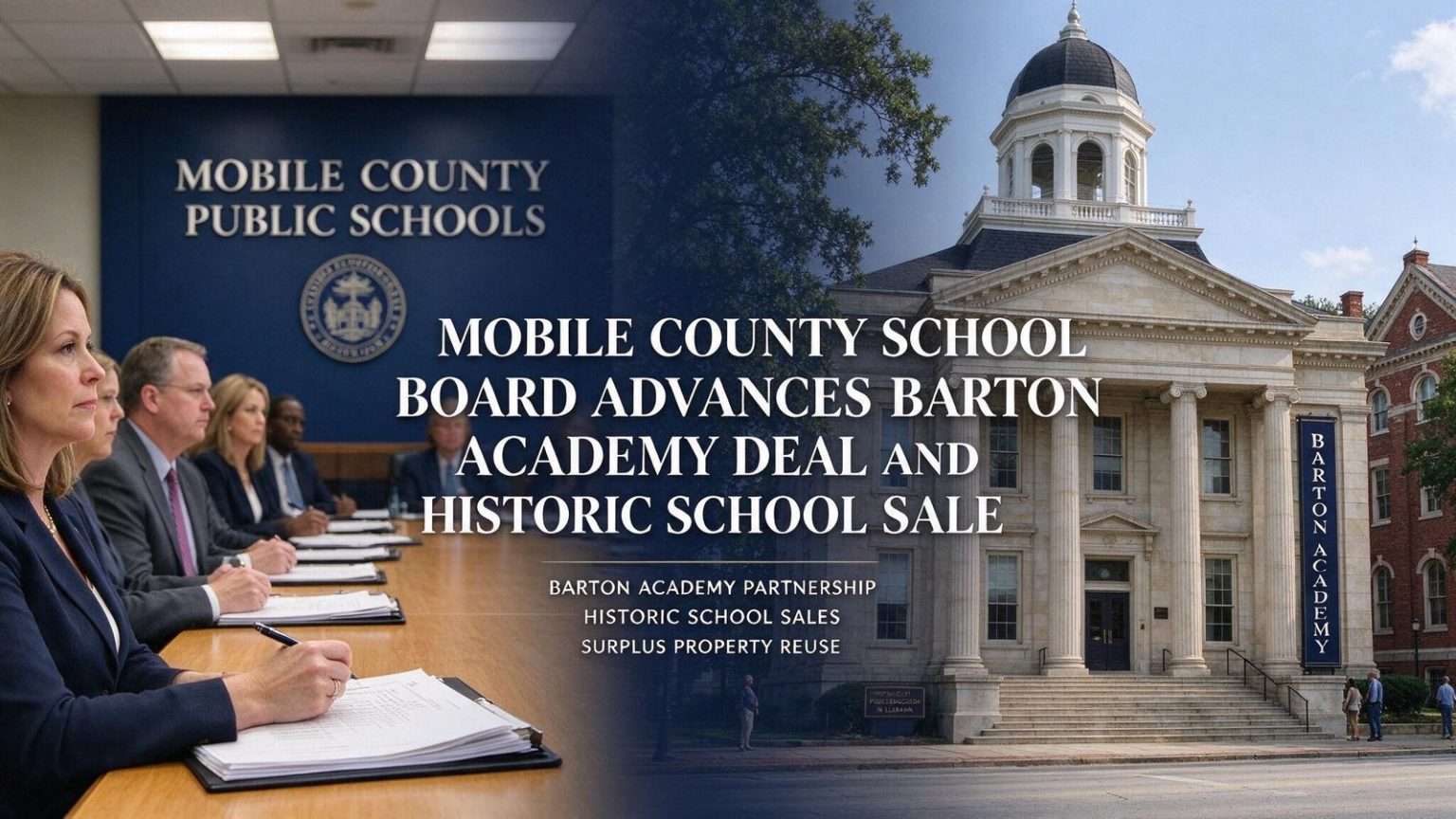
Mobile County School Board Advances Barton Academy Deal and Historic School Sale
The Mobile County school board approved a Barton Academy Foundation agreement and a sales contract for two historic school buildings.
MOBILE, Alabama – The Mobile County school board took action on two long-running historic property matters during its Monday night meeting, approving a formal agreement with the Barton Academy Foundation and finalizing a sales contract for two century-old former school buildings. The votes closed out items that have been in motion for months and moved the district another step forward on the disposal and reuse of surplus historic properties scattered across Mobile.
Board members approved a sales contract for the Old Shell Road School and Russell School buildings, both roughly 100 years old, moving forward on a deal first outlined in October when the board accepted a letter of intent to sell the properties for $800,000 to a Georgia-based developer. Monday’s vote represented the next formal step in finalizing that sale, which would return two architecturally significant but unused campuses to a productive role after years on the district’s surplus property list.
The Old Shell Road School campus has occupied a prominent spot along the street that gives it its name for a century, and the Russell School likewise stands as a relic of an earlier era of Mobile County education, when neighborhood schools were built to last with brick, plaster and hardwood. Keeping such buildings maintained while empty is expensive for any school system, and boards across Alabama have increasingly turned to private buyers who can shoulder rehabilitation costs the districts cannot.
The developer was represented locally by a Mobile-based real estate professional who is also handling the separate sale of the former Augusta Evans Special School on Florida Street to an out-of-state acquisitions firm for roughly $1.55 million. That transaction, still proceeding separately from the Old Shell Road and Russell deal, would add another substantial figure to the proceeds the school system realizes from clearing its books of idle buildings.
School officials have described the sales as a win on multiple fronts: the district sheds maintenance liabilities on buildings it no longer uses, properties that anchor their surrounding neighborhoods return to the tax rolls, and buyers with redevelopment plans take on the restoration work. In older Mobile neighborhoods, the fate of a former school building is often closely watched, since the structures tend to be among the largest and most recognizable in their areas.
Barton Academy agreement formalizes the partnership
Separately, the board approved a memorandum of understanding with the Barton Academy Foundation, formalizing a partnership between the school system and the foundation as they work together on fundraising efforts tied to transforming the historic Barton Academy building into an international school. The agreement gives the foundation an official standing in the project rather than an informal advisory role, a step supporters of the restoration have sought for years.
Barton Academy, the Greek Revival landmark on Government Street named for former Alabama governor Willoughby Barton, is widely regarded as the birthplace of public education in Alabama. The building served as the state’s first public school when it opened in the nineteenth century and later housed the administrative offices of the Mobile County Public School System. Its distinctive dome and columned facade make it one of the most recognizable structures on Government Street, and its long vacancy has made its restoration a perennial subject of civic discussion.
The international school concept envisions a themed program within the public school system, an idea that fits with the district’s experience operating magnet schools that draw students from across Mobile County. Backers of the plan have argued that a globally focused program in a restored Barton Academy would give families another high-quality option while rescuing one of the city’s most important historic buildings from continued decline.
The school system already has a roughly $2.8 million contract with a local construction firm to restore the exteriors of both Barton Academy and the adjacent Yerby School, with work that began the previous month expected to wrap up by the following August. That exterior phase addresses roofs, masonry and other weather-tightening needs that must come first for any historic rehabilitation, protecting the buildings while the larger fundraising campaign proceeds.
Superintendent Martha Peek told the board the new agreement gives the foundation a clearer formal role in supporting that broader transformation effort. Foundations formed to save individual historic buildings typically carry the fundraising burden that public agencies cannot easily shoulder themselves, and the memorandum of understanding spells out how the two organizations will divide responsibility as the project moves from exterior stabilization toward a full interior build-out.
The Yerby School building adjacent to Barton has been part of the campus’s working life for generations, and including it in the exterior restoration contract reflects the practical reality that the two structures would function together in any reopened campus. Preservation advocates have pointed to the paired buildings as an unusually complete historic school complex in the heart of downtown Mobile, within walking distance of the city’s civic and cultural institutions.
Public comments range from technology to enrollment
During the public comment portion of the meeting, board members heard from two Mobile County residents. One parent raised concerns about technology resources available at Grant Elementary School, where his child is enrolled. The comment touched on an issue that has grown steadily more prominent in public education: the gap between schools that have modern devices, reliable networks and up-to-date software and those that lag behind, a divide with real consequences as instruction and testing both shift onto digital platforms.
A representative of the Williamson High School Alumni Association told the board her organization was concerned about the school’s long-term enrollment outlook, citing trends that have raised questions about the campus’s future. Williamson, a institution with deep roots in Mobile’s African-American community and an alumni network that spans generations, has seen its enrollment picture shift as population patterns and school choice options have changed across the district.
Alumni associations play an unusual role in discussions about school closures and consolidation. In Mobile, as in many Southern cities, graduates often remain closely tied to their alma maters for decades, contributing scholarships, mentoring and advocacy, and they are frequently among the first to organize when enrollment declines put a campus on a watch list. The alumni representative’s appearance before the board signaled that the association intends to be part of any conversation about the school’s trajectory.
Enrollment trends carry real financial weight for a school system of Mobile County’s size, one of the largest in Alabama. Public school funding follows students, so campuses that lose population see their staffing and budgets tighten, which can in turn accelerate the decline — a cycle that boards and administrators work to interrupt through program changes, magnet offerings and capital investment.
Why the surplus property sales matter
The evening’s property votes fit into a broader pattern across Alabama, where aging school systems are balancing the upkeep of cherished historic buildings against the cost of modern facilities. Old school buildings pose particular challenges: they predate modern electrical, HVAC and accessibility standards, and rehabilitating them for educational use is often far more expensive than building new. Selling them to developers preserves the structures while relieving the district of a burden.
For the neighborhoods involved, the sales can be transformative. A closed school building that sits vacant becomes a magnet for vandalism and a drag on nearby property values, while a successful conversion — whether to housing, offices or community use — restores a neighborhood anchor. The $800,000 price for the Old Shell Road and Russell buildings and the roughly $1.55 million sale price for Augusta Evans represent significant returns on properties that were costing the district money to simply keep standing.
The Georgia-based developer’s purchase, once closed, will also return the two school properties to the property tax rolls, generating revenue for the very school system that sold them along with the city and county. Officials have noted that dynamic as one of the quieter benefits of surplus property sales in the district.
With the memorandum of understanding in place, the Barton Academy Foundation moves into its fundraising phase with a defined role, while the exterior restoration continues toward its August completion target. School board members are expected to receive updates on both the Barton project and the final closing of the Old Shell Road and Russell sale in the months ahead, as the district works through one of the most consequential rounds of historic property decisions in its recent history.
Board officials have indicated that proceeds from the property sales will be directed back into the system’s capital needs, adding to funds available for the ongoing renovation and construction program already under way across Mobile County’s public schools. Every dollar that goes toward maintaining an empty building is a dollar unavailable for classrooms, and district administrators have made that argument repeatedly as the surplus property list has been worked down over successive board terms.
The district’s real estate activity also reflects the scale of the Mobile County Public School System, which operates dozens of campuses across an area stretching from the Mississippi line to the Eastern Shore. With enrollment centers on the city of Mobile and the fast-growing suburbs, older inner-city buildings constructed for larger student populations decades ago have increasingly outlived their original purpose, even as their architectural value and neighborhood significance remain undisputed.