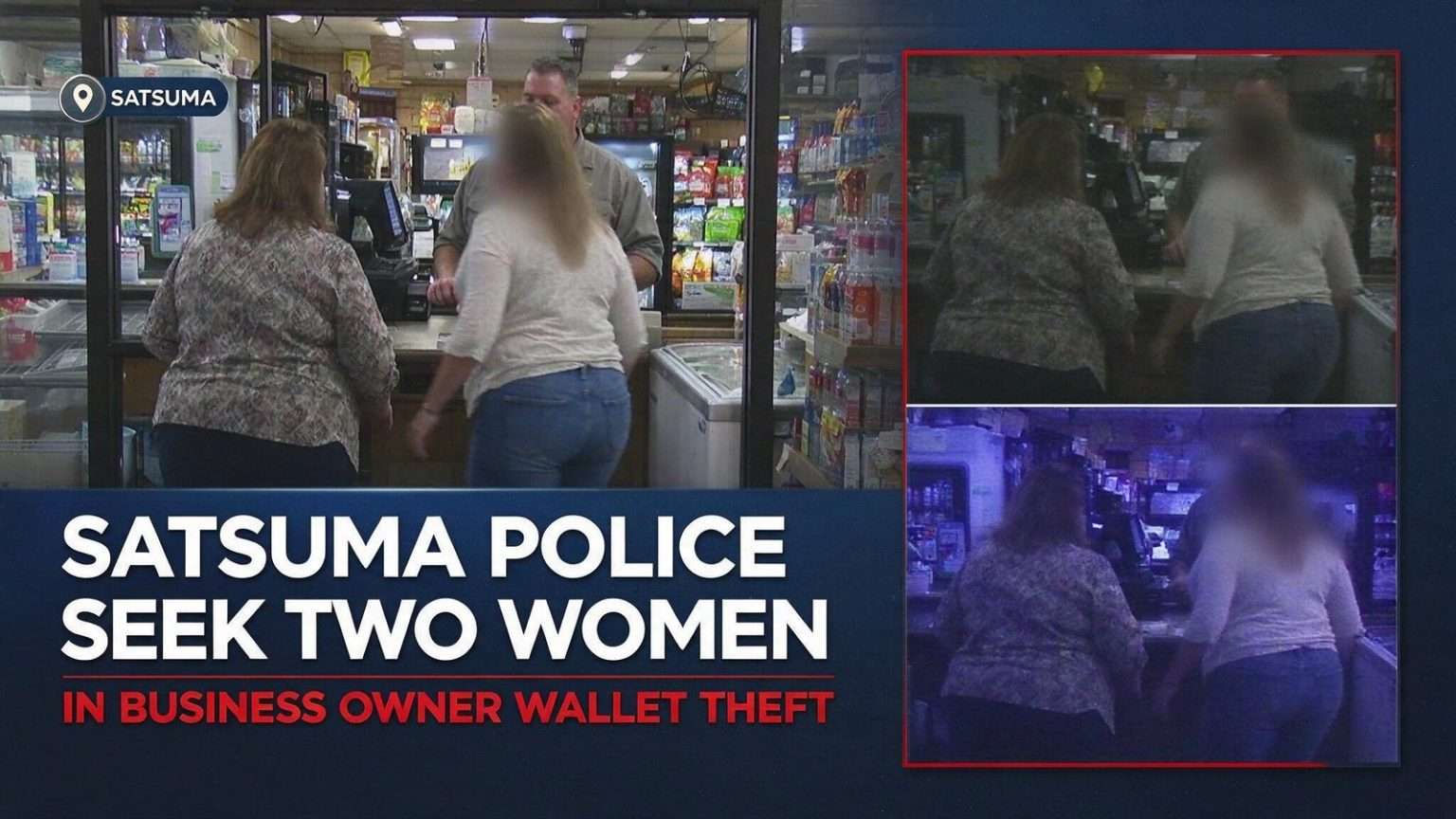
Police in Satsuma turned to the public for help identifying two women accused of teaming up to steal a wallet from a local business owner.
Satsuma Police Chief Chris McLean released two images of the suspects, both dated Nov. 11, the same day as the reported theft. Investigators hoped that residents who recognized the pair would come forward with information.
According to Det. Douglas Walley, the two women walked into a Satsuma store on Nov. 11. While one of them kept the business owner occupied, the other took the owner’s wallet, a classic distraction tactic that gave the pair a window to slip away undetected.
The theft did not end there. Walley said the women then tried to use the stolen credit cards at several businesses, with most of those attempts concentrated in the Tillman’s Corner area southwest of downtown Mobile.
Investigators believed the case might stretch beyond the Mobile area. Walley said a pair matching the description of the Satsuma suspects was also under investigation in connection with similar crimes in Ocean Springs, Mississippi, raising the possibility that the two were working a regional pattern of thefts and fraudulent card use.
Cases like this one are a familiar concern for small businesses, where a brief lapse in attention at the counter can give thieves the opening they need. Distraction thefts often rely on two people working in tandem, one to engage the clerk or owner and another to grab cash, cards or valuables left within reach.
Satsuma police asked anyone who recognized the women or had information about the theft to contact the department. Authorities noted that surveillance images can be a valuable tool in identifying suspects, particularly when the same individuals appear to be operating across multiple communities.

The appeal underscored how local police departments increasingly lean on community tips and shared information with neighboring jurisdictions to track suspects who move from town to town. For Satsuma merchants, the episode served as a reminder to stay alert and to keep wallets, purses and registers secured, even during routine transactions.
Mobile is the county seat of Mobile County in southwest Alabama and the state’s only saltwater port. Situated where the Mobile River meets Mobile Bay near the northern Gulf of Mexico, the city has long served as a commercial and cultural gateway between Alabama and the wider Gulf Coast. Founded in 1702 as Fort Louis de la Louisiane and ruled in turn by France, Britain, and Spain before joining the United States in 1813, Mobile carries a layered heritage distinct from the rest of the state.
Today Mobile anchors a metropolitan area spanning Mobile County and neighboring Baldwin County, and it remains a center for shipping, aerospace, healthcare, and higher education in the region. Its downtown and waterfront have seen sustained revitalization, while historic neighborhoods preserve architecture from its colonial and antebellum past. The city’s identity is shaped as much by its working port and industrial base as by its festivals and food culture, making it a frequent focal point for news about growth and change in southern Alabama.
Local law enforcement across South Alabama is carried out by municipal police departments, county sheriff’s offices, and state agencies that together cover a mix of urban, suburban, and rural territory. City departments handle policing within municipal limits, while sheriff’s offices provide courthouse security, jail operations, and patrol in unincorporated areas.
Cooperation among these agencies, and with federal partners, is central to tackling problems that cross jurisdictional lines, from drug trafficking to violent crime. Joint task forces that pair federal agents with local officers have become a standard mechanism for sharing information and concentrating resources on threats that no single agency could address alone.
Public-safety agencies in the region also contend with staffing, training, and community-relations challenges common to departments nationwide. How they allocate patrols, respond to calls, and engage neighborhoods is a regular subject of local oversight and news coverage, particularly where residents expect both accountability and visible protection.
The economy of the Mobile region is diversified across shipping and logistics, aerospace and shipbuilding, healthcare, tourism, and manufacturing. The Port of Mobile is one of the nation’s busiest seaports and a cornerstone of the local and state economy.
Major employers in aviation and defense contribute to a skilled workforce, while economic-development organizations aim to attract investment and jobs through incentives and infrastructure improvements. Small businesses, from restaurants to professional services, form the backbone of neighborhood commerce.
The health of the regional economy is a frequent subject of public discussion and reporting. Workforce development, recruitment of industry, and the fortunes of local retailers all feed into a broader picture of how the Gulf Coast competes and adapts in a changing national economy.
Collegiate athletics are a major part of life in southern Alabama, where the University of South Alabama in Mobile fields the Jaguars across a range of sports. The university’s football program, which began competition in the 2000s, has become a rallying point for students, alumni, and residents and a source of regional pride.
Beyond the campus, youth, high-school, and recreational leagues across Mobile and Baldwin counties sustain a deep local sports culture, and tailgating and game-day traditions reflect the social fabric of the community. Coverage of local teams regularly intersects with broader themes of economic impact, community engagement, and the role of athletics in mid-sized Southern cities.
Sports also serve as a lens on community investment. Stadium construction, scheduling, and the success of local programs ripple into nearby businesses and neighborhoods, making them a recurring and widely followed subject in regional reporting.
Baldwin County sits directly east of Mobile County across Mobile Bay and is the largest county in Alabama by land area. It encompasses the Eastern Shore communities of Daphne, Fairhope, Spanish Fort, and Foley and stretches south to the beaches of Gulf Shores and Orange Beach along the Gulf of Mexico.
Long among the fastest-growing counties in the state, Baldwin blends suburban development near the bay with tourism-driven coastal economies. Its proximity to Mobile and its position on the Eastern Shore make it a recurring subject of regional news covering growth, infrastructure, schools, and the balance between development and coastal preservation.
Mobile Bay is a shallow estuary in southern Alabama where freshwater from the Mobile, Tensaw, and other rivers mixes with saltwater from the Gulf of Mexico. It is among the largest estuarine systems in the United States and supports commercial and recreational fishing, shipping through the Port of Mobile, and wetlands that buffer the coastline from storms.
The bay’s Eastern Shore, in Baldwin County, includes Daphne, Fairhope, and Spanish Fort, while the Western Shore lies in Mobile County. Its ecology and economy have guided settlement for centuries, and the bay figures in regional debates over development, navigation, and conservation. Events on either shore are routinely covered as part of the interconnected life of the Mobile metro area.
The Gulf of Mexico borders Alabama’s southern edge and defines much of the state’s coastal identity. Alabama’s Gulf coastline, centered on Dauphin Island, Gulf Shores, and Orange Beach, supports a tourism industry built around beaches, charter fishing, and marine recreation, while offshore waters host shipping lanes and energy interests.
The Gulf’s warm, shallow shelf and exposure to hurricanes make weather and disaster preparedness recurring concerns for communities from Mobile to Baldwin County. The marine environment also underpins commercial seafood harvests that have sustained Gulf Coast families for generations, tying the region’s economy and culture closely to the water.
Alabama is a state in the southeastern United States bordered by Tennessee, Georgia, Florida, the Gulf of Mexico, and Mississippi. Often called the Heart of Dixie, it spans Appalachian foothills in the north and flat coastal plains in the south. Its largest cities include Birmingham, Montgomery, Huntsville, and Mobile.
Alabama’s history encompasses Indigenous roots, Spanish and French colonial settlement, a cotton-plantation economy, the Civil War and Reconstruction, and the Civil Rights Movement of the 1950s and 1960s, followed by a shift toward manufacturing, aerospace, and technology. Local news across the state frequently reflects this mix of tradition and change.
The Federal Bureau of Investigation is the principal investigative arm of the United States Department of Justice, tasked with protecting the country against terrorist threats, foreign intelligence operations, cyber attacks, and major criminal activity. Established in 1908, the bureau operates a network of field offices across the country, each responsible for federal law-enforcement matters within its region.
Field offices such as the one serving Mobile work closely with state and local agencies, reflecting the bureau’s reliance on partnerships rather than unilateral action. The director, appointed by the president and confirmed by the Senate, sets national priorities that cascade down to individual offices handling everything from counterterrorism to public-corruption and civil-rights investigations.
Because federal agents are seldom the first to notice a threat in a community, much of the bureau’s effectiveness depends on tips and vigilance from local residents and police. That reality has made community outreach, including visits by senior leaders to field offices, a deliberate part of how the FBI maintains trust and communication with the public it serves.