Historical crime report, published from archived local news coverage.
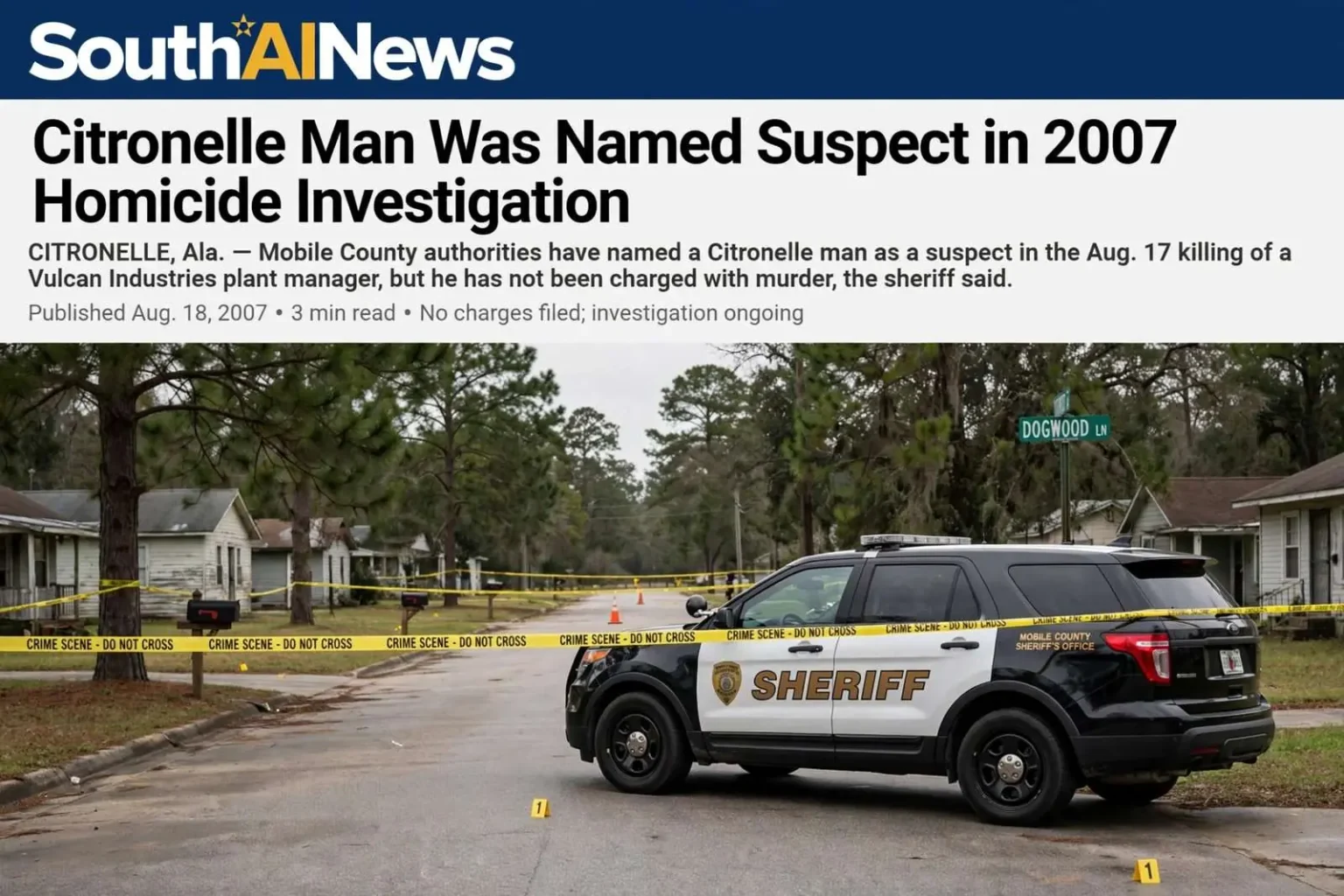
In 2007, Mobile County authorities named a Citronelle man as a suspect in the Aug. 17 killing of a Vulcan Industries plant manager, according to an archived local news report — an announcement that tied a small north Mobile County town to an investigation that stretched across workplace, neighborhood and financial threads.
The report said the victim was found shot inside a truck near his Dogwood Lane home, a discovery that turned a quiet Citronelle street into the focal point of a homicide investigation in a town where violent deaths are rare enough to register across the entire community.
Authorities stated at the time that the suspect was the victim’s neighbor and coworker, a doubling of connections that investigators said shaped the case from the start. In a town the size of Citronelle, where the Vulcan Industries plant was among the largest employers, the overlap of neighborhood and workplace was not unusual — but it gave detectives two separate webs of relationships to work through.
The sheriff said the man had not been charged with murder at the time of the report, an important distinction in a case where public suspicion had outrun the formal charges. Naming a suspect in a press conference and securing an indictment in a courtroom are different steps, and the report made clear which stage the case had reached.
The case as reported
The station also reported that the man had been charged separately with theft and making a false report to authorities, charges that existed alongside — but distinct from — the homicide suspicion. Those charges gave prosecutors a formal handle on a man whom investigators were still building a murder case against.
Investigators said they believed his account of an earlier attack did not add up and alleged that he had caused his own injury. That allegation became a hinge of the case as reported: a claim the man made about being attacked was, in investigators’ view, staged, and disproving it became part of the work of dismantling his account of events.
The report said deputies also alleged that money was taken from company funds, adding a financial dimension to the investigation that ran alongside the shooting itself. Detectives following the money trail were examining whether financial pressure or gain played a role in the killing, according to the archived coverage.
Vulcan Industries operated a manufacturing presence in the Citronelle area, and the killing of a plant manager touched both the company’s workforce and the wider community that depended on it. Employers of that scale in small towns are more than workplaces; they are civic anchors, and a manager’s violent death there resonated well beyond the company’s fences.
Citronelle and the investigation
Citronelle sits in the far northern reaches of Mobile County, a small city surrounded by timberland and oil fields whose distance from the urban core of Mobile shapes much of its character. The Mobile County Sheriff’s Office handles law enforcement there, and a homicide investigation of this profile would have drawn deputies, investigators and forensic resources from across the county.
For the sheriff’s office, the case combined several investigative threads at once: a shooting scene at a residential address, a workplace relationship to map, an alleged staged attack to disprove, and financial records to reconcile. Each thread involved different evidence and different specialists, and the public reporting of the period captured the case only as investigators were willing to describe it.
Homicide investigations in rural county jurisdictions move at the pace of their evidence. Without the surveillance density of an urban core, detectives in places like Citronelle lean heavily on interviews, physical evidence and financial records — the same materials the archived report referenced in describing the sheriff’s case against the man it named as a suspect.
The Aug. 17, 2007, killing remained, as of the archived report, an open question in the courts as well as in the investigation. A suspect named is not a defendant convicted, and the report’s careful language reflected the legal distance between the two.
Suspects, charges and the presumption of innocence
The case as reported illustrates how criminal allegations unfold in stages. Police and sheriff’s investigators name suspects when evidence points toward them; prosecutors file charges when they believe the evidence supports conviction; and courts determine guilt only after a trial or a plea. At the time of the archived report, the Citronelle man stood at an intermediate point — named as a suspect in the killing, formally charged with other offenses, and not yet charged with murder.
That distinction matters for readers of the historical record. The allegations reported in 2007 — the suspected staging of an injury, the claimed misappropriation of company funds, the suspicion in the plant manager’s death — were law-enforcement statements reported at the time, not findings of guilt, and the archived coverage itself noted that the man had not been charged with murder.
This historical article reflects law-enforcement allegations and charges reported at the time. It does not establish guilt or report any later court outcome. Names, charges and case statuses can all change after an initial report, and the archived coverage should be read as a snapshot of the investigation as it stood in 2007.
How such cases reach the public
The reporting trail in a case like this runs through the sheriff’s briefings and courthouse records. When a sheriff names a suspect at a press availability, local stations report the identification, the victim’s circumstances and the charges on file — and each subsequent development, from formal charges to court hearings, adds to the public record.
Archived reports like this one preserve that record for researchers, but they also freeze it at a moment. A case described in one month’s coverage may have moved substantially by the next — charges added or dropped, a suspect arrested or released, evidence that reframes the entire investigation. The 2007 Citronelle report is one frame of that film, valuable for what it documents and careful not to claim more.
The victim and the workplace connection
The killing of a plant manager occupies a particular place in the annals of workplace crime. Managers hold positions that combine authority, salary information, scheduling power and knowledge of a company’s finances — the very factors investigators weigh when a workplace connection surfaces in a violent case. The allegation that money was taken from company funds placed the financial relationship squarely in the center of the investigation as reported.
Vulcan Industries’ presence in the area gave the case its employment geography: a plant manager living on Dogwood Lane, a coworker and neighbor named as a suspect, and a company whose payroll and records became evidence in a murder investigation. The overlap meant that investigators’ interviews ranged across two settings — the plant floor and the neighborhood — in search of the same account of events.
The report that the suspect’s account of an earlier attack did not add up added a psychological dimension to the case as investigators described it. Allegations that a suspect staged an attack on himself are among the most consequential claims detectives can make publicly, because they convert the suspect’s own narrative into evidence against him — a framing the archived report preserved exactly as authorities stated it.
None of these allegations, as the report and this article emphasize, constituted a finding of guilt. They were the sheriff’s office’s account of where the evidence pointed in the late summer of 2007, reported by a local station and preserved in the archive this article draws from.
Reading historical crime coverage responsibly
Archived crime reporting serves researchers, genealogists and curious readers, but it carries obligations both for the original reporters and for anyone republishing it. Allegations must remain allegations; charges must be distinguished from convictions; and the passage of time must be acknowledged, because every case continues past its last report.
The 2007 Citronelle case as archived here follows that discipline. It names the victim’s circumstances — found shot inside a truck near his Dogwood Lane home — and the suspect’s connections, but it withholds the judgments that only courts can render, and it states plainly that the man had not been charged with murder at the time of the report.
For readers encountering the story for the first time, the honest summary is the one the record supports: Mobile County authorities in 2007 named a Citronelle man — the victim’s neighbor and coworker at Vulcan Industries — as a suspect in the Aug. 17 killing of a plant manager; he faced separate charges of theft and making a false report; investigators alleged he staged his own injury and that company money was taken; and the courts, not the coverage, would decide what came next.