A Mobile woman facing a manslaughter charge in connection with the 2013 shooting death of her boyfriend could resolve her case with a blind plea when she returns to court next month, according to her attorney. The possibility emerged during a brief hearing this week in Mobile County Circuit Court, where the case has been pending for more than a year.
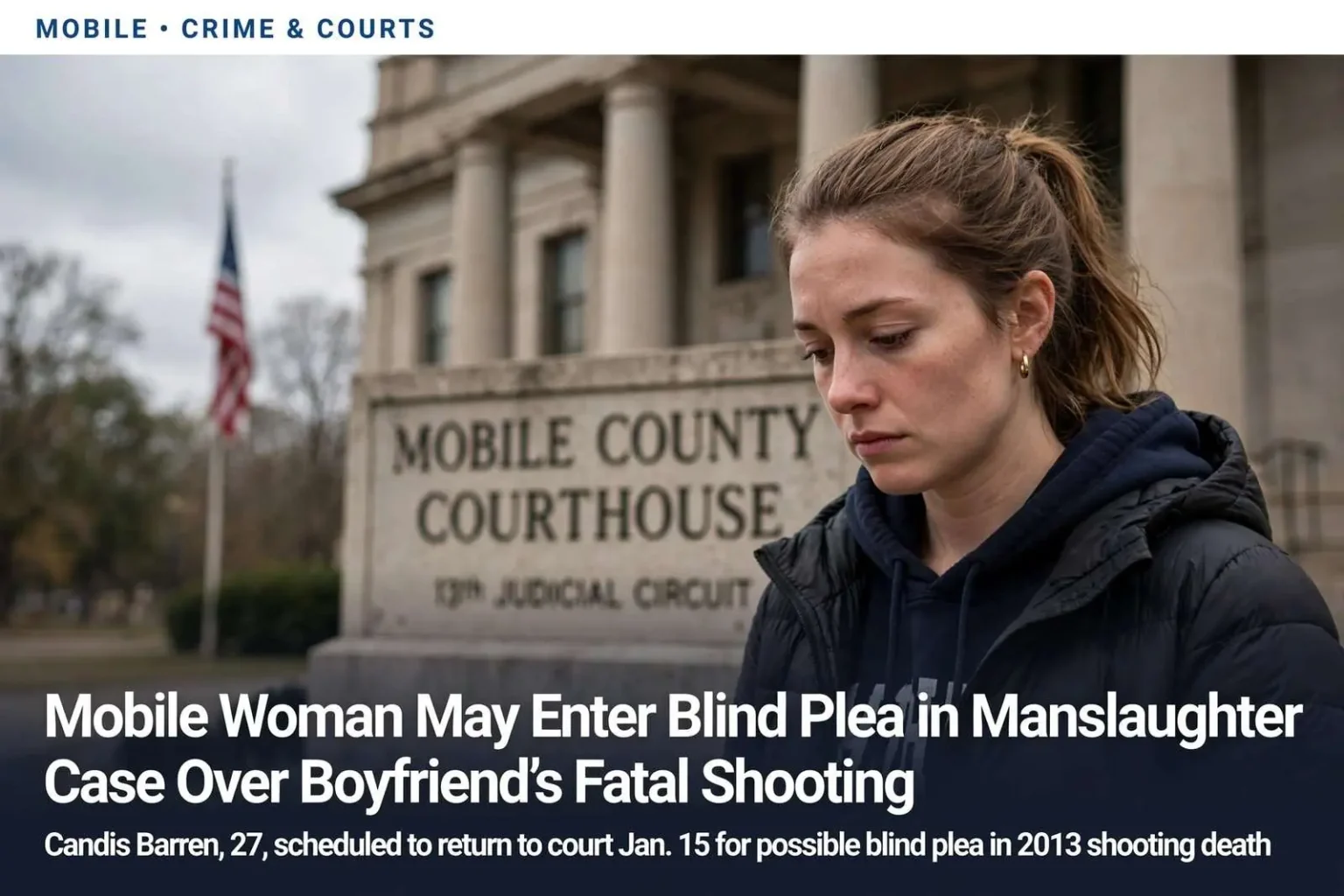
Candis Barren, 27, who lived in the 1400 block of Gulffield Drive, appeared briefly before Mobile County Circuit Court Judge Sarah Stewart this week. She is scheduled to return to court Jan. 15 to formally enter a plea on the manslaughter charge stemming from the September 2013 shooting.
Mobile police say Barren unintentionally shot 28-year-old Louis McMillian on Sept. 2, 2013, while handling a handgun in a reckless manner. The shooting occurred at a residence in Mobile and led to a manslaughter charge against Barren in the months that followed. No evidence in the case has suggested the shooting was deliberate, and the charge itself reflects that distinction between intentional and careless conduct.
What a blind plea means in an Alabama courtroom
A blind plea is among the least predictable paths a criminal case can take. In a typical negotiated resolution, prosecutors and the defense agree in advance on a recommended sentence, and the judge frequently adopts that recommendation. In a blind plea, by contrast, the defendant pleads guilty with no agreement at all: the state makes no sentencing recommendation, and the decision rests entirely with the judge after hearing from both sides.
That structure cuts both ways for a defendant. A person who believes the evidence against her is strong may prefer to plead and avoid the risk of a trial conviction on the same charge. At the same time, a judge weighing a blind plea retains the full sentencing range the law allows, unbounded by any promise the prosecution has made. The defendant gives up certainty on the front end in exchange for avoiding the greater uncertainty of a jury verdict.
Attorney Jason Darley, who represents Barren, described his client as deeply affected by the case. “She’s devastated about it,” Darley said outside the courtroom this week. “She’s distraught about it. She comes from a good family, great mother. It’s devastating to the family.”
Darley’s remarks, delivered as Barren’s court date approached, offered a rare public glimpse into the human weight such a case carries. A manslaughter prosecution arising from the death of a romantic partner places two families in the same courtroom, one grieving a loss and the other facing the prospect of prison for one of its own.
Darley said discussions between his office and the Mobile County District Attorney’s Office have been ongoing, but no formal plea agreement has been reached. If Barren ultimately enters a blind plea in January, prosecutors will not make a sentencing recommendation to the judge, leaving the decision entirely in the court’s hands.
“The (district attorney) and I have had meetings about it,” Darley said. “She has not agreed to anything yet. The state has not made an offer. Based on the evaluation of the evidence, we’re likely looking at possibly resolving it via blind plea.”
Darley’s description of the negotiations suggests the two sides have been unable to find middle ground on what an appropriate resolution should look like. In cases where prosecutors decline to make an offer, or where an offer is unacceptable to the defense, a blind plea allows a defendant to accept responsibility and take her chances with the court rather than face the expense, delay and risk of a jury trial. It also spares the victim’s family from having to relive the events of September 2013 in open court.
The manslaughter standard in Alabama law
Alabama’s criminal code treats manslaughter as a distinct offense from murder, and the difference turns on a person’s state of mind. Murder generally requires an intent to cause death or serious physical injury, or conduct showing extreme indifference to human life. Manslaughter, by contrast, applies when a death is caused recklessly — meaning the person was aware of and consciously disregarded a substantial and unjustifiable risk that death would result.
Because prosecutors have described the conduct in this case as reckless rather than intentional, the charge carries the classification of a Class B felony, which in Alabama is punishable by two to 20 years in prison. The gap between that range and the penalties for murder, which can reach life in prison, illustrates how much turns on the distinction. Handling a firearm carelessly and unintentionally causing a death is treated far differently under the law than shooting someone on purpose, even though the outcome — a young man’s death — is the same.
Judges in Alabama also have tools short of a straight prison term. Depending on the case, a sentence may be split so that a defendant serves part of the term in confinement and the remainder on supervised probation, or a court may suspend a sentence entirely and place the defendant on probation. The weight a court gives to those options varies with the facts of each case, the defendant’s background and criminal history, and the judgment of the presiding judge — which is precisely why the identity of the judge matters so much in a blind plea.
The case has moved through the Mobile County court system for more than a year, with this week’s hearing setting the stage for a resolution date in mid-January. Court officials confirmed the case remains assigned to Judge Stewart’s docket, with the manslaughter charge tied specifically to the September 2013 shooting.
Mobile County’s circuit court, part of Alabama’s 13th Judicial Circuit, is one of the busiest trial courts in the state, handling felony prosecutions from across the county. Once a felony case is assigned to a particular judge, it generally remains on that judge’s docket through plea or trial. That continuity matters in a case heading toward a blind plea, because the judge who accepts the plea is the same judge who will weigh and impose the sentence — with no agreement constraining either side.
Why reckless-homicide cases often move toward blind pleas
Manslaughter cases involving allegations of reckless rather than intentional conduct, as prosecutors have described in this case, often move toward blind pleas when both sides are unable to reach a negotiated sentencing agreement. The reason lies in the nature of the offense itself. In a case built on recklessness, the core facts are frequently not in serious dispute: what happened, how it happened, and who was involved. The dispute tends to center on what the conduct deserved.
When the defense sees a punishment at the lower end of the range and the prosecution believes a higher one is warranted, a negotiated plea can stall indefinitely. Rather than take that disagreement to a jury, which would have to sort through the same questions at far greater cost, the parties can hand it to the judge. A blind plea converts a factual and moral dispute into a sentencing decision, the kind of judgment courts are designed to make.
For defendants, the calculation involves real risk. Pleading blind means accepting a conviction with no assurance about the sentence, and a judge could impose the full term the law allows. But it also closes out the case months or years sooner than a trial would, and it removes the possibility of a conviction on a greater charge. For prosecutors, a blind plea still produces a conviction and a criminal record, even without the leverage of a negotiated recommendation, and it resolves the case without subjecting witnesses to cross-examination.
The dynamics are especially common in deaths arising from accidents involving firearms, vehicles or other dangerous instruments, where a moment of carelessness rather than a plan of violence produced the tragedy. Prosecutors in Mobile County and across Alabama handle such cases with an eye toward both accountability and the circumstances that separated the conduct from an intentional killing.
What to expect when the case returns in January
If Barren enters a blind plea on Jan. 15, the hearing itself is likely to be brief in form. The charge would be read, the plea entered on the record, and the judge would confirm that the plea is knowing and voluntary. The case would then move to sentencing — either immediately or after a presentence investigation ordered by the court. In Alabama felony cases, judges commonly order such an investigation before imposing sentence, giving the court a report on the defendant’s background, the circumstances of the offense and any prior record.
That process also opens the door for McMillian’s family to be heard. Victim impact — presented in writing or in person — is a standard part of sentencing hearings in Alabama, and judges routinely take it into account alongside the statutory range and the arguments of both sides. In a blind plea, that input often carries added weight, since the judge lacks a plea agreement to guide the decision.
The outcome of Barren’s January court date will determine what sentence, if any, a judge imposes in connection with McMillian’s death. The options range across the full span of Alabama sentencing law for a Class B felony: an unsuspended prison term of two to 20 years, a split sentence that divides time between confinement and probation, or a suspended sentence with supervised probation. Whatever the choice, it will rest on the court alone.
For now, the case remains pending on Judge Stewart’s docket, and Darley’s comments indicate both sides expect resolution without a trial. The January hearing will close out a case that has shadowed two Mobile families for more than a year — one mourning a 28-year-old man, the other awaiting judgment on a 27-year-old woman whose attorney says has been devastated by what happened. In a blind plea, neither side will have shaped the outcome by agreement; the decision, at last, will belong to the court.