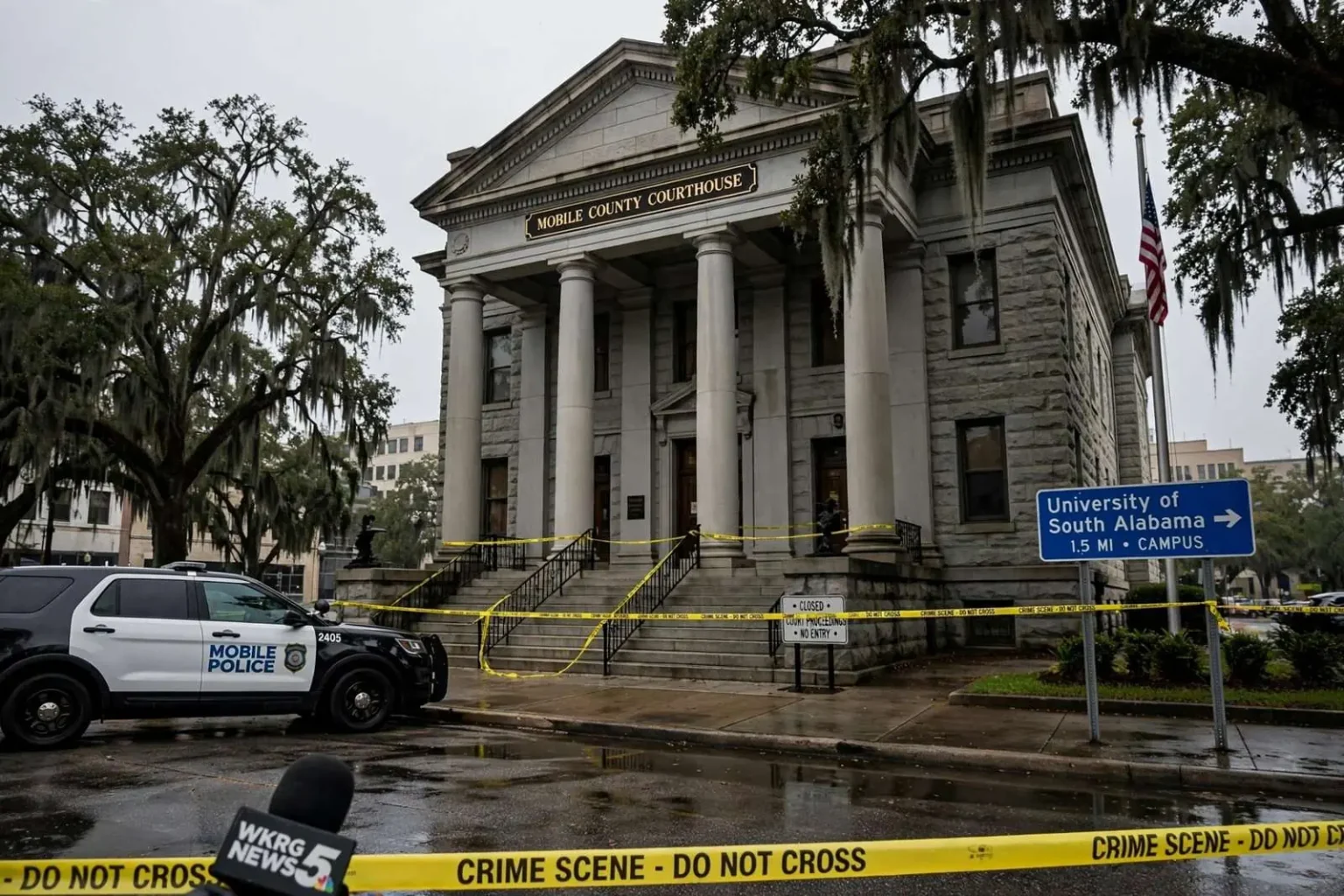
A Mobile man has been sentenced to life in prison after pleading guilty to a series of violent crimes that began with the abduction of a University of South Alabama student from a campus parking lot earlier this year. The resolution of the case closes one of the more alarming episodes of the year for the neighborhoods surrounding the university, where two violent incidents within a single 24-hour span had unsettled students and residents alike.
The Crimes and the Sentences
JaWaun Dawson, 24, who lived in the 8700 block of Stillwood Court, was sentenced earlier this week following a guilty plea entered last month. He admitted to charges of first-degree sodomy, first-degree sex abuse and first-degree robbery stemming from the April incident. A guilty plea spared the victim the ordeal of testifying at trial, but it also required her attacker to stand in court and admit, charge by charge, what he had done — an accounting that prosecutors in such cases describe as part of the justice the process is designed to deliver.
According to the Mobile County District Attorney’s Office, the victim was abducted at gunpoint on April 24 from a University of South Alabama parking lot. Campus parking lots occupy a particular place in the safety calculations of any university: they are large, they are necessarily open, and they connect the places students must go — cars, classrooms, apartments — with the places they want to feel safe. An armed abduction in broad daylight from such a lot was, for the university community, an intrusion of the most direct kind.
Prosecutors said she was forced to perform a sex act before being driven to nearby Municipal Park, where the assault continued. Her wallet was also taken during the attack. The sequence — abduction, assault, robbery — exposed her to every category of Alabama’s most serious felony statutes at once, and the charges Dawson admitted reflect each stage of what happened between the campus lot and the park.
A Mobile County judge sentenced Dawson to life in prison on both the robbery and sodomy convictions. He received an additional 10-year sentence on the sex abuse charge, with the sentences addressing the full scope of the April 24 attack near the university’s campus. First-degree robbery and first-degree sodomy are both Class A felonies under Alabama law, and a life sentence on each count means the sentences will run concurrently and effectively remove any realistic prospect of release.
A Second Crime, a Second Set of Sentences
The case did not end with the University of South Alabama incident. Prosecutors said Dawson was also connected to a break-in the day before, on April 23, when he forced his way into a woman’s apartment in the 100 block of East Drive. During that incident, an iPhone and an Xbox gaming console were reported stolen. The proximity of the two crimes — a day apart, both within the orbit of the campus and its surrounding neighborhoods — is what had made the pair so unsettling for residents keeping watch over their own streets while investigators worked.
Dawson pleaded guilty to first-degree robbery and first-degree burglary in connection with that case and was sentenced to an additional 20 years. First-degree burglary under Alabama law covers a dwelling entered by force while a person is or may be present — the most serious form of the charge, reserved for home invasions rather than empty buildings. The 20-year term stands separately from the life sentences, meaning that even in the unlikely event of any future relief on the life counts, the burglary and robbery terms would remain.
The Investigation That Followed
The University of South Alabama, along with Mobile police, had worked to identify a suspect in the weeks following the assault before Dawson was taken into custody. Campus police departments and municipal forces coordinate routinely on cases that cross their jurisdictional lines, and this one required it: the abduction began on university property and ended in city space, the apartment break-in fell to Mobile police, and the two cases had to be tied together before either could be presented as a whole.
The Mobile County District Attorney’s Office presented the case as part of a broader effort to hold violent offenders accountable for crimes targeting the university community. The district surrounding the campus — a mix of student apartments, older neighborhoods and commercial strips along University Boulevard and Old Shell Road — had been the focus of heightened attention after the April incidents, with students adjusting routines and campus police increasing visibility in lots and walkways while the search for a suspect continued.
Concern from students and residents in the area surrounding the campus was immediate and sustained, where the two incidents occurred within a day of each other. In the weeks that followed the arrest, the resolution of the case served as the answer to the question that had hung over the neighborhood since April — whether the person responsible would be found and held to account.
Why the Plea Resolved Everything at Once
Court records show the sentences were handed down together, resolving all of the charges connected to both the April 23 apartment break-in and the April 24 abduction and assault near the university. Global pleas of that kind are common in multi-victim, multi-count cases: they let the court impose one coherent set of sentences that reflects the full span of a defendant’s conduct, rather than litigating each incident separately over months of trials and appeals.
For prosecutors, the calculation is practical as well as moral. Two separate trials would have required two sets of witnesses, two rounds of testimony from victims, and two opportunities for the cases to end in uncertainty. A plea that resolves everything guarantees the outcome — life in prison — and spares the woman attacked on campus the experience of reliving the assault before a jury. In violent-crime prosecution, that certainty is often the objective, and it is why District Attorney’s Offices across Alabama will trade the possibility of a longer trial verdict for the guarantee a plea delivers.
The structure of the sentences also carries a message about how the justice system weighs such crimes. The life terms attach to the offenses involving the greatest violence; the additional terms — 10 years for sex abuse, 20 years for the burglary and robbery of a different victim the day before — ensure each victim’s case was separately accounted for in the final judgment, not folded into a single number.
The Context Around the Campus
The University of South Alabama sits in the heart of west Mobile, its campus bordered by residential neighborhoods and busy corridors that students share with the city at large. When a violent crime touches the campus, the effects rarely stop at the property line: apartment complexes tighten their lighting and locks, parents call their students, and campus police issue advisories that remain pinned to phones for weeks. University police and Mobile police both operate in that shared space, and cases like this one become a measure of how well that cooperation works under pressure.
The April 24 abduction also renewed familiar conversations about parking lot security — the lighting, patrols and camera coverage that universities weigh against open access — and about the practical advice that safety officials repeat after every such incident: walk in groups, stay in well-lit areas, and report anything suspicious immediately. None of it changes what one victim endured, but it is the residue such cases leave in a campus community’s daily habits.
Officials with the District Attorney’s Office noted that the life sentences reflect the severity of the crimes and are intended to ensure Dawson does not pose a further threat to the community. With the plea entered and all sentences imposed, the case moves to the correctional system, where the terms will be served — and the two April days that began with an armed abduction and a home invasion end with a single, decisive accounting in a Mobile County courtroom.
A Case That Stayed With the Neighborhood
Long after the headlines move on, the effects of a case like this one remain part of the neighborhood’s story. Residents in the blocks around the campus learned the details as they unfolded — the strangled silence of the parking lot that morning, the search that followed, the knock of detectives on doors along East Drive — and the resolution of the case, months later, offered the first real closure many of them had been waiting for since April.
The case also stands as an example of how the pieces of the criminal justice system fit together when they work as designed. Campus police preserved the scene and canvassed witnesses; Mobile police connected the apartment break-in and pursued leads across jurisdictional lines; the District Attorney’s Office assembled the two incidents into a single prosecutable case; and the court, through a guilty plea and a single sentencing hearing, imposed a punishment matched to the whole of the conduct rather than a fraction of it. Each handoff was a place where the case could have stalled. It did not.
For the victim, the sentencing hearing closes a chapter that began with a gun in a campus parking lot. Prosecutors and victim advocates will tell you the hearing is rarely the end — recovery from an assault of this kind runs on its own clock, in counseling sessions and in the ordinary courage of returning to a parking lot at night — but the certainty of a life sentence removes from her future the one thing she could not control: the possibility of her attacker walking free.
For the university community and its neighbors, the message of the resolution is the one officials emphasized when announcing the outcome: that crimes committed against students will be investigated across jurisdictional boundaries, prosecuted to the full extent of the law, and punished in a way that reflects the harm done. The April incidents tested that commitment; the sentences delivered this week, in a Mobile County courtroom, answered it.