Orange Beach Weighs New Deal to Keep SEC Soccer Championship
Orange Beach officials are considering sportsplex lighting upgrades in hopes of continuing to host the SEC Women's Soccer Championship beyond 2015.
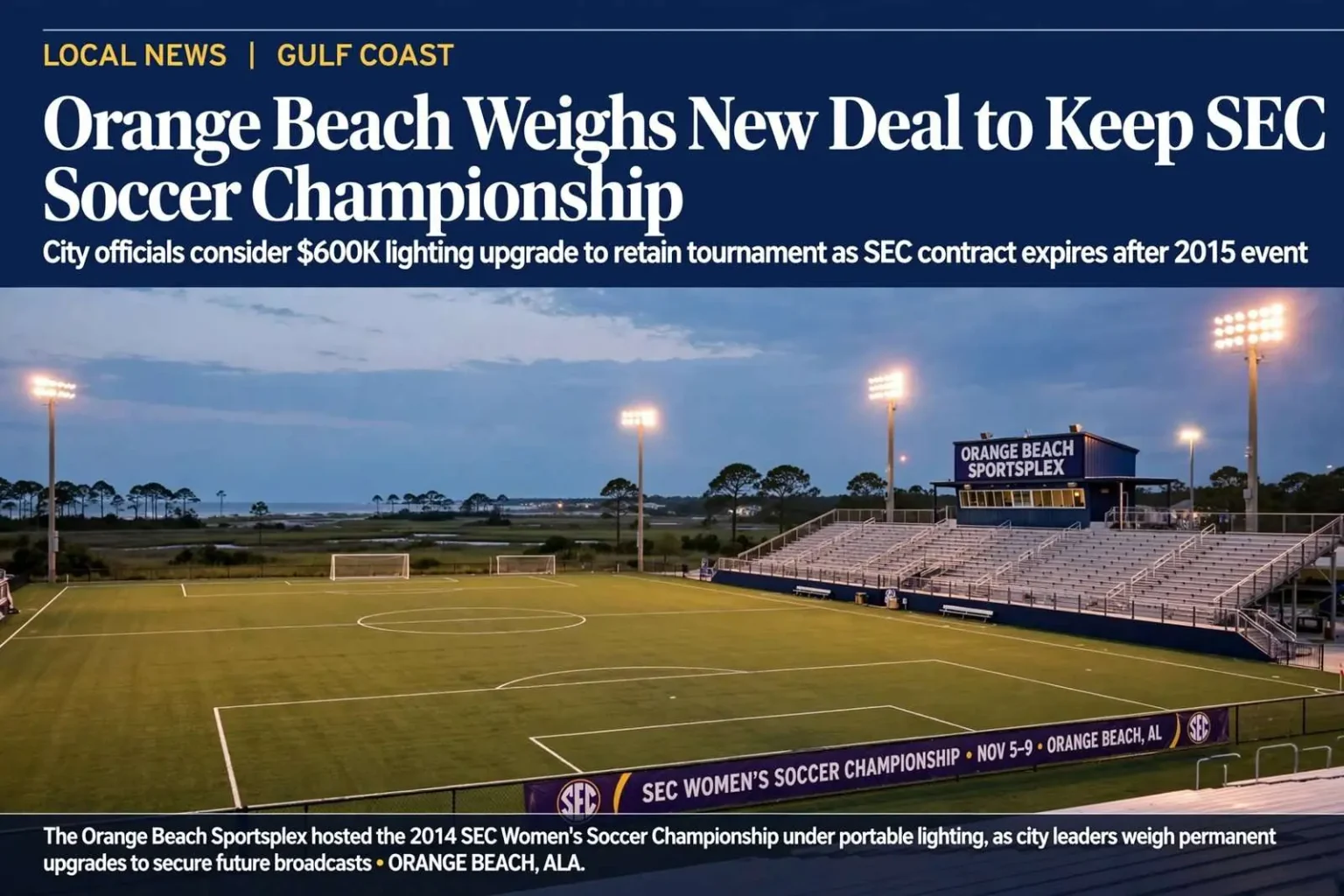
Orange Beach officials are weighing what it will take to keep one of south Baldwin County’s most reliable tourism draws in town beyond next year, as the city’s contract to host the Southeastern Conference Women’s Soccer Championship nears its end. City Administrator Ken Grimes and Gulf Shores & Orange Beach Tourism President and CEO Herb Malone briefed the City Council this month on the tournament’s economic impact, arguing that continued investment in the Orange Beach Sportsplex — particularly stadium lighting — will be critical to retaining the event after the current agreement runs out following the 2015 tournament.
The message to the council was straightforward: the tournament has become exactly the kind of event the city spent years trying to attract, and keeping it will require the sort of capital spending that other competing destinations are already making. With the contract clock ticking, the briefing set up a budget-season decision on whether Orange Beach will upgrade its flagship sports facility or risk losing a national television showcase to a city better equipped for it.
Numbers That Get a Council’s Attention
The numbers presented were substantial for a single annual event. Tourism officials say the tournament has generated roughly 3,700 hotel room nights and more than $1 million in direct visitor spending since Orange Beach began hosting it a decade ago, with 2014 alone accounting for nearly $200,000 in direct spending — about double the prior year’s total. For an event that lasts only a few days, those figures rank among the strongest returns of any annual booking on the city’s sports calendar.
Hotel room nights are the currency of destination marketing, because visitors who sleep in a city eat in its restaurants, shop in its stores and buy fuel at its stations before they leave. A tournament that fills rooms during a shoulder season, when the beaches are empty and restaurants are staffing down, multiplies the value of each dollar spent. City officials have long treated sports tourism as a way to smooth out the dramatic seasonal swings that define the Gulf Coast economy, and the soccer championship has become one of the anchor bookings that makes that strategy work.
Much of the recent growth, Malone told the council, stems from an expanded broadcast partnership between the SEC and ESPN. For the first time this year, every game in the 10-team tournament was shown live, with early-round matches airing on the SEC Network and the championship game broadcast on ESPNU to a potential audience of 87 million homes nationally. What had once been a regional sporting event with modest coverage has become a nationally televised production, and the trajectory points upward as the conference’s broadcast arrangements mature.
That broadcast exposure, Malone argued, is worth far more to the city’s profile than the direct tourism dollars alone. A national audience watching matches played against a backdrop of the Alabama coast sees the destination itself, not just the scoreboard — the kind of advertising that no tourism budget could purchase outright. Convention and visitors bureaus across the country have learned to price that exposure, and Malone’s pitch to the council leaned on the argument that the camera time alone justifies protecting the event.
The Timing Is Part of the Value
He noted the tournament falls during a traditionally slow week for the Gulf Coast tourism industry in early November, making it valuable both for filling hotel rooms in the off-season and for showcasing the area on a national stage. November along the Alabama beaches is a quiet month by design: the summer crowds are gone, condo occupancy drops, and businesses that depend on visitor traffic tighten their schedules. An event that brings teams, families and fans to town in that window delivers revenue precisely when the market has none to spare.
The off-season timing also changes the calculus for the city’s hospitality businesses. A summer weekend fills rooms regardless of what is booked, because demand does the work on its own. Early November is different: restaurants that might trim hours that week instead add staff, and hotels that would otherwise discount deeply can hold rates closer to in-season levels. Those margins, spread across a decade of hosting, explain why local operators have come to count on the tournament as a fixture of the fall calendar.
The Lighting Catch
The expanded television coverage, however, comes with a catch: HDTV production requires brighter, more consistent lighting than the sportsplex currently offers. City crews brought in portable lighting to accommodate this year’s broadcast, but officials say a permanent upgrade — similar to the roughly $600,000 track-and-field lighting project completed at the Gulf Shores sportsplex in 2013 — may be needed to keep hosting major broadcast events.
Portable rigs solve the problem for a single weekend, but they cost money to rent every year, require setup time, and cannot match the evenness of a permanent installation. Broadcast engineers need consistent light across the entire field to avoid shadows and glare on camera, and as tournaments grow in production value, the tolerance for makeshift arrangements shrinks. The Gulf Shores project two years earlier demonstrated both the price tag and the payoff of doing the work permanently, and it gave Orange Beach a ready-made benchmark for what its own upgrade would look like.
The Orange Beach Sportsplex has served as the city’s hub for competitive athletics since it opened, hosting youth and adult tournaments across soccer, softball and other field sports throughout the year. Facilities like it form the backbone of the Gulf Coast’s sports tourism economy, which has grown into a significant year-round segment for south Baldwin County. Neighboring Gulf Shores’ own investments in sports infrastructure have shown how quickly a well-equipped complex can climb the rankings of regional tournament destinations, and the two cities have often found themselves competing for — and sometimes sharing — the same events.
No Budget Yet, But the Clock Is Running
Council members did not commit to a lighting budget following the presentation, but Grimes said city staff would continue evaluating options as the current SEC contract’s expiration approaches. That non-commitment is typical of the council’s budget process, in which capital projects are weighed against paving, drainage, public safety and beach-nourishment needs before any spending plan is adopted. The presentation was designed to start that conversation early, so that a funding decision could be made before the final year of the contract slips away.
The stakes of the decision extend past a single soccer tournament. Cities that let broadcast-quality facilities lag behind increasingly lose events not to distant competitors but to close ones — municipalities within the same region that invested earlier and can promise producers a turnkey setup. Malone’s argument was essentially that Orange Beach has built a decade of credibility with the SEC and ESPN, and that credibility is only worth maintaining if the physical venue can keep pace with what the broadcasts now require.
Officials say a strong track record with the soccer tournament has also helped position south Baldwin County to attract other college-level athletic events to the area. Conference administrators talk to one another, and a smooth, well-attended, well-televised championship in one sport is the best possible reference when another sport’s staff scouts potential hosts. That spillover effect — one event serving as a gateway to others — is the quiet engine behind much of the region’s sports tourism growth, and it is the part of the pitch that a simple hotel-room-nights figure cannot capture.
What Comes Next
For now, the sequence is set. City staff will develop lighting options and cost estimates, the council will consider them during its budget deliberations, and tourism officials will keep the conference informed about the city’s intentions. The current agreement runs through the 2015 tournament, which means the city has a limited window to demonstrate that its facility can meet the production standards the broadcast partnership now demands.
If the investment is made, Orange Beach would enter contract negotiations with a facility matching or exceeding what competitors can offer, and a decade of successful hosting to point to. If it is not, the city risks learning what many destination communities have learned the hard way: that national broadcast partners are loyal to quality venues, not to host cities, and that the events most worth keeping are the ones that require the most from the infrastructure beneath them. The council’s decision in the coming months will determine which of those lessons Orange Beach learns firsthand.
Regional context helps explain why the conference relationship matters so much to a city of Orange Beach’s size. The Southeastern Conference draws member institutions from across the South, and its championship events rotate among host communities that can guarantee facilities, lodging and organizational support. Baldwin County’s beach towns have spent the better part of two decades building exactly that portfolio, adding facilities and staff with an eye toward the growing market for amateur and collegiate sports travel. Hosting an SEC championship — with its built-in television inventory and its guaranteed ten visiting fan bases — represents one of the highest-profile bookings any community of this size can land.
The economics of retention also favor acting before the contract lapses. Conference officials evaluating host bids weigh everything from field quality and locker rooms to media work areas, parking and the reliability of local operations. A city that arrives at the negotiating table with a finished lighting upgrade presents a fundamentally stronger bid than one promising to complete the work later, and hosts that wait too long often discover the event has already accepted an invitation elsewhere. Grimes’ deliberate pace — evaluate first, then bring options to the council — reflects an attempt to balance those pressures against the city’s broader capital needs.
Residents, meanwhile, get a different share of the benefit. Tournament weeks bring visitors whose spending supports local payrolls well beyond the hotels, from the restaurants along the Perdido Beach Boulevard corridor to the grocery stores and service businesses that serve visiting teams. The visibility of a nationally televised event also reinforces the city’s brand with prospective summer visitors, the audience tourism officials spend the rest of the year trying to reach. Those secondary effects rarely show up in a single year’s ledger, which is precisely why advocates argue the spending decision should be judged over the life of the relationship rather than one tournament at a time.