
Four Mobile Natives Raise $61 Million to Buy Up Distressed Gulf Coast Real Estate
The Gulf Coast Opportunities Fund, formed by four Mobile natives, quickly raised $61 million to acquire distressed beachfront and land across Baldwin County and the wider Gulf Coast.
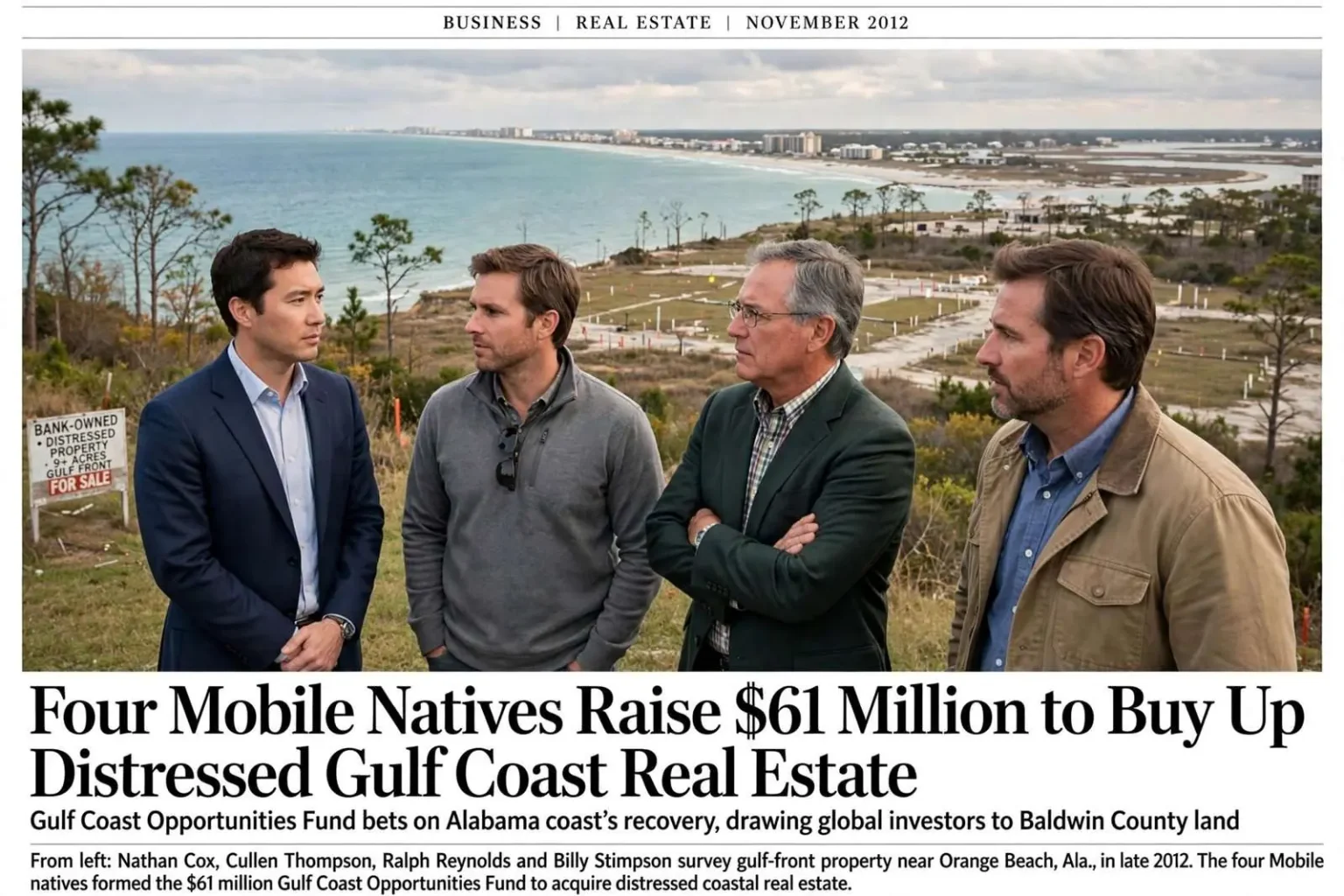
Four Mobile natives set out to buy distressed properties on their home turf and, in a matter of months, raised $61 million to do it. The Gulf Coast Opportunities Fund, formed by Bienville Capital Management principals Ralph Reynolds, Cullen Thompson and Billy Stimpson, along with member Nathan Cox, drew investors from around the world to a bet on the Alabama coast’s recovery. By late 2012, with Baldwin County still working its way out of the wreckage of the national real estate collapse, the fund had become one of the most closely watched private efforts to put capital back into the ground along the Gulf.
The premise was simple and, to the partners, deeply personal. Prices for coastal property had fallen to levels that seemed unthinkable before the housing crash, while the underlying attractions of the region — the beaches, the schools, the growing population — remained intact. The partners believed the gap between perception and reality would not last, and they built a fund designed to buy quality assets before the market closed it.
A fund built on local knowledge
All four partners were graduates of UMS Preparatory School in Mobile, and their combined resumes read like a tour of Wall Street and international real estate. Bienville Capital Management, the New York-based firm behind the fund, gave them an established platform for sourcing and structuring deals, but the partners said the real edge was familiarity: they had grown up on the bay, watched the coast grow, and understood which parcels sat where the region was headed rather than where it had been.
By late 2012, roughly 44 percent of the $61 million had been invested in raw land, beachfront property and subdivision lots, most of it bank-owned or short-sale deals. About $20 million had gone into Baldwin County alone, with the partners also eyeing the Florida Panhandle and the Mississippi coast. The purchases clustered around the kinds of assets that banks had repossessed in volume after 2008: unfinished subdivision entries, gulf-front tracts abandoned by failed condo developers, and approved lots that had sat unsold through the downturn.
Thompson, 35, who kept homes in Baldwin County and New York, said about 70 percent of the fund’s investors were new relationships drawn from across the globe. The group had aimed to raise $50 million and capped the fund at $61 million even as more investors sought to participate. The oversubscription, the partners said, reflected how unusual it was to offer outside investors a professionally managed way into a market they could not easily buy into on their own.
Cox, who led some 30 tour groups from Mexico to Canada as part of the fundraising effort, said nearly everyone who visited ended up investing, floored by the values and cost of living they found. The tours doubled as due diligence trips: investors walked the beaches, toured the subdivisions and saw the scale of the recovery for themselves before committing capital. Many arrived expecting a battered post-storm landscape and left describing a coast that looked, functionally, like it had never stopped growing.
Bargains at a fraction of peak prices
The fund’s strategy was to acquire quality assets at steep discounts and hold them for the next development cycle. Cox said research showed some targeted properties had fallen 60 to 90 percent from their 2006 peaks, and that he had bought some land at 1995 prices. Every purchase, he said, came with two or three plans attached — exit strategies that ranged from resale to development to long-term holding, so that no single parcel’s fate depended on one outcome materializing.
Among the marquee deals, the fund paid $9.7 million for more than nine acres of gulf-front property near the Hampton Inn & Suites in Orange Beach, land that included 855 feet of frontage on the water. That parcel had been part of a 15.8-acre tract, appraised at $154 million in 2007, that was to have become Mandalay, a 500-unit condominium project, before lenders foreclosed in 2008. The distance between the boom-era appraisal and the fund’s purchase price became, in effect, a shorthand for the entire market: the same sand and water that had carried nine-figure expectations at the peak was changing hands for pennies on the dollar.
In a separate transaction, the fund paid $6.15 million for a five-acre lot with 333 feet of gulf frontage in Orange Beach, once slated for a $100 million resort hotel and convention center. Like the Mandalay tract, the site represented a project whose financing had evaporated in the crash, leaving lenders holding land they had no interest in developing themselves. Deals of that shape — permitted, fronted on the gulf, and priced far below replacement cost — were precisely the ones the fund was organized to find.
The Orange Beach purchases also illustrated the geography of the opportunity. The city had rebuilt rapidly after Hurricane Ivan in 2004 and Hurricane Katrina in 2005, and its condo and resort inventory had recovered physically even as the financing market that had fueled the boom collapsed. That combination — improved infrastructure and amenities on the ground, distressed ownership on paper — was what made gulf-front parcels available at prices the partners considered generational.
Selling the region as much as the real estate
Reynolds, 50, who split time between Darien, Connecticut, and homes in Point Clear and Magnolia Springs, said the fund had already turned away significant additional investment after reaching its cap. Investors, many of them institutions or overseas buyers, conducted extensive due diligence and visited the coast before committing, with some putting in as much as $3 million to $5 million apiece. The partners said the willingness of outside capital to go through that process — rather than simply wiring money on a pitch — said something about how credible the recovery story had become.
The fund earned early notice from Grant’s Interest Rate Observer, which highlighted Baldwin County’s resilience, noting the county had grown 29.8 percent between 2000 and 2010, far outpacing statewide growth, despite the BP oil spill and hurricanes Ivan and Katrina. For an investment publication to single out the county was notable precisely because the decade had thrown everything at it: two major hurricanes, the deepest housing bust since the Great Depression, and the 2010 oil spill that threatened the very beaches the fund was buying around. Population had kept arriving anyway.
“We were selling the area as much as the real estate itself,” Reynolds said. The pitch to investors, the partners acknowledged, was only partly about individual parcels. It was about Baldwin County’s trajectory — schools, beaches, and a low cost of living that continued to draw retirees and families from elsewhere — and about the proposition that a coast that keeps gaining residents will eventually revalue its land.
What the money means for the coast
For Baldwin County residents, the arrival of institutional capital in the distressed-property market cut both ways. On one hand, buyers with patience and plans meant that bank-owned subdivisions and weed-filled lots would not simply sit and deteriorate; parcels acquired by the fund were expected to be maintained, and eventually improved or resold to builders. On the other, the purchases signaled that the steepest discounts of the post-crash years were being claimed, and that residents waiting for prices to fall further were likely to see the floor rise instead.
The fund’s focus on raw land and lots rather than finished condos also reflected a judgment about how the next cycle would unfold. Rather than betting on a quick return of the high-rise boom that had produced the Mandalay proposal, the partners positioned the fund to supply land to whatever form of development eventually returned — smaller projects, single-family subdivisions, or resort concepts scaled to what lenders would actually finance.
The timing question hung over everything. The partners were, in effect, wagering that the coast’s recovery would run on a lag: population and tourism had already come back, but private development capital had not, and the space between those two recoveries was where the fund’s returns would be made. Local officials, for their part, generally welcomed sophisticated buyers into a market that had been dominated by foreclosures and stale listings, since every bank-owned parcel that changed hands moved a step closer to the tax rolls and to productive use.
Targets and expectations
The partners aimed to double or triple the fund’s value over three to six years while targeting an annual return of about 8 percent for investors, confident, as Cox put it, that their timing was as perfect as it could be. The combination — a modest annual payout target alongside a large potential capital gain — mirrored the structure of the bet itself: hold the land, collect what income it could produce, and wait for the development cycle to return.
Whether the fund’s purchases proved brilliant or merely early, the enterprise stood as a measure of how far the Gulf Coast real estate conversation had traveled since 2006. A few years earlier, the story of the Alabama coast had been nine-figure condo towers and record appraisals. By late 2012, it was Mobile natives raising money around the world to buy the remnants of that era at a discount, betting that the fundamentals — beaches, growth, geography — would outlast the bust that had temporarily buried them.
The partners declined to detail future plans for specific tracts, but the pattern was clear in what they had already bought: gulf frontage in Orange Beach, subdivision lots across Baldwin County, and land positioned along the corridors where the county’s growth was already flowing. For a region that had spent the better part of a decade absorbing shocks, the sight of four hometown investors capping a global fundraising effort at $61 million to buy in — not out — was, for many residents, its own kind of signal about where the coast was headed next.


