
An Orange Beach Developer Takes On Jo Bonner, and the Oddsmaker Is Unimpressed
Peter Gounares, 35, announced a Republican primary challenge to U.S. Rep. Jo Bonner, arguing the incumbent had abandoned fiscal conservatism. Mobile oddsmaker Danny Sheridan called the newcomer a huge underdog.
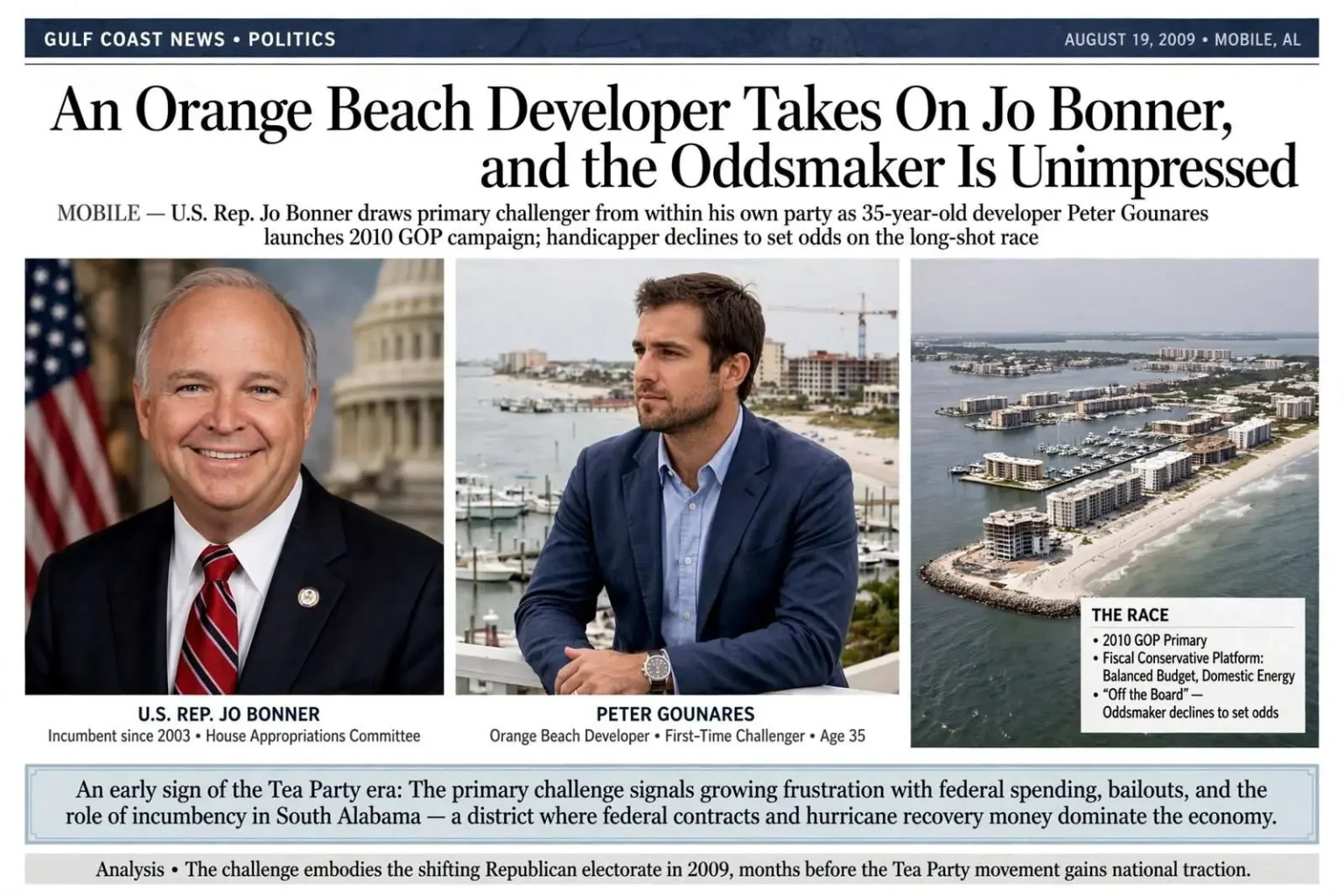
MOBILE – U.S. Rep. Jo Bonner drew a challenger from within his own party this week, and the most quoted handicapper in Alabama promptly declined to give the challenger a price.
The challenge came from Peter Gounares, a 35-year-old Orange Beach developer and political newcomer, who announced plans to run against Bonner in the 2010 Republican primary for Alabama’s 1st Congressional District. Gounares argued that the incumbent did not represent true Republican values of fiscal conservatism. His platform called for a balanced federal budget, increased energy exploration within the United States and climate policies “based on sound science, not media hype.”
An argument ahead of its time
It was, in its way, an early sighting of an argument that would soon reshape Republican politics nationally. The complaint that congressional Republicans had spent too freely under President George W. Bush – on the prescription drug benefit, on the bank bailout – was about to find organized expression in the Tea Party movement, and a primary challenge from the right would become a routine hazard of incumbency.
In the Gulf Coast district, the timing had particular resonance. The 2009 stimulus fight, the auto bailouts and the bank rescue had left conservative voters in south Alabama openly angry about Washington’s spending, and a developer from Orange Beach standing up in his own party’s primary to make that case was a preview of what was coming for incumbents everywhere. What was still novel in the summer of 2009 would be commonplace within a year.
Gounares’s profile made the challenge unusual in other respects. Orange Beach had been rebuilt after Hurricane Ivan and again after Hurricane Katrina by developers willing to take risks on the barrier island, and Gounares spoke the language of balance sheets and budgets rather than the usual rhetoric of a first-time candidate. At 35, he was a generation younger than the incumbent and openly framed the race as a question of what the party stood for rather than a quarrel over a single vote.
The oddsmaker’s verdict
Danny Sheridan, the Mobile-based oddsmaker and political and sports analyst whose lines were quoted nationally, was asked to assess the matchup. He would not post one. A Bonner-Gounares race, Sheridan said, would be “off the board.”
Gounares, he added, was a “huge, huge underdog.” Sheridan’s assessment reflected the obvious. Bonner had held the seat since 2003, had inherited the organization of his predecessor and former boss Sonny Callahan, and sat on the House Appropriations Committee – a perch that mattered enormously in a district whose economy leaned on federal shipbuilding contracts, hurricane recovery money, port improvements and, above all, the aerial refueling tanker competition that could bring an Airbus assembly line to Mobile.
The Callahan inheritance deserves its own weight in the accounting. Sonny Callahan had held the district’s seat for nearly two decades, first as a Democrat and then as a Republican, and built a political operation — donors, county chairs, civic connections — that he effectively handed to his former aide. Bonner ran in 2002 as the endorsed continuation of that operation and won easily, and no primary challenger since had come close to loosening the grip.
The Appropriations seat, meanwhile, was the practical reason the district tolerated incumbency. From shipbuilding work along the Mobile River to the federal reimbursements that followed every hurricane season, the 1st District’s economy was braided through with federal spending, and a congressman with a committee seat that steered it was an asset no primary opponent could match with rhetoric.
Bonner’s own pitch
Bonner, for his part, spent the week making an economic argument of his own. Speaking to the West Mobile Rotary Club, the congressman said a five-year moratorium on the capital gains tax would deliver a genuine boost to the economy through means tried and true – unlike, he argued, the 1,000-plus-page, $787 billion stimulus plan President Barack Obama had just signed.
That position placed Bonner squarely with the rest of the Alabama congressional delegation, which had largely opposed the stimulus. It also raised an awkward local question, one being asked openly in Mobile political circles: whether the delegation’s opposition to the administration’s spending would cost the area leverage when the Pentagon finally awarded the tanker contract.
The tanker competition was, by common agreement, the biggest economic prize the region had ever chased. A win would mean an assembly line, thousands of jobs and a permanent aerospace industry in Mobile; a loss would mean watching the future go elsewhere. And because the award would come from a Democratic administration, every vote Bonner and his colleagues had cast against the stimulus now carried a potential price — the central tension of his week, with Rotary on Monday and the primary challenge on his right all the while.
Bonner’s answer to that tension was the one Appropriations incumbents have always given: seniority delivers, and the moratorium-on-capital-gains argument played to the same fiscal audience Gounares was courting. The congressman was, in effect, running against the stimulus from the safe side of a primary he had not yet formally been forced to run in — pre-empting the challenge by outflanking it.
What the race meant
Primary challenges from the right rarely succeeded in 2010 against incumbents as well-financed as Bonner. But their existence changed behavior, pulling incumbents toward harder positions and making cooperation with a Democratic administration politically expensive – even, as in Mobile’s case, when the cooperation might have paid for itself in jobs.
That was the real significance of Gounares’s announcement, and the reason political observers paid attention despite the odds. A district that needed an Airbus deal, a new class of Navy ships and a steady stream of hurricane money needed a congressman who could work with whoever held the White House. A primary electorate primed to punish that cooperation was a structural problem no single election would settle.
Gounares’s candidacy was, on its face, a long shot that a professional oddsmaker declined to price. As a signal of where the Republican electorate was heading, it was worth more attention than the odds suggested.
The 1st District itself explained why the signal mattered. Stretching from Mobile’s port and shipyards down the Baldwin County beaches and across the wire-grass counties toward the Florida line, it was among the most reliably Republican seats in Alabama — which meant the primary, not the general election, was where its politics were actually decided. A candidate who could move that electorate, even without winning, moved the incumbent.
For Bonner, the calculation was straightforward. He had won the seat in 2002 and held it since without serious trouble, and his committee position gave him a fundraising edge no newcomer could approach. But incumbents across the country were learning that same summer that the energy in Republican primaries had shifted to voters who were angry first and pragmatic second, and who were willing to test everyone, everywhere.
Mobile’s version of that test came with a twist the rest of the country did not have: the tanker. The community that stood to gain most from a Democratic administration’s decision had a congressman committed to fighting that administration’s agenda. Gounares’s challenge forced the question early — would the district’s voters reward the fight or the leverage? — and whichever way they answered, the race that Danny Sheridan would not price had already done its work.
The money question framed it from the other side. A balanced-budget amendment, expanded domestic energy exploration and a leaner federal government — the core of Gounares’s platform — sound abstract in most districts, but along the Gulf Coast every one of them lands close to home. Federal contracts fund the shipyards, federal insurance maps shape the coast, federal disaster declarations arrive after every storm, and federal tax policy drives the development market a candidate like Gounares worked in daily. A primary debate about the size of government was, locally, a debate about the region’s single largest employer: Washington.
Whatever the voters ultimately did, the episode offered a small lesson in how political eras announce themselves. No professional gambler would take the bet, and few expected the newcomer to survive the June primary. But the themes Gounares carried into the race — spending, bailouts, the party’s identity — were the same ones that would dominate Republican politics for years afterward, and south Alabama’s role as an early proving ground for them was set the week an oddsmaker looked at the matchup and, for the first time in his career, refused to name a number.
Sheridan, for his part, had built a national reputation doing exactly that — pricing what others would only guess at — and his refusal carried its own weight in a town that followed both politics and point spreads. When the oddsmaker said off the board, Mobile heard it as a verdict: this race was not about whether the challenger could win, but about what his challenge would cost the man already holding the seat.


