Seventeen Months After Herman Thomas Left the Bench, Mobile’s Courts Still Wait for Answers
Seventeen months after Herman Thomas resigned from the Mobile County circuit bench and ended his ethics trial, he has not been charged, the allegations remain untested, and the criminal investigation has produced no public result.
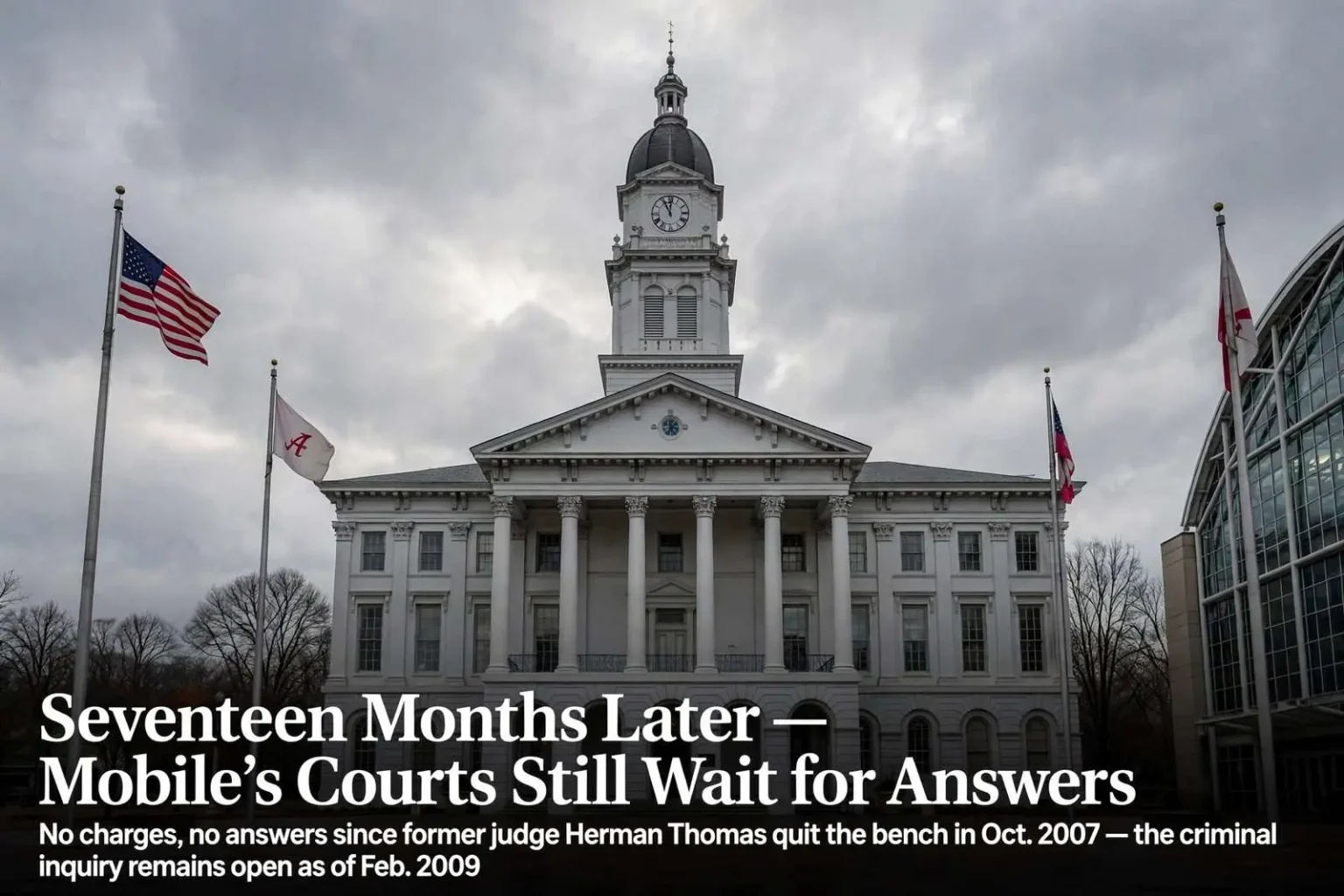
MOBILE, Ala. — Seventeen months have passed since Herman Thomas quit the Mobile County Circuit Court bench, and none of the questions that forced him out has been answered by any court or agency.
Thomas resigned late on Monday, Oct. 1, 2007, less than a month before he was due to stand trial before the Alabama Court of the Judiciary on ethics charges brought by the state Judicial Inquiry Commission. The resignation ended the disciplinary case. It did not end the investigations, the rumors around the courthouse, or the demands from some lawyers and judges for a full public accounting. As of late February 2009, Thomas has not been charged with any crime. He continues to practice law in Mobile, and the criminal inquiry that District Attorney John Tyson Jr. confirmed at the time of the resignation has produced no public result.
How the case began
Thomas’s troubles started with a relative. His cousin and Kappa Alpha Psi fraternity brother, then-school board member David Thomas, was sentenced by Circuit Judge Rusty Johnston to seven days in jail for leaving the scene after running over a child’s foot on Mardi Gras Day 2005. David Thomas ended up serving the time in the Prichard city jail, which was much less crowded than the Mobile County Metro Jail. Herman Thomas was widely reported to have helped arrange the move, and the episode became front-page news. Thomas then asked the Judicial Inquiry Commission to look into his own conduct, apparently expecting to be cleared.
The commission instead brought charges. In March 2007 Thomas was suspended with pay. The charges accused him of letting family, social and political relationships influence his judicial conduct, of improperly helping relatives and friends with legal matters, and of taking cases from other judges without permission in order to change defendants’ legal status or reduce their sentences. Lagniappe has since obtained a list of 356 cases Thomas transferred from other judges’ dockets. The list does not show the charge in each case.
The disciplinary case also touched on more disturbing reports: that Thomas took male inmates out of the jail, brought them to a small private room in the courthouse and spanked them. When he resigned, his attorney Dave Boyd said, “Judge Thomas categorically denies all of that.” Thomas’s own statement was narrower: “While I do not believe that I ever intentionally violated any canon of judicial ethics, I recognize that the controversy surrounding me has been disruptive.”
Why resignation ended the ethics case
The Court of the Judiciary can reprimand, suspend or remove a sitting judge. Once Thomas left office, removal, the most serious penalty available, no longer meant anything, and the commission lost jurisdiction. The trial set for Oct. 29, 2007, never happened. No witnesses testified under oath and no findings were made.
Peggy Groves, assistant director of the Judicial Inquiry Commission, has said that whatever a judge may have done, the commission has no authority to continue once the judge resigns. That was true even though, according to Lagniappe’s reporting, fellow Circuit Judge Rusty Johnston had given the commission a signed affidavit describing sexual allegations against Thomas. When Thomas resigned, the commission’s inquiry stopped.
The seat moved on; the questions didn’t
The courthouse filled the vacancy quickly. A screening committee chaired by Presiding Circuit Judge Charles Graddick sent names to Gov. Bob Riley, who appointed Mobile attorney Michael Youngpeter to the seat. Youngpeter, a Republican, campaigned for the seat in 2008. Former District Attorney and Circuit Judge Chris Galanos considered challenging him as a Democrat but decided not to run. Thomas, a Democrat, had been appointed to the district bench in 1990 by Gov. Guy Hunt and elevated to the circuit court in 1999 by Gov. Don Siegelman. His seat now belongs to a Republican.
The docket Thomas left behind is harder to settle than the seat. Hundreds of cases passed through his courtroom after he moved them from other judges, and some defendants he supervised spent long stretches on probation under him. Kulakowski has argued that some of those probation terms ran longer than the law allows and that those defendants’ cases deserve a second look.
A private investigator with a law license
Much of what the public knows about the Thomas case has come from Mobile attorney Joe Kulakowski. Kulakowski is a former assistant district attorney who has practiced privately since 1975, and he has spent the better part of two years collecting statements from men who say they had dealings with Thomas.
In an interview with Lagniappe, Kulakowski said his inquiry began in 2007 while he was preparing a criminal defense. A witness told him that a young man had described being paddled by Thomas, and a second client then told him, “He whooped me too.” Kulakowski says he went on to interview a large number of men who describe paddlings and, in some cases, sexual coercion. Some said they were threatened with harsher treatment in their cases if they refused. Kulakowski says he has turned most of his taped statements over to law enforcement.
These are allegations. None of them has been tested in any court. Similar claims came up years earlier: a 2002 lawsuit filed by an inmate, Michael Dewayne Anderson, accused Thomas of sexual impropriety. That suit was dismissed.
Kulakowski is openly frustrated. He says the district attorney’s office has been inconsistent about pursuing the case. He says the attorney general’s office first handled part of the investigation before a special investigator was brought in, and that he has also been in contact with federal investigators. He points to Alabama’s custodial sexual misconduct law, which makes sexual conduct with a person in the custody of a sheriff, county or municipality a Class C felony. He also worries that the statute of limitations, which he says is three years for most crimes and two years for assault, is running on possible charges while prosecutors wait.
What officials have said
Publicly, officials have said little. Tyson told reporters in October 2007, “We do have a criminal investigation going on,” and his office has not announced any charges since. The courts have not explained publicly how one judge was able to move hundreds of cases from colleagues’ dockets without being noticed, or how, as Kulakowski and others allege, inmates could be checked out of the jail at a judge’s request.
Meanwhile, Thomas has gone back to work as a lawyer. He has joined the Brandyburg law firm and has appeared several times in Mobile County Youth Court. Youth Court Judge Edmond Naman has said those appearances were as a privately retained attorney, not as a court appointee.
Waiting for answers
This leaves Mobile’s justice system in an awkward position. The judge at the center of one of the county’s most closely watched courthouse controversies left before any tribunal ruled on the charges against him. The disciplinary process that could have produced sworn findings is closed. And a criminal investigation that has been under way for well over a year has produced no public result.
For Thomas, that means he is neither cleared nor charged, and he continues to deny wrongdoing. For the men who have told investigators their stories, it means waiting. For the courthouse, it means questions about oversight: how dockets are assigned, how case transfers are checked and how release orders are verified. Those questions remain open whatever happens to the former judge.
Seventeen months after the resignation, the only formal record of the Thomas affair is a set of charges that were never tried and an investigation that has produced no public result.