A Birmingham Congressman Kept Turning Up in Mobile, and Everyone Knew Why
U.S. Rep. Artur Davis delivered his 'false choices' speech to the Mobile Rotary Club, his second appearance in the city in about a month, as speculation grew about a 2010 run for governor.
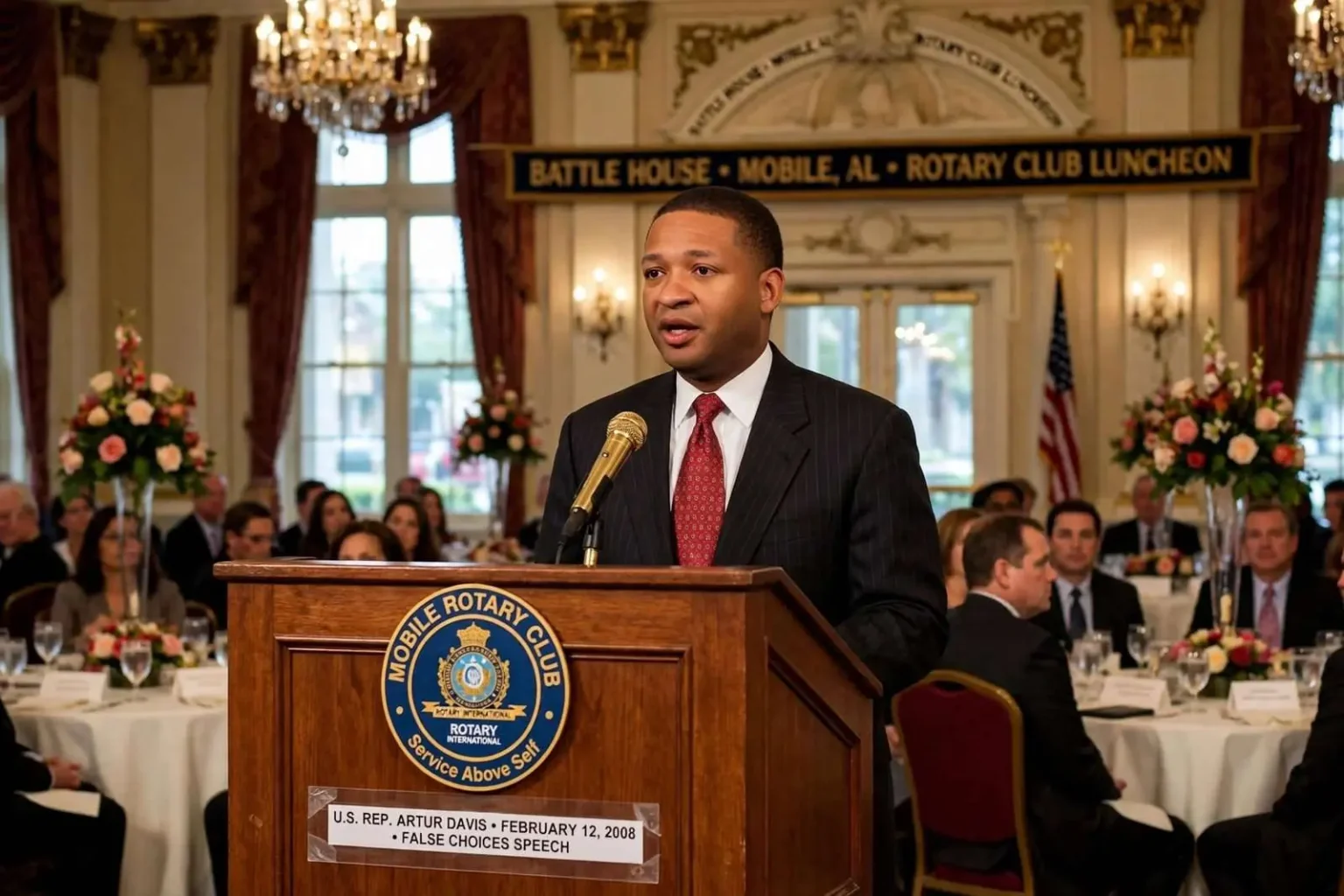
U.S. Rep. Artur Davis delivered his “false choices” speech to the downtown Mobile Rotary Club at the Battle House in February 2008. It was his second appearance in the city in roughly a month, following a talk at Spring Hill College. Nobody in the room needed the itinerary explained: the Democratic congressman from Birmingham was scouting terrain for a run for governor in 2010.
The venue itself carried meaning. The Battle House, the storied downtown hotel that had reopened in 2007 after a sweeping restoration as part of the Renaissance revival of Mobile’s central business district, had quickly reestablished itself as the city’s premier stage for political speeches and business gatherings. A candidate testing a statewide message wanted exactly that room, and exactly that audience.
The message of the moment
Davis’s thesis was that modern Alabama had grown economically diverse and healthy enough that its people no longer needed to accept the either-or propositions that had bound the state during its poorer past. He called them false choices — funding colleges or funding K-12 schools; attracting manufacturing jobs or protecting a clean environment; investing in vibrant urban communities or pursuing economic development in rural areas.
It was a message calibrated for a Rotary lunch and for a statewide audience: optimistic, business-friendly, and framed around growth rather than grievance. In a state where Democratic candidates had often struggled to escape the perception that their party’s message stopped at the city limits, Davis was making an explicit appeal across regional and racial lines — the same strategy that had guided the statewide campaigns of the party’s last successful governors, and one its strategists believed was essential to ever winning again.
A Harvard-educated lawyer raised by his mother in west Montgomery, Davis represented the 7th Congressional District, which stretched from Jefferson County southwest to Choctaw County. The district, one of the most heavily Democratic in Alabama, had been drawn to concentrate the state’s Black Belt and urban minority communities, and Davis had won the seat in 2002 after serving as a federal prosecutor. His biography — a young Black congressman with academic credentials and a reputation for ambition — made him, almost immediately upon arriving in Washington, one of the most talked-about statewide prospects in the Alabama Democratic Party.
He told the Mobile audience that his circle of friends in the city had once been small but was expanding. Asked about the impending U.S. Air Force refueling tanker award — the contract that would determine whether an aircraft assembly line came to Mobile’s Brookley Field — Davis said the Rev. Jesse Jackson had been wrong to back Boeing in the fight. “Jesse is wrong about that,” he said, “but Jesse is wrong about a lot of things.”
For a Mobile audience, it was exactly the right answer. The tanker competition was, by 2008, the single most consequential economic question hanging over the city, and local officials of both parties had spent years lobbying Washington on behalf of the Northrop Grumman-EADS bid that would bring the work to Brookley. A Birmingham congressman siding publicly with Mobile on the issue — and needling a nationally prominent civil rights figure in the process — sent a signal that Davis intended to campaign as a candidate for the whole state, not merely for his party’s traditional base.
The 2010 calculation
Lt. Gov. Jim Folsom was generally regarded as the frontrunner for the Democratic nomination for governor, though persistent talk suggested his desire to return to the governor’s mansion had cooled. Veteran officeholders put the cost of a serious 2010 gubernatorial campaign at around $15 million.
The arithmetic favored Davis more than the price tag suggested. Assuming the Black vote consolidated behind him, he could be formidable in a Democratic primary even while spending far less than Folsom. Alabama’s Democratic electorate included a large and reliably loyal Black constituency, and a candidate who could count on near-unanimous support from those voters could win a nomination with a modest share of the white vote — a calculation that had shaped every Democratic primary in the state for a generation.
That calculation drove the speculation — and the repeat visits to Mobile. Davis’s courtship of the city’s Rotary and business crowds, its college campuses and its civic clubs, was a working demonstration of the strategy: pair a consolidated Black vote with enough support among moderate and business-minded voters in places like Mobile, Baldwin and Madison counties to survive a general election. Whether the coalition would actually hold together was the question everyone in the Battle House ballroom was implicitly asking.
History decided otherwise. Davis entered the 2010 race but lost badly in the Democratic primary to Ron Sparks, then the state agriculture commissioner, after failing to secure the endorsements of the state’s major Black political organizations, whose support he had spent years holding at arm’s length. The defeat was swift and lopsided — a rejection of the very premise of the Davis strategy, and a demonstration that in Alabama Democratic politics, organizational endorsements still mattered more than cross-party appeal.
He left Congress, moved to Virginia and later switched to the Republican Party. The fall was one of the steepest in modern Alabama politics: a congressman once discussed as a future governor and, by some supporters, as a historic national candidate, was out of elected office within two years of his Mobile Rotary appearance. The 2010 governor’s race itself was won by Republican Robert Bentley, capping a Republican sweep that sealed the party’s dominance of state government.
Bonner stays put
Mobile’s own congressman was the subject of similar rumors, and he moved to end them. U.S. Rep. Jo Bonner’s reported interest in a 2010 gubernatorial bid faded with his appointment to the House Appropriations Committee — one of the most valuable assignments in Congress and a strong reason to stay.
Bonner said anyone floating such talk clearly had not spoken with his wife.
The appointment mattered for reasons that hit close to home for Mobile. Appropriations seats give members direct leverage over federal spending, and for a Gulf Coast district still rebuilding from Hurricane Katrina and watching the tanker competition closely, the committee’s clout was a tangible argument for staying in Washington. Bonner, a Republican who had held the 1st District seat since 2003, went on to keep the post for years afterward — a career path that, in hindsight, validated the decision not to gamble on a statewide run.
Democratic optimism, and a veteran’s caution
Local Democratic enthusiasm was running high. Ed Kahalley Sr. of Mobile, long known as “Mister Democrat,” wrote to former Lt. Gov. Bill Baxley urging the party to field a candidate for every office on the 2008 ballot. Kahalley believed the excitement surrounding a possible Obama nomination, combined with lingering disgust over the Bush administration, could produce a Democratic landslide in Alabama comparable to Barry Goldwater’s 1964 sweep of the state.
The comparison was a deliberate inversion of history. In 1964, Republican Barry Goldwater carried Alabama in a landslide — one of the few times the GOP had swept the state — as conservative Alabamians fled a national Democratic Party moving on civil rights. Kahalley’s wager was that 2008 could flip the pattern: that Barack Obama’s campaign would generate a surge of new Black voters and young voters, that white moderates would defect from a battered Republican brand, and that the combination could deliver Alabama to the Democrats for the first time in a generation.
Baxley admired the spirit but not the forecast. “I don’t know that you’ll ever see a landslide like 1964 in my lifetime,” he said, “but I think it is certainly conceivable for the Democrats to carry the state. We can carry the state with some good nominees.” A 65-35 margin, he said, was not happening.
Baxley, a former attorney general and one of the most prominent Democrats of his era, had spent decades watching the state’s political realignment and understood the arithmetic behind his caution. Alabama had been trending Republican in federal races since the 1980s, and by 2008 the state’s delegation, legislature and constitutional offices had tilted decisively to the GOP. A competitive statewide race, in his view, required good nominees and the right national climate — not a tidal wave.
Baxley was closer to right. John McCain carried Alabama that November by about 60 percent to 39 percent.
Obama improved on recent Democratic performances in some urban counties, and the race drew record participation from Black voters, but the expected realignment never came close to materializing. McCain’s margin in Alabama was among the largest he recorded in any state, underscoring how far the state had drifted from the Democratic presidential column even as local Democrats held pockets of strength in the Black Belt and in cities like Mobile and Birmingham.
What the episode reveals
Seen together, the 2008 episodes — Davis’s repeated visits, Bonner’s calculations, Kahalley’s letter — capture Alabama politics at a hinge point. Democrats still harbored credible statewide ambitions and could still assemble the makings of a serious gubernatorial campaign, but the coalition they needed was fraying, and the party’s most ambitious figures were already reading the map that way. Davis’s fatal mistake, in the judgment of party elders, was pursuing the strategy while alienating the organizations whose endorsement made it work.
For Mobile, meanwhile, the 2008 cycle was less about party than about leverage. The city mattered because the tanker contract hung in the balance, and candidates of both parties found reasons to appear there and praise the Brookley bid. Davis’s jab at Jesse Jackson was remembered locally less as a partisan statement than as evidence that Mobile’s economic priorities could pull a Birmingham politician to its side of an argument.
The tanker fight itself would stretch on for years — with reversals, rebids and congressional battles — before the Brookley site finally landed a commercial aircraft assembly line, vindicating in the long run the civic campaign that every 2008 visitor to Mobile was expected to endorse. By then, the “false choices” speech had faded into the long record of Alabama campaigns that briefly looked inevitable and never were.