Mobile Regional Airport Awarded a 15-Year Food and Newsstand Concessions Contract
In February 2006, Mobile Regional Airport awarded a 15-year concessions contract for newsstands, restaurants and bars, promising travelers Quiznos, a Chart Room bar and a Carpe Diem cafe.
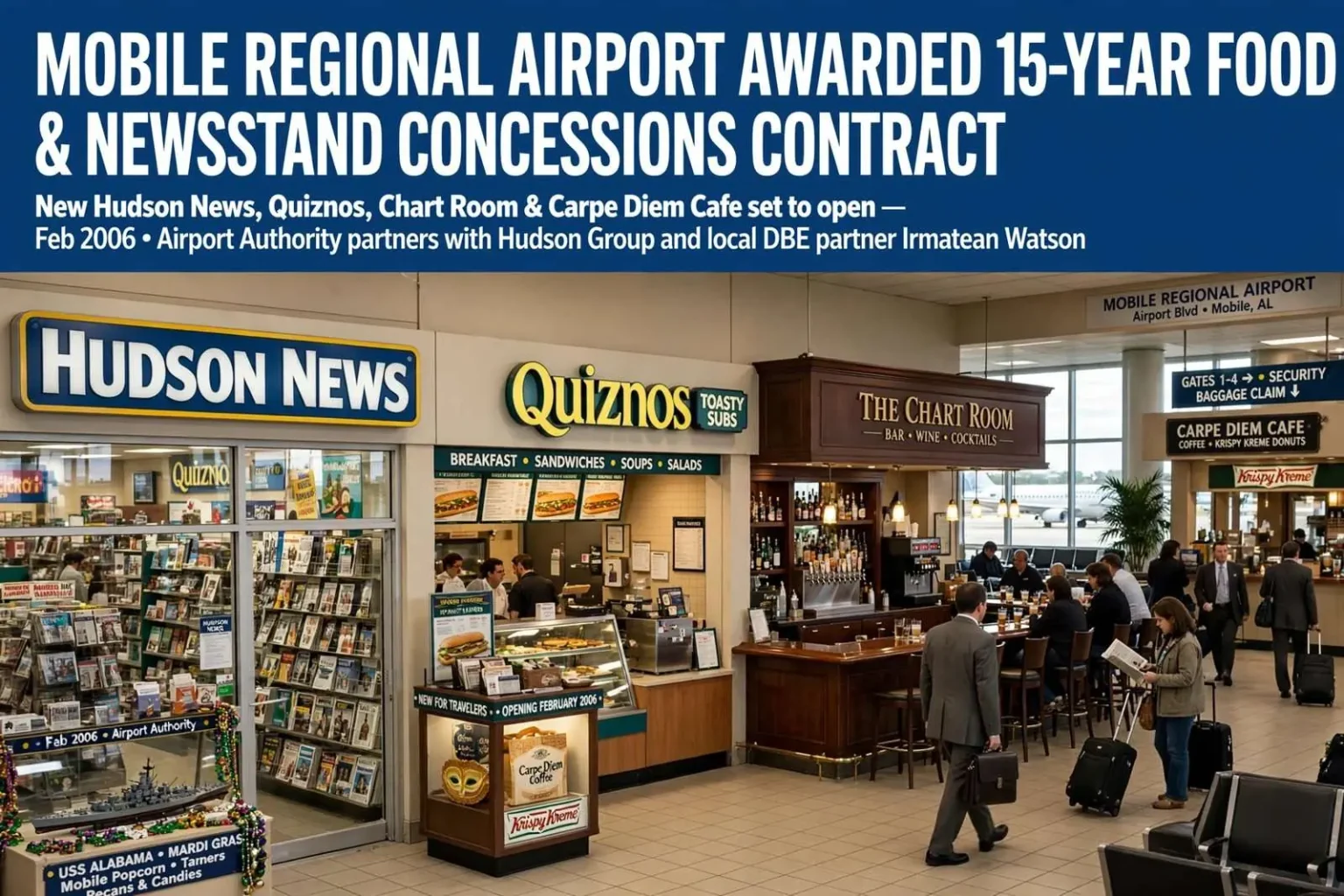
Travelers passing through Mobile Regional Airport were promised a substantially different experience in February 2006, when the airport awarded a 15-year contract covering newsstand retail and a new food and beverage program. The winning bid came from Hudson Group, the airport retail company best known for its Hudson News newsstands, partnered with a local disadvantaged business enterprise partner, Irmatean Watson. The package added several restaurant and bar concepts alongside two new newsstand locations, supplementing the company’s existing airside operation at the field.
The award was the airport’s most significant concessions step in years. Mobile Regional, the city’s primary commercial field on Airport Boulevard west of downtown, had long offered travelers the basics and little more, and the 15-year term signaled that both sides expected the relationship to define the terminal for a generation. For the Mobile Airport Authority, a long contract was the price of getting a partner to invest in real build-out — counters, seating, kitchens — rather than a thin retail presence.
What passengers were promised
The concessions were configured in two clusters, one on either side of the security checkpoint.
Pre-security, three concepts grouped together: a Hudson News store, a Quiznos sandwich shop offering breakfast, lunch and dinner items, and the Chart Room, a full-service bar serving draft and bottled beer, wine and mixed drinks along with fountain drinks, coffee and hot beverages.
The placement was deliberate. A pre-security cluster serves not only departing passengers but the greeters, well-wishers and business travelers who spend time in a terminal without flying — a constituency a small airport ignores at its peril. The Quiznos brand, then one of the fastest-growing sandwich chains in the country, brought a recognizable national name to a terminal that had few, and the Chart Room’s full bar gave Mobile’s terminal its first true sit-down drinking establishment.
Airside, past the checkpoint, a second combination location anchored by a smaller Hudson News store, with the Carpe Diem Cafe built into the newsstand, featuring the local Carpe Diem coffee brand alongside nationally branded Krispy Kreme doughnuts. The adjacent Cruise City Bar and Grill was to offer self-service and quick-service breakfast, hot entrees, cold and grilled sandwiches, soups, salads and desserts, plus a full bar.
The airside cluster answered the traveler’s oldest complaint — nothing to eat or drink after security — and its menu read like a response to early-morning departures: coffee, doughnuts, a quick breakfast, and a bar for the delayed evening. Building the cafe into the newsstand kept the footprint compact, a necessity in a terminal not designed around restaurants.
Thomas Hughes, director of aviation for the Mobile Airport Authority, said the airport was pleased to expand the company’s presence. “We have had a strong and mutually beneficial relationship for many years,” Hughes said. “Our passengers will enjoy a dramatic improvement in food and beverage options.”
A deliberate turn toward the local
One notable feature of the award was how much of it was pointed at Mobile itself. The gift sections of the three newsstands were to carry merchandise tied to local attractions and cultural institutions, including the USS Alabama Battleship Memorial Park, the Delta Queen steamboat, Mobile’s Mardi Gras, and two annual events, the Fishing Rodeo and the Festival of Flowers.
The concessionaire also committed to stocking merchandise from local providers such as Carpe Diem Coffee, Tanners Pecans & Candies and Mobile Popcorn.
The local list reads like a map of Mobile’s civic identity at the moment. The USS Alabama, the World War II battleship moored in the bay since 1965, is the city’s signature attraction, and its museum park draws visitors from across the region. The Delta Queen, the storied overnight steamboat, tied the terminal’s retail to the river cruise trade. Mardi Gras — which Mobile claims, with solid historical grounds, as the oldest in America, predating New Orleans — is the city’s cultural calling card. The Alabama Deep Sea Fishing Rodeo, held on Dauphin Island each summer, is one of the largest fishing tournaments in the country, and the Festival of Flowers, launched at Providence Hospital, had quickly become a spring fixture.
Even the naming reflected the moment. The Cruise City Bar and Grill took its name from the cruise business then operating out of the Alabama Cruise Terminal in downtown Mobile, a venture the city had launched in late 2004 and was actively promoting as a regional draw.
The terminal had opened with the promise of turning downtown’s riverfront into a departure point for Caribbean-bound cruise ships, and for a few years it anchored the city’s tourism pitch. Naming an airport bar and grill after it folded the airport’s retail into that same civic story — a traveler buying a drink at “Cruise City” was, in the city’s hopes, being introduced to the port itself.
Joseph DiDomizio, the company’s executive vice president and chief operating officer, said the food and beverage side of the business was expanding rapidly, noting the company then operated 37 food and beverage concessions in 22 airports with annual sales of more than $16 million.
“In Mobile, as elsewhere, we will feature a comprehensive selection of gifts reflecting the local region as well as merchandise from local providers,” he said.
Those figures placed Hudson at the leading edge of a change sweeping airport retail in the mid-2000s. The Hudson News brand, which had grown from a single newsstand in the late 1980s into the largest airport newsstand operator in North America, had begun pairing its core stores with branded food concepts — a model that would come to dominate terminals nationwide. Mobile, a mid-sized field, was getting the same commercial formula that New York and Atlanta travelers saw, adapted to local merchandise.
The local partner
Irmatean Watson, the local partner in the venture, was a Mobile pharmacist with a long record in airport concessions. She had been involved in operations at Gulfport-Biloxi Airport since 1987 and at Birmingham’s airport since 1990, and was a partner in both. She had first participated in concessions at Mobile Regional Airport in 1986 and had been the incumbent operator there since 1998, working with Hudson Group in Mobile since 2003.
Her role reflected the disadvantaged business enterprise requirements attached to federally assisted airport concession programs, which are designed to ensure that minority- and women-owned firms share in the revenue generated inside airport terminals. In Watson’s case, the DBE designation described a business partner with two decades of hands-on experience in the field.
The DBE framework, administered under federal aviation law, obliges airports that receive federal grants to structure concession opportunities so that disadvantaged businesses hold genuine participation — not merely a signature on a contract. Watson’s two decades across Gulfport, Birmingham and Mobile made her precisely the kind of partner such programs are meant to find: a local operator with real operational history, whose participation gave the 15-year contract a continuous local thread running back to the 1980s.
Why it mattered for Mobile
Concessions are not a footnote in airport finance. They are a meaningful revenue stream for the operating authority and, for a mid-sized field competing for passengers who might otherwise drive to Pensacola or New Orleans, a visible measure of whether the airport feels like a serious place to fly from.
The competition for passengers was the quiet context behind the award. Mobile travelers had long faced a choice: drive ninety minutes to a larger hub with more airlines, more schedules and a livelier terminal, or fly from home. Every improvement the Mobile Airport Authority could make — in service, in airlines, in the terminal’s feel — was aimed at keeping those drivers on Airport Boulevard. Concessions that made the terminal worth arriving early for were part of that calculus, the same way gate counts and parking prices were.
A 15-year term signaled a long-horizon commitment on both sides. For the airport authority, it locked in a partner willing to invest in build-out. For travelers, it meant that the small indignities of a sparse terminal — no hot meal before an early flight, nowhere to sit down for a drink after a delay — were being addressed.
Long concession terms carry their own logic. Equipment, counters and seating are expensive, and no operator will spend them on a contract it might lose in three years. A 15-year commitment let Hudson plan its investment across a full amortization period and let the authority budget revenue against a stable operator, while giving both sides time to adjust concepts as tastes and security rules changed. Airports that write such terms tend to get terminals that improve continuously; airports that do not get turnover and empty storefronts.
The airport at the time was also seeking federal help for land acquisition, and the concessions announcement fit a broader effort to strengthen the region’s air service.
That broader effort — land for expansion, airlines courted, terminal commerce upgraded — was the airport’s answer to the region’s growth. Mobile and Baldwin County were adding population steadily through the 2000s, and the airport’s position depended on convincing both business travelers and leisure flyers that flying locally was easier than driving to a bigger field. A terminal with national brands, local merchandise and a sit-down bar made the argument in the most concrete way available: by making the airport a better place to spend an hour.
The gate-side coffee and doughnuts were, in their modest way, part of the same argument Mobile was making about itself. A city rebuilding its downtown around a cruise terminal, an aviation park on the bay and a growing port was presenting its airport as a front door — and in February 2006 it furnished that front door with a newsstand, a sandwich shop, two bars and fifteen years of local names on the shelves.