Mobile County Democrats Take Their Meetings on the Road and Eye Two GOP-Held House Seats
The county Democratic executive committee planned to meet around the county during 2009 to build interest, as two Democrats were reported preparing challenges to Republican state Reps. Victor Gaston and Jim Barton.
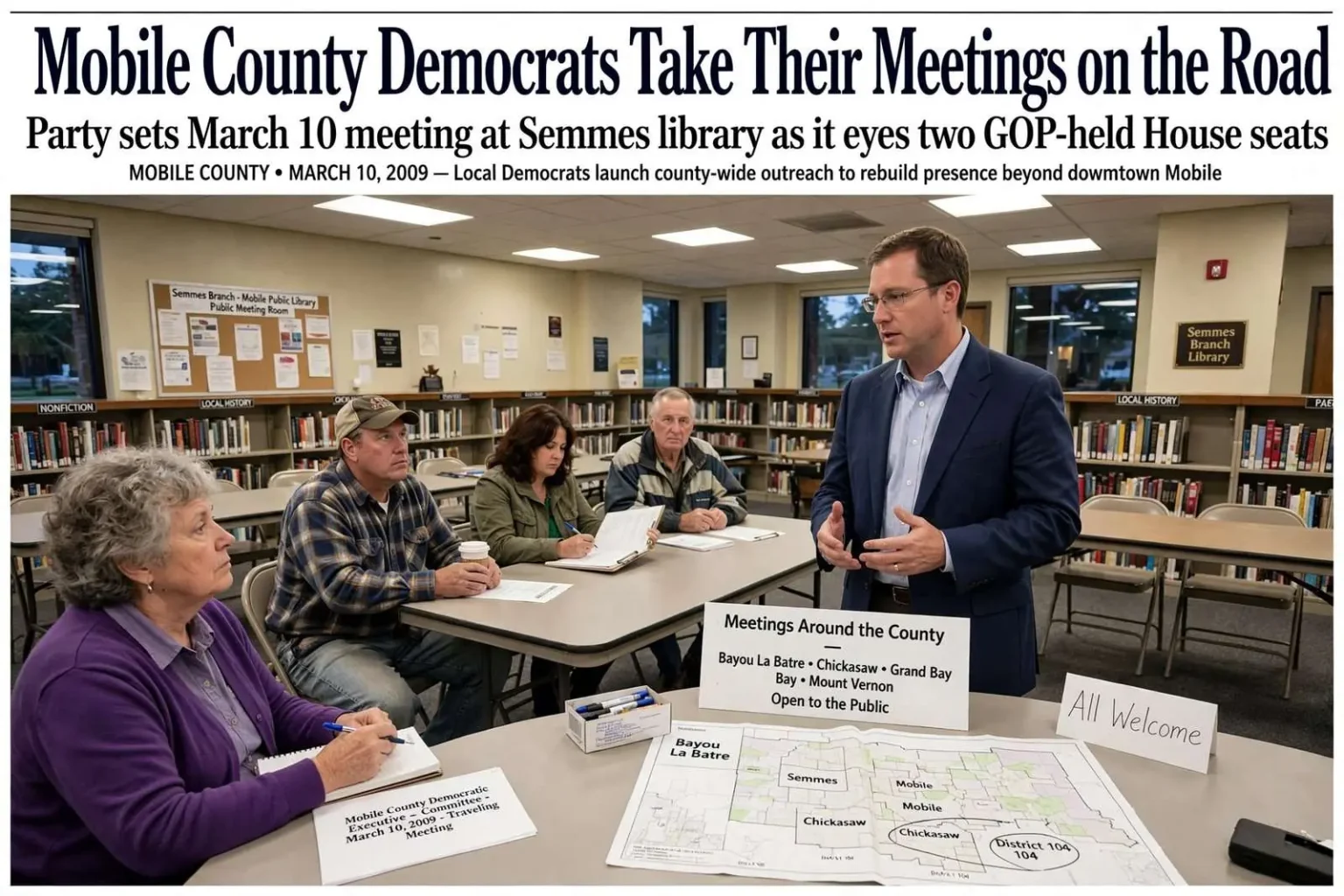
MOBILE COUNTY – The Mobile County Democratic Party set out in 2009 to do something local parties rarely do: leave their usual meeting room.
A party that travels
The Mobile County Democratic Executive Committee scheduled a meeting for Tuesday, March 10, at 6 p.m. at the Semmes branch of the Mobile Public Library, party Chairman Brad Warren said. It was to be the first of several.
Warren said the committee planned to meet at a variety of locations throughout the county during the year, both to generate broader interest in the party and to make attendance more convenient for the members of the committee itself, who were scattered across a county that runs from Bayou La Batre to Mount Vernon. The public was welcome at the meetings.
The geography explains the logic. Mobile County sprawls across roughly 1,200 square miles of south Alabama, from the fishing communities of Bayou La Batre on the Gulf to the small towns of the county’s northern end near Mount Vernon, and a commitment to a single meeting place on Government Street asks a member in Semmes or Grand Bay or Chickasaw for a drive across the entire county and back. Rotating the meetings put the party where its members actually lived — and made each session a local event rather than a downtown obligation.
The strategy said something about the party’s position. Mobile County had been a Democratic stronghold within living memory. By 2009 the party held the mayor’s office in Mobile and several legislative seats, but Republicans had won most of the county’s suburban territory, and the Democratic organization itself was thinly staffed and short of money.
The shift had unfolded over a generation. The county that once delivered heavy Democratic margins in statewide races had watched its suburban precincts — west Mobile, the growing corridors along Airport Boulevard and Schillinger Road — move steadily into the Republican column through the 1990s and 2000s, following the pattern that transformed Alabama’s suburban politics statewide. What remained of the Democratic base was concentrated in the city of Mobile and scattered pockets elsewhere, an electoral map that made the party’s downtown meeting habit look, in retrospect, like a portrait of its shrinking footprint.
The timing gave the outreach effort an added edge. Democrats had just won the White House in 2008, and local organizers across the South reported a surge of renewed interest in party politics — new volunteers, new donors, new names on mailing lists. A county party that could capture that energy locally stood to rebuild roster and relevance at the same time. Traveling the meetings around the county was Warren’s answer to the opportunity: meet the enthusiasm where it lived, in the communities that had stopped seeing the party in person.
Two challengers surface
Meanwhile, at least two Democrats were reported to be preparing challenges for Mobile County seats in the Alabama House of Representatives.
Tim Morgan, a public school teacher who described himself as a conservative Democrat, was said to have his eye on the House District 100 seat held by state Rep. Victor Gaston – a venerable Republican who had represented parts of Mobile since the 1980s and who was, by that point, among the longest-serving members of the House.
Adam Jackson was reported to be considering a run at House District 104, held by Republican state Rep. Jim Barton. Jackson’s platform, as described, centered on improved infrastructure for educational facilities and on better zoning and economic planning in the county.
Both were uphill assignments. Gaston and Barton were established incumbents in districts that had grown steadily more Republican, and 2010 – the year the challenges would be tested – would prove to be a wave election in the opposite direction.
Zoning as a campaign issue
The mention of zoning in Jackson’s platform is worth noting, because it points to a genuine local grievance rather than a national talking point. Most of unincorporated Mobile County had no zoning at all. Development happened where it happened, and the county commission’s authority to shape it was limited. For residents watching subdivisions, industry and traffic arrive without a plan, that was not an abstraction.
The issue had a long history in the county. Proposals to extend zoning into the unincorporated stretches of Mobile County had surfaced repeatedly over the years, and each time they ran into a familiar coalition of resistance — property owners who did not want restrictions on their land, developers who preferred flexibility, and rural communities that viewed countywide planning as an urban imposition. The result was a patchwork in which incorporated cities and towns planned their own growth while the land between them developed largely at the discretion of whoever owned it.
The consequences were visible along the county’s growth corridors, where mobile home parks, industrial operations and residential subdivisions could end up side by side without any buffer or review. Residents who wanted a say in what went in next door had few tools, and county commissioners — even when sympathetic — had limited statutory authority to intervene. A candidate promising “better zoning and economic planning” was, in effect, promising to reopen a fight that had stalled in the courthouse for decades.
The same could be said of school facilities. Mobile County’s public school system was the largest in Alabama, and its buildings – many of them decades old – were a recurring subject of bond issues, tax votes and complaint. School construction and repair questions had driven some of the county’s most contentious tax referendums, and communities on the edges of the county often complained that aging campuses in their neighborhoods waited in line behind newer projects closer to the city. A platform built on educational infrastructure was speaking directly to that standing frustration.
The party’s larger problem
Warren’s outreach campaign was launched into a difficult year, and it would soon be overtaken by an internal fight over an $8,500 transfer of state party money through the county committee’s bank account, a dispute that consumed the organization through the spring.
Internal money fights are hardly unique to county parties, but in an organization with little cash and less staff, a dispute of that size could dominate every other agenda item. The fight pulled attention and energy away from the traveling-meeting program at exactly the moment the outreach was supposed to bear fruit, and it gave the party’s skeptics an easy answer to the question of whether the local organization could govern itself.
The episode reflected the harder truth about county party organizations in early-twenty-first-century Alabama: they existed in a political ecosystem that had drained them of their traditional functions. Modern campaign money, professional consultants and nationalized messaging had moved the real action in legislative races away from local committees, leaving the organizations to serve as credentialing bodies, social clubs and occasional conveners. A committee fighting over an $8,500 transfer was, whatever the merits, a committee showing how thin its margin of operation had become.
Still, the traveling-meeting idea addressed a real problem. A party that meets only downtown eventually hears only from downtown. Whether the Semmes library and the meetings that followed it produced any lasting change in Mobile County’s political arithmetic is a question the following year’s returns would answer.
What the Semmes meeting looked like
The choice of the Semmes branch of the Mobile Public Library for the opening session was fitting on its own terms. Semmes, in the county’s northwestern corner, had built its identity around its nursery industry and its own community institutions, and its library had become one of the busiest branches in the system serving a fast-growing suburban and semi-rural population. Holding the party’s first traveling meeting there put the Democratic committee in a community that rarely saw it — and in a building whose regular patrons included exactly the kind of civic-minded residents the outreach hoped to reach.
Library branches have long served this role in Alabama civic life. They are neutral, accessible, free to community groups, and distributed across the county in a way almost no other public institution matches. For a party trying to demonstrate that it belonged everywhere in Mobile County — not just in the blocks around Government Plaza — a branch library meeting was a small statement of intent.
The districts on the map
The two legislative districts the prospective challengers eyed tell their own story about the county’s political geography. House District 100, the seat held by Gaston, covered portions of the southern and western parts of the county, while District 104, held by Barton, took in territory in the county’s western suburbs. Both sat in the portion of Mobile County where the Republican trend had been steepest — the districts that had flipped from Democratic hands a generation earlier and stayed put.
Gaston’s seniority made him a fixture rather than a typical target. Legislators who reach the House’s upper ranks of service accumulate the committee posts, institutional knowledge and cross-district relationships that make them difficult to dislodge, and campaigns against them typically run less on the incumbent’s record than on the challenger’s argument that it is simply time for new representation. Barton, likewise, had built the kind of suburban-incumbent profile — visible in community affairs, established in business — that had made west Mobile reliably resistant to Democratic recruitment.
That is what made the reported interest of Morgan and Jackson notable in the first place. The party’s recruiting problem in suburban districts was not finding voters with grievances — infrastructure, schools, zoning — but finding candidates willing to absorb near-certain losses for the sake of contesting every district. A teacher running as a conservative Democrat in District 100 and a platform built on schools and planning in District 104 were the raw material of the only strategy available: show up everywhere, even where the map said no.
The season ahead
Between the March meeting at the Semmes library and the qualifying deadlines that would define the 2010 ballot, the county committee had a year to test whether presence could be converted into organization — new precinct officers, new donors, credible candidates in every district. The traveling-meeting plan, the two prospective House challenges and the internal money fight would all be part of that answer, each in its own way measuring whether a local Democratic Party in a reddening county could still function as more than a memory of its own majority.