Congressional Challenger Works the Coast as GOP Primary Campaigns Intensify
Peter Gounares carried his challenge to U.S. Rep. Jo Bonner across five counties, Bradley Byrne called a news conference in Orange Beach, and Luther Strange lined up Mobile money.
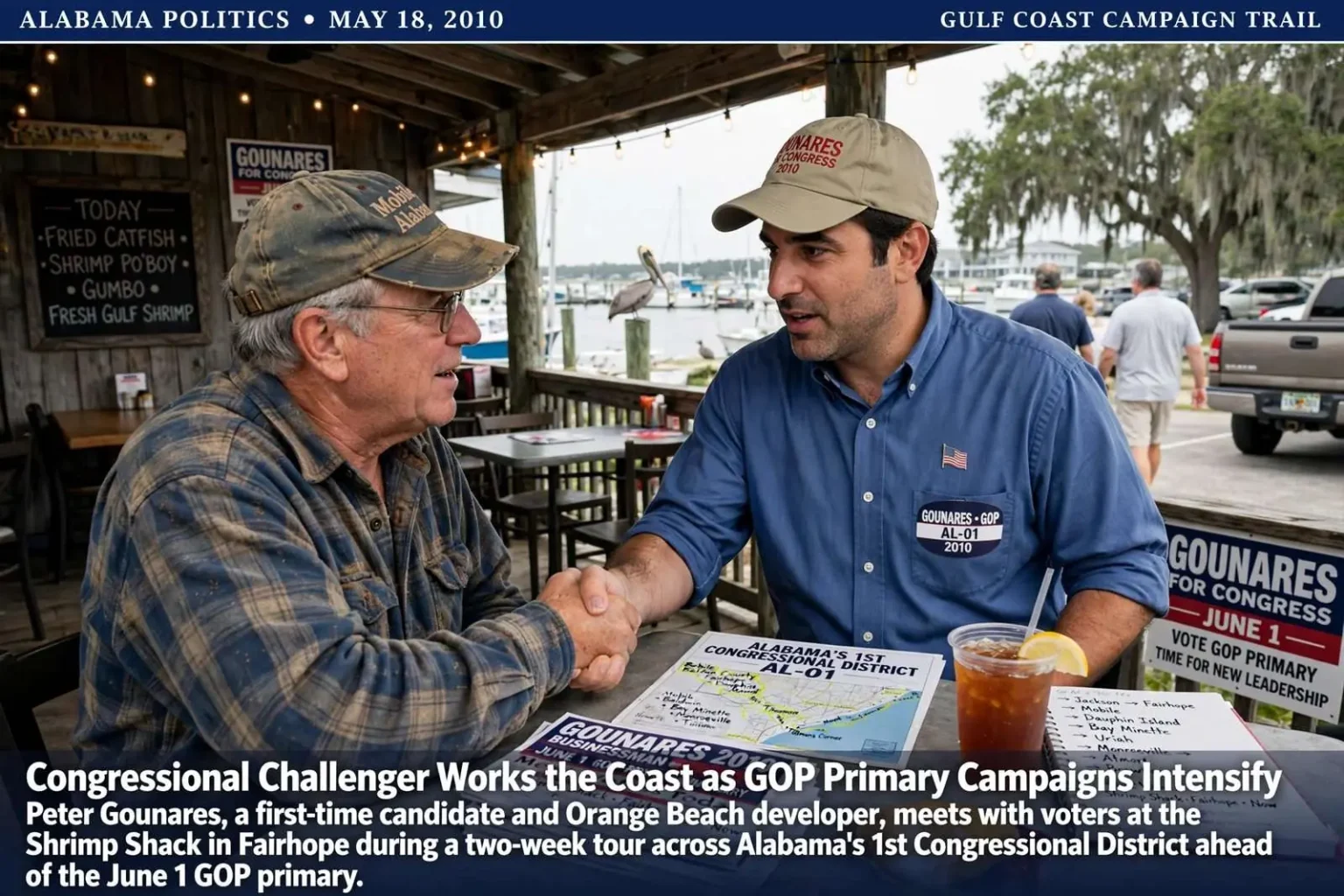
With two weeks left before Alabama’s June 1 party primaries, the Republican campaigns competing across the Gulf Coast shifted into their final gear, trading television time for coffee shops, seafood restaurants and living rooms. The final fortnight of an Alabama primary is a season unto itself — polls tighten, endorsements dry up, and candidates abandon any strategy that does not put them in front of actual voters — and the Gulf Coast’s 2010 contests were no exception.
Gounares takes on Bonner
Peter Gounares, an Orange Beach real estate developer making his first run for public office, scheduled a string of meet-and-greet appearances across the sprawling 1st Congressional District as he pressed his challenge to incumbent U.S. Rep. Jo Bonner. The itinerary was a fair map of the district itself, running from the Downtown Grill in Jackson to the Shrimp Shack in Fairhope, from Serda’s Coffee in downtown Mobile to the senior center in Tillmans Corner, from Dauphin Island to Pelican Reef on the Dauphin Island Parkway.
Later in the week he planned stops at Street’s Seafood in Bay Minette, the Cotton Patch Cafe in Uriah, David’s Catfish in Monroeville, Pintoli’s Italian Cafe in Atmore and David’s Catfish House in Brewton. The schedule reflected the arithmetic of a primary challenge with limited money: a first-time candidate cannot outspend an incumbent with a congressional office and a fundraising base, so he tries to out-travel him.
Alabama’s 1st District at the time stretched from the Mississippi line across Mobile and Baldwin counties and north into Washington, Clarke, Monroe and Escambia counties — a territory of beach towns, port industries, pineywoods farm counties, and small courthouse squares, each with its own menu of local grievances. A restaurant stop in Uriah and a senior center in Tillmans Corner reach voters no television buy can: the personal ask, the photo with the grandkids, the promise to remember the town when elected. Gounares’s two-week sprint across it was the classic shape of a long-shot challenge — everywhere at once, sustained by shoe leather and catfish.
Bonner, seeking another term as the district’s congressman, represented the establishment side of the contest. A Mobile native and longtime Capitol Hill staffer before his election in 2002, Bonner had built a reputation as a disciplined, low-drama Republican whose office focused on constituent services, defense matters tied to the region, and the port and aerospace interests that anchor the Gulf Coast economy. Challengers in primaries typically run against Washington more than against the incumbent’s specific record, and Gounares’s campaign was no different, framing the race as a question of whether the district wanted a businessman’s outsider energy in place of a professional politician’s seniority.
Byrne calls a news conference at the beach
Republican gubernatorial candidate Bradley Byrne announced a Monday news conference in Orange Beach, promising to “reveal factual information that every Alabama voter deserves to know.” His campaign set the event for 10:30 a.m. at the intersection of the Foley Beach Express and Canal Road, one of the most heavily traveled crossroads in south Baldwin County and a spot loaded with local meaning given the long-running politics of beach access, tolls and coastal development.
Byrne, a former state senator and former chancellor of Alabama’s two-year college system, had entered the governor’s race as the establishment reform candidate, campaigning on his record of cleaning up the two-year college system after its scandal-plagued years and arguing that Alabama’s government needed professional management more than political revolution. The Beach Express location was a deliberate choice: the toll bridge’s route and its rival, the state-financed Beach Express extension, had been entangled in Baldwin County politics for years, and an event at the crossroads signaled Byrne’s intent to talk about development, transportation, and the handling of public money — the themes his campaign believed would distinguish him in a crowded field.
The gubernatorial contest that year was one of the most crowded and expensive in recent Alabama memory, with a field of prominent Republicans splitting the anti-establishment and establishment lanes. Byrne’s campaign bet that voters wanted a manager with a record, while rivals bet on outsider energy. Two weeks out, the stops-and-stunts phase — news conferences at crossroads, revelations promised — gave way to the only phase that decides Alabama primaries: turning out loyal voters on June 1.
The district and the deadline
The geography of the 1st District shaped both congressional campaigns. Baldwin County’s fast-growing municipalities — Fairhope, Daphne, Spanish Fort, Gulf Shores, Orange Beach — supplied the district’s most reliable Republican voters, while Mobile’s city precincts and the rural northern counties added texture and, in general elections, Democratic strength that the primary winner would not have to face. A primary candidate who could dominate Baldwin’s beach communities and Mobile’s conservative suburbs held a strong hand, which is why the final two weeks’ itineraries clustered around coastal venues even as the candidate courted the inland counties.
For Gounares, the coming fortnight would decide whether a first-time candidate’s personal campaign could compete with an incumbent’s infrastructure; for Byrne, whether a promised revelation at a toll-bridge crossroads could cut through a crowded field’s noise. Alabama’s primaries have long rewarded candidates who show up — at the Shrimp Shack, the Cotton Patch, and every crossroads in between — and in the last two weeks before June 1, the Gulf Coast’s Republican campaigns were doing exactly that.
Why restaurants and coffee shops decide Alabama primaries
The meet-and-greet circuit that Gounares worked is the native habitat of Alabama retail politics. Restaurants along Highway 31, Highway 90, and the rural state routes serve as the unofficial civic centers of small Gulf Coast towns — places where the owner knows the regulars and a candidate standing by the counter can shake twenty hands before the coffee cools. Campaign professionals in the state have long advised hopefuls to skip expensive media until the money is there and put the candidate where the food is, because a primary is decided by a fraction of the electorate, and that fraction disproportionately includes the civic-minded diners who show up to look a candidate in the eye.
The two-week sprint also imposed its own discipline. A schedule that runs from Jackson to Fairhope to Mobile to Dauphin Island and then north through Bay Minette, Uriah, Monroeville, Atmore, and Brewton covers both the coastal population centers and the small black-belt and pineywoods towns whose votes count the same as any other. Local leaders in those towns take attendance: a candidate who shows up in Uriah in May remembers Uriah in January, and the memory works both ways. For a challenger, the tour is the campaign’s proof of concept — evidence that he can endure the district’s size and variety, the same endurance the job of congressman demands.
The Beach Express and Baldwin’s growth politics
Byrne’s choice of the Foley Beach Express and Canal Road intersection carried a decade of context. The Beach Express, a privately built toll road connecting Interstate 10 to the Gulf Shores beaches, was conceived to relieve the summer gridlock on Highway 59 and to open south Baldwin’s interior to development. Its route, its tolls, and the state road projects that competed with it had been fought over in county commission races, legislative seats, and every Baldwin countywide contest for years. A gubernatorial candidate promising “factual information” at that intersection was speaking directly to Baldwin County voters who had watched the corridor’s politics up close — and to the broader Alabama audience that views coastal development as a test of how public-private deals should be handled.
The announcement’s format — a promised revelation rather than a policy platform — fit the ritual style of Alabama campaigns, where candidates stage events to force rivals to respond and to earn a news cycle in the closing days. Whether the promised facts landed on targets or fell short, the event guaranteed coverage in the Mobile and Pensacola markets that wash over Baldwin County, and it put Byrne’s reform-and-management message in front of the county whose Republican turnout could decide a crowded primary.
The 2010 landscape
The primary contests of 2010 unfolded in a political year unlike any since 1994. The recession had left Alabama with double-digit unemployment, anger at Washington ran through both parties, and the anti-incumbent mood that would define that November was already visible in primary fields across the state. In the 1st District, that mood gave a first-time candidate his opening argument; in the governor’s race, it crowded the Republican side with contenders all claiming the reform mantle. Two weeks out, the campaigns’ final-phase choices — Gounares’s retail sweep, Byrne’s staged confrontation — were each answers to the same question: how does a candidate break through when voters are angry and attention is scarce?
Alabama’s June 1 primary that year would set the general-election matchups for the fall, and the Gulf Coast’s contests were part of a statewide story that included a hard-fought congressional race in the 2nd District and a governor’s race that would eventually send a legislator rather than a manager to the mansion. But on the coast, the closing days belonged to the old verities: the restaurant tables, the senior centers, the crossroads news conferences, and the candidates’ promise — renewed every two years, in every diner from Jackson to Brewton — that they would remember, once elected, exactly who stopped to talk with them before the vote.
When the results came in, whichever candidates had converted shoe leather and coffee into turnout would move on to November, and the others would return to the developments, businesses, and private lives they had stepped away from. The two-week sprint across the 1st District and the crossroads moment in Orange Beach were the campaign’s last full notes — the part of an Alabama primary where every candidate is everywhere, and the district gets its final, best look at them all.