Port Director Jimmy Lyons Briefed Sunrise Rotary as Mobile’s Docks Boomed
Alabama State Port Authority chief Jimmy Lyons addressed the Sunrise Rotary Club of Mobile in February 2009, with a $100 million Pinto Island terminal under way to serve the ThyssenKrupp steel mill.
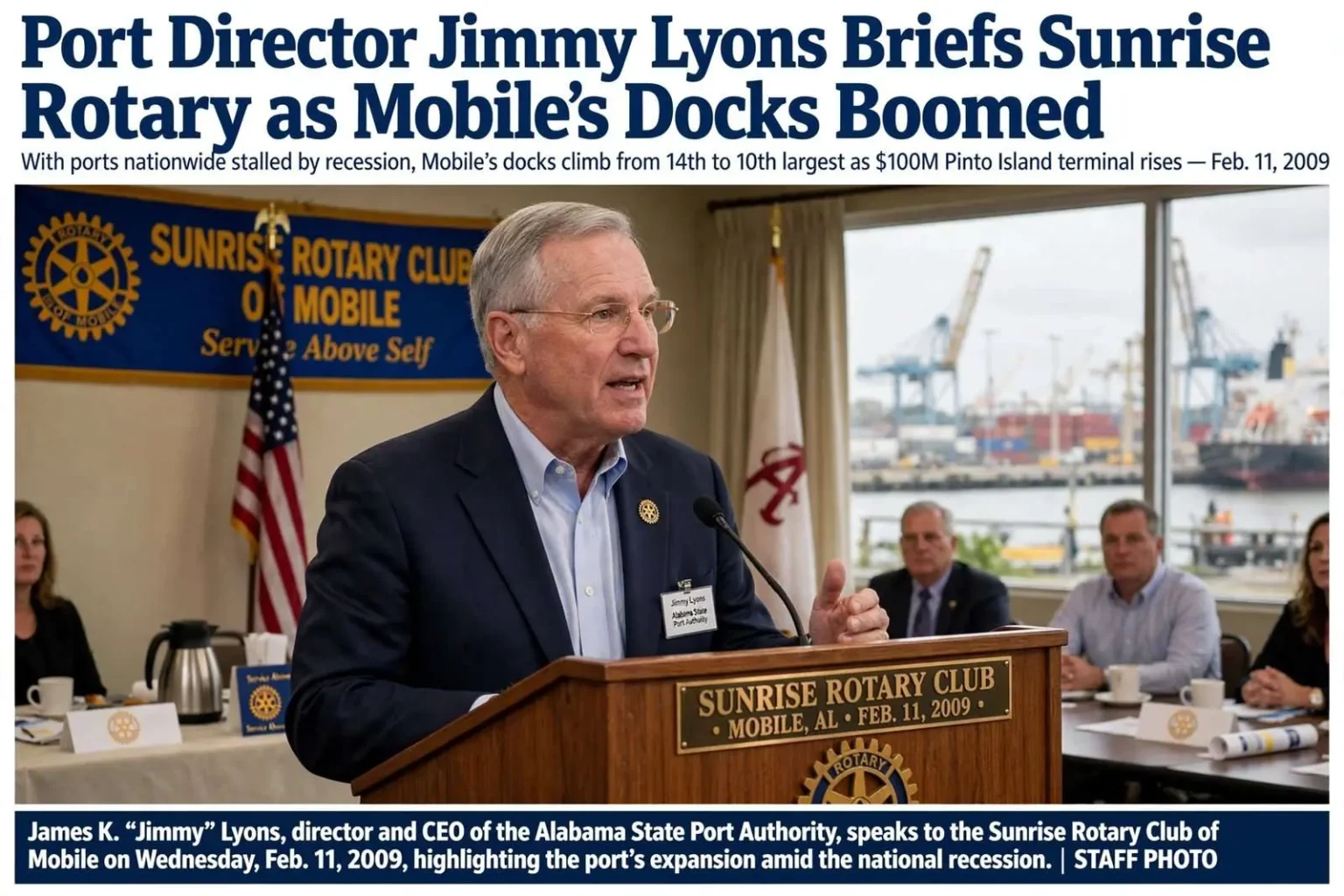
James K. “Jimmy” Lyons, director and chief executive of the Alabama State Port Authority, was the speaker before the Sunrise Rotary Club of Mobile on Wednesday, Feb. 11, 2009 — a moment when the port he ran was in the middle of the largest expansion in its modern history even as the global economy contracted around it.
The timing gave the talk its edge. By February 2009 the national recession had emptied warehouses, idled ships at anchorages and cut trade volumes worldwide, and Mobile’s business community had watched plant closings and layoffs accumulate through the winter. Against that backdrop, the port’s story was one of the few in the region that still pointed upward, and Lyons was the man who could tell it.
From 14th to 10th largest
Lyons had led the authority, still widely known in Mobile as the state docks, since July 1, 1999. Over his tenure the port climbed from the 14th to the 10th largest seaport in the country. His 36-year maritime career had run through marketing, financial management, transportation, stevedoring and terminal operations, and he had worked as a consultant advising port managers and shipping lines before taking the Mobile job.
By 2009 he was managing an organization of about 650 employees with revenues approaching $130 million in the 2008 fiscal year and cargo volumes of more than 26 million tons. The mix — coal and forest products, chemicals, containerized cargo, breakbulk steel and the barge traffic of the river system — made the authority one of the most diversified tenants in the Gulf port trade, and one of Mobile’s largest single economic engines.
Under his direction the authority had rebuilt piers, upgraded rail connections and replaced equipment, and had absorbed the post-2001 wave of maritime security requirements — new surveillance and fencing, information technology upgrades, a port police force and compliance with the federal Transportation Worker Identification Credential program. The security buildout, expensive and unglamorous, had become a permanent part of port operations in the decade after the attacks, and Mobile had carried it out while still growing its cargo base.
Climbing four places in the national rankings during a decade that included a hurricane, a security overhaul and two national economic shocks was the statistic at the center of Lyons’ case. Port rankings move slowly and only with sustained investment; a port that rises does so because cargo keeps arriving, terminals keep expanding and the connections inland — rail, river and highway — keep working.
Pinto Island and the steel mill
The centerpiece of his remarks was the capital program then under construction. The authority was building a $100 million terminal on Pinto Island to serve ThyssenKrupp’s $4.3 billion steel and stainless steel processing complex rising on the Tombigbee River north of Mobile in Calvert. The ThyssenKrupp project was, at that point, the largest private industrial investment in Alabama history, and the terminal was the link that made it work: slabs arriving by ship from Brazil would be unloaded at Pinto Island and moved upriver by barge to the mill.
The logistics were the whole design. The German steelmaker had chosen the Calvert site precisely because it combined deepwater access with river access — raw slab steel could cross an ocean to a public terminal and travel the last forty miles by barge, while finished coils could ride rail and highway to automotive and appliance customers across the Southeast. The Port Authority’s terminal, with heavy-lift capacity on Pinto Island, was the piece of public infrastructure that turned a site in the Mobile-Tensaw delta into a global manufacturing address.
Construction of the terminal meant work for dredging firms, pile-driving crews, crane operators and the electricians and welders of the region’s maritime trades — jobs flowing into Mobile even as other sectors contracted. For an audience of Mobile business people watching layoffs mount across the country, the port’s construction schedule was one of the few unambiguously encouraging economic stories in the region.
Lyons holds a bachelor’s degree in political science and economics from the University of Alabama and completed the executive development program at the University of Tennessee in Knoxville. He is married to Beth Marietta Lyons, a Mobile attorney, and they have a son, Patrick.
Youth Merit Award
The club’s Youth Merit Award was presented the previous week to Ashton and Allison Johnson of Little Flower Catholic School, who were photographed with club president Jay Ison. The award, a fixture of the Sunrise Rotary calendar, recognizes students for character and service as much as for grades, and the club presents it with school leaders and families on hand.
Interact raises $1,717 for the heart association
The St. Paul’s Interact Club and the school’s Service Leadership class reported the results of their National Wear Red Day effort on Friday, Feb. 6. The students held an out-of-uniform day and a bake sale and raised $1,717 for the American Heart Association’s work against heart disease and stroke. Both organizations are made up of female students, and members said the cause mattered to them because heart disease is the leading killer of women.
National Wear Red Day, observed on the first Friday of February, grew out of the American Heart Association’s Go Red for Women campaign, which aims to close a long-standing gap in awareness: cardiovascular disease kills more American women each year than all forms of cancer combined, yet for decades it was widely treated as a man’s disease. For a school club to build a fundraiser around the statistic was the campaign working as designed — awareness passed from national advertising to a bake-sale table.
The Interact Club was also continuing its “Pretty in Pink Boutique,” accepting donations of gently used prom dresses at St. Paul’s through Saturday, March 7. The boutique collects dresses ahead of prom season and puts them in the hands of students who might otherwise skip the dance over the cost of a gown, turning a closet clear-out into a small act of community economy.
Interact, Rotary’s service arm for high school students, functions in practice as a junior version of the club that sponsors it: the students plan projects, handle the money and report their results in the same meeting format the adults use. The St. Paul’s club’s winter run — a heart-health fundraiser and a dress drive back to back — was typical of the pace the clubs keep through the school year.
Bidding on Bill Gates’s ball cap
Members were pointed to an unusual fundraiser: the baseball cap Bill Gates wore and autographed at Rotary’s 2009 International Assembly was being auctioned on eBay to support Rotary’s $200 Million Challenge for polio eradication, with bidding open through Feb. 12. The Bill and Melinda Gates Foundation had awarded Rotary International $255 million for the polio fight, bringing the two organizations’ combined commitment to $555 million.
The challenge matched Rotary’s structure to the task: a worldwide network of local clubs raising cash locally, with the Gates money conditioned on Rotary’s own fundraising pushing the total toward the goal. Polio remained endemic in only a handful of countries, and the endgame — vaccination campaigns that reach every child in the hardest places on earth — was exactly the kind of logistics problem Rotary had spent decades proving it could execute.
Even a novelty auction fit the model. A ball cap worn by one of the world’s best-known philanthropists, sold to Rotarians online, raised both money and attention for the deadline the challenge imposed. Every dollar Rotary raised toward the $200 million mark unlocked the Gates match, which meant the auction’s final bid counted twice.
Coming programs
Teeto Graham, program chairman for February, had Estella Dorn, executive director of the Mobile International Festival, scheduled for Feb. 18. The festival, a decades-long Mobile tradition, brings the city’s many cultural communities together each year for food, music, dance and displays from around the world, and its director’s visit gave the club a preview of the annual event’s scope.
There would be no meeting Feb. 25 because of Mardi Gras. In Mobile, the Carnival season closes business as usual at its climax: parades roll through downtown, schools and offices adjust their calendars, and even civic clubs that meet weekly stand down for the final days before Ash Wednesday. Mobile’s Mardi Gras predates the better-known New Orleans celebration, and the city treats the holiday as its own.
March programs, arranged by Billy McLean around Rotary’s literacy theme, were to address illiteracy, poverty and the school dropout problem, closing with a members’ panel on workforce development. The sequence traced the pipeline Rotarians in Mobile had watched for years: a child who cannot read by the early grades, a teenager who drops out, and an adult who arrives at a port, hospital or shipyard without the credentials the modern economy requires. Rotary International’s emphasis on literacy gave the club’s programming a frame, and the closing panel would put the issue in front of the members themselves.
Applications also remained open to all students for the RYLA leadership conference April 2-5 at Camp ASCCA on Lake Martin. RYLA — Rotary Youth Leadership Awards — gathers high school students for several days of team-building and leadership training, and Camp ASCCA, Alabama’s specially equipped camp for people with disabilities on Lake Martin, has long hosted the state’s session. For the Sunrise club, the recruiting window each spring is one of its principal youth investments, sitting alongside the Youth Merit Award and the Interact clubs it supports.
A meeting that ranged from a steel terminal on Pinto Island to prom dresses on a school stage was, in miniature, what the Sunrise Rotary Club had built itself around: the port economy of Mobile, the service economy of its schools, and the international reach of the organization that binds both together.