Senior Bowl Week Brought Phil Savage Back to Sunrise Rotary’s Podium
The Mobile native and recently departed general manager of the Cleveland Browns made his traditional Senior Bowl week appearance before the Sunrise Rotary Club of Mobile in January 2009.
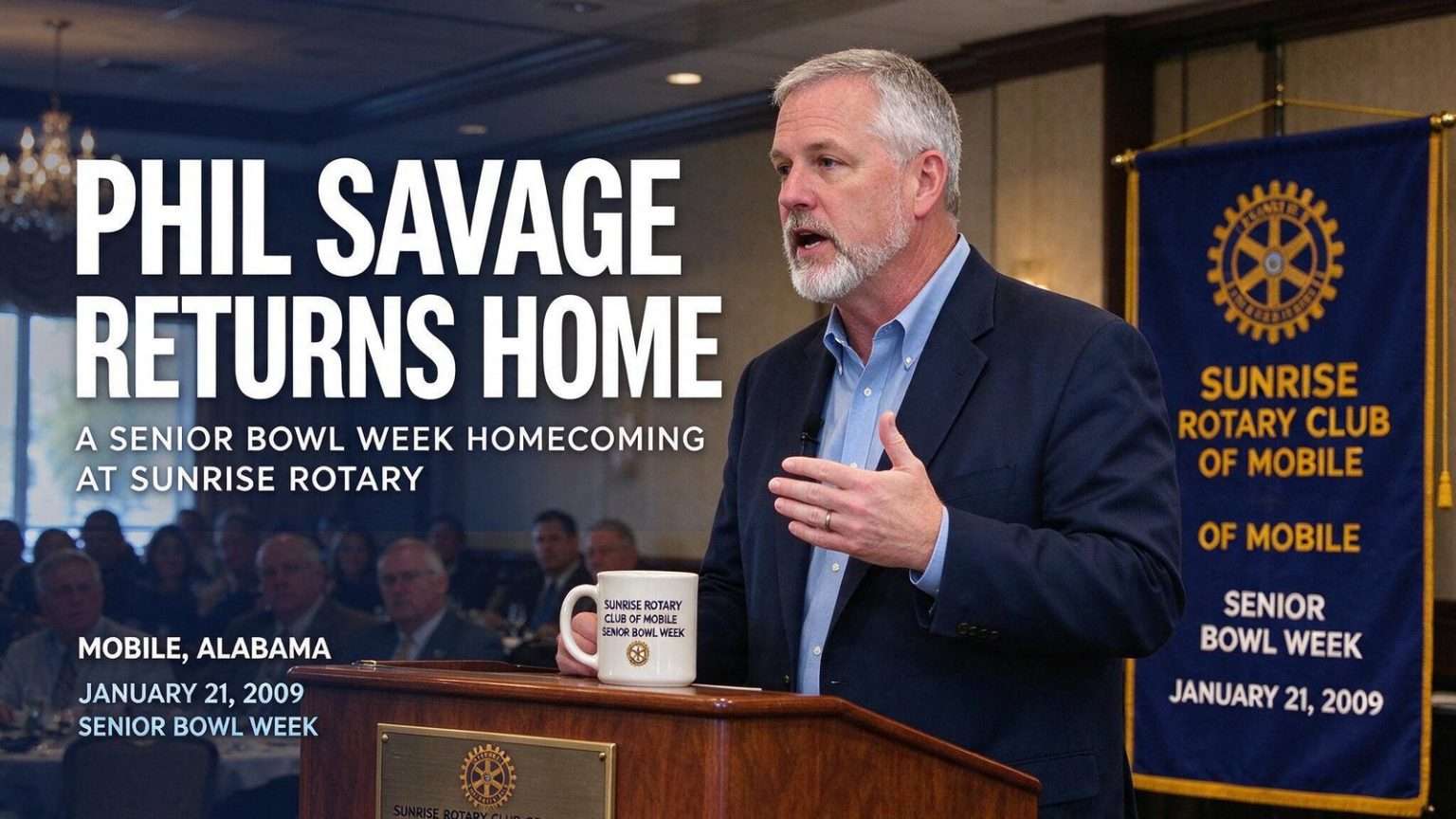
Senior Bowl week has always belonged to Mobile in a way few sporting events belong to any city, and for the Sunrise Rotary Club of Mobile it has long carried a tradition of its own. On Wednesday, Jan. 21, 2009, the club’s program featured Phil Savage, the 43-year-old Mobile native who until weeks earlier had been general manager of the National Football League’s Cleveland Browns.
Savage’s annual appearance before the club had become one of the most eagerly anticipated dates on its calendar. Local football fans rarely get the chance to hear a talent evaluator working at his level, and his visit fell in the one week of the year when Mobile is thick with NFL general managers, scouts and coaches — all of them in town for the all-star game that closes the college football season.
The timing of this year’s visit gave it a different texture. Savage had been dismissed by Cleveland at the end of the 2008 season after four years running the club’s football operations, and the man who had spent recent Januarys evaluating Senior Bowl practices as an NFL decision-maker was back home evaluating the week as a hometown son between jobs.
A Hometown Scout in a National Job
His tenure in Cleveland included the drafting of players who would go on to Pro Bowl selections and a 10-win season in 2007 that briefly returned the franchise to contention. For a general manager whose career began in the scouting ranks, those were the results that mattered — evidence that the eye he had trained over decades could build a roster in one of the league’s hardest markets.
He had come up through the scouting ranks, and his roots in Mobile and in Alabama football gave his assessments of the players on the field at Ladd-Peebles Stadium a particular authority for a hometown audience. When he described a lineman’s week of practice or a quarterback’s arm, listeners knew he was speaking as someone who grew up watching the same football the rest of the room had grown up watching.
His talk came at a moment of transition in his own career. In the years that followed, Savage would become deeply identified with the Senior Bowl itself, eventually taking over as its executive director and turning the annual all-star game into an even larger fixture of the national football calendar and of Mobile’s winter economy. From the vantage of the Sunrise Rotary podium in January 2009, that path was not yet visible — but the connection between the man and the game he would later run was already the reason the club had filled the room.
The homecoming narrative cut both ways. A Mobile native running an NFL franchise had long been a point of local pride; the same man returning home after losing that job gave the program an undertone that a routine Senior Bowl briefing would not have had. Club members got, in effect, two talks at once: the scouting report, and the view from someone who had just lived through the league’s annual accounting.
Why the Senior Bowl Matters to Mobile
Played since 1951, the Senior Bowl brings the best graduating college seniors in the country to Mobile for a week of practices watched by every NFL franchise. The practices, more than the game itself, are what draw the scouts, and the week fills hotels, restaurants and meeting rooms across the city.
For local civic clubs, it has always been a natural hook for programming. The week delivers to Mobile a density of football expertise found nowhere else in the country outside the league itself, and organizations like the Sunrise Rotary have made a habit of putting that expertise in front of their members. Savage’s appearances became a fixture because he could give the hometown crowd what no visiting speaker could: an insider’s briefing delivered in the local idiom.
The Week in the Life of the City
The scale of Senior Bowl week is easy to underestimate. Every NFL franchise sends personnel — general managers, head coaches, position coaches, scouts, medical staffs — and for a week Mobile’s hotels and restaurants do business with the entire league at once. Ladd-Peebles Stadium, the historic south Mobile venue that has hosted the game for generations, fills with fans for Saturday’s game after four days of practices that are, in professional terms, the more important event.
The practices matter because they are the last extended look the league gets at draft prospects in a competitive setting before the draft itself. College all-star games long ago became a drafting tool, and the Senior Bowl is the standard among them: invitation-only rosters, NFL coaching staffs running the teams, and evaluation happening in real time from the sidelines. A player can raise or lower his stock more in a week of Mobile practices than in a month of speculation.
That is the machinery a general manager comes to town to work, and it is why Savage’s January visits carried weight beyond nostalgia. As Cleveland’s GM he was in Mobile to work — interviewing players, watching practices, comparing notes with the hundred or so other evaluators in the stands. The Rotary appearance slotted between those obligations, a hometown hour carved out of a working trip.
Mobile’s Football Economy
The game’s place in Mobile’s winter economy has grown with the sport itself. What began in 1951 as a post-season exhibition has become, in the modern era, the opening event of the NFL draft season — a week that generates hotel nights and restaurant tabs across the city in what is otherwise a slow season for tourism, and one that puts Mobile on national television precisely when the football world is paying attention to draft boards.
The civic return compounds the economic one. Hosting the league’s entire personnel apparatus each January has made Mobile a familiar stop for football people, and the relationships built over decades of Senior Bowls helped make the case when the city pursued other football showcases. For a city that measures itself in part through its institutions, the Senior Bowl is among the oldest and most durable.
Savage’s own story braided through that history. A Mobile native who rose from the scouting ranks to run an NFL roster, he embodied the pipeline the city likes to advertise — the idea that a kid who grows up watching Alabama and Auburn football can end up drafting players on Sunday. His presence at the Rotary podium each January was proof of the concept, delivered to a room full of people who had watched him grow up.
The 2009 appearance, then, was more than a program slot. It was a hometown institution hearing from one of its own at the exact hinge of his career — out of one job that had defined him, not yet in the next one that would. The players he described that week would soon be drafted by teams like the one he had just left; the game he described would one day be his to run. Mobile, which has always understood the Senior Bowl as its own, could claim both.
The Rotary audience itself says something about how Mobile consumes its football. The Sunrise Rotary Club of Mobile is a business and civic organization, not a booster club, yet its Senior Bowl week program has long drawn the kind of attention other speakers cannot command. The reason is simple: in Mobile, football personnel talk is business talk. The men and women in the room run banks, law firms, shipping companies and hospitals, and they understand the Senior Bowl as the same kind of asset they manage in their own industries — an annual event that draws the country’s attention to their city and money into its tills.
Savage’s briefings fit that audience. He spoke as an evaluator, but also as an executive — someone who had built a roster, managed a payroll, and lived with the consequences of draft-day decisions. That dual identity made his talks unusual: part scouting seminar, part management lecture, delivered by a man the room had known since he was a kid on the sideline.
The scouting profession he came up through is worth describing for a hometown audience, because it is largely invisible. Scouts spend the fall on the road, logging high school, college and pro games, writing the reports that front offices rely on, building the boards that become draft picks. It is a trade of travel and judgment, learned under veteran evaluators and proven over years. Savage made the climb from that road-warrior life to a general manager’s office — a path that runs, in the modern NFL, directly through January weeks like the one Mobile was hosting that month.
His Cleveland tenure illustrated both the power and the precariousness of that trade. The drafts he oversaw in Cleveland produced Pro Bowl players, and the 2007 season’s ten wins put the Browns on the cusp of the playoffs — real progress for a franchise that had known little of it. But the NFL’s accounting is unforgiving, and when the following seasons fell short, the football operations leadership paid the price. Savage’s dismissal at the end of the 2008 season was the league’s standard outcome; his hometown standing was untouched.
That, in the end, is what made the Jan. 21, 2009, program the one longtime club members still recall. The Senior Bowl gave Mobile its annual audience with the NFL; Phil Savage gave the Sunrise Rotary its annual proof that the city’s football culture runs deeper than fandom — that it produces, and keeps, people who shape the game at its highest levels. The franchise that dismissed him moved on; the hometown that watched him grow up kept its seat at the podium filled.