University of South Alabama Mobile
Russell Ladd’s ‘Delta Awareness’ Took Sunrise Rotary Into the Mobile-Tensaw Swamp
A twelve-minute film drawn from six decades in the Mobile-Tensaw River Delta was the program at the Sunrise Rotary Club of Mobile on Feb. 4, 2009, along with a warning about the delta's decline.
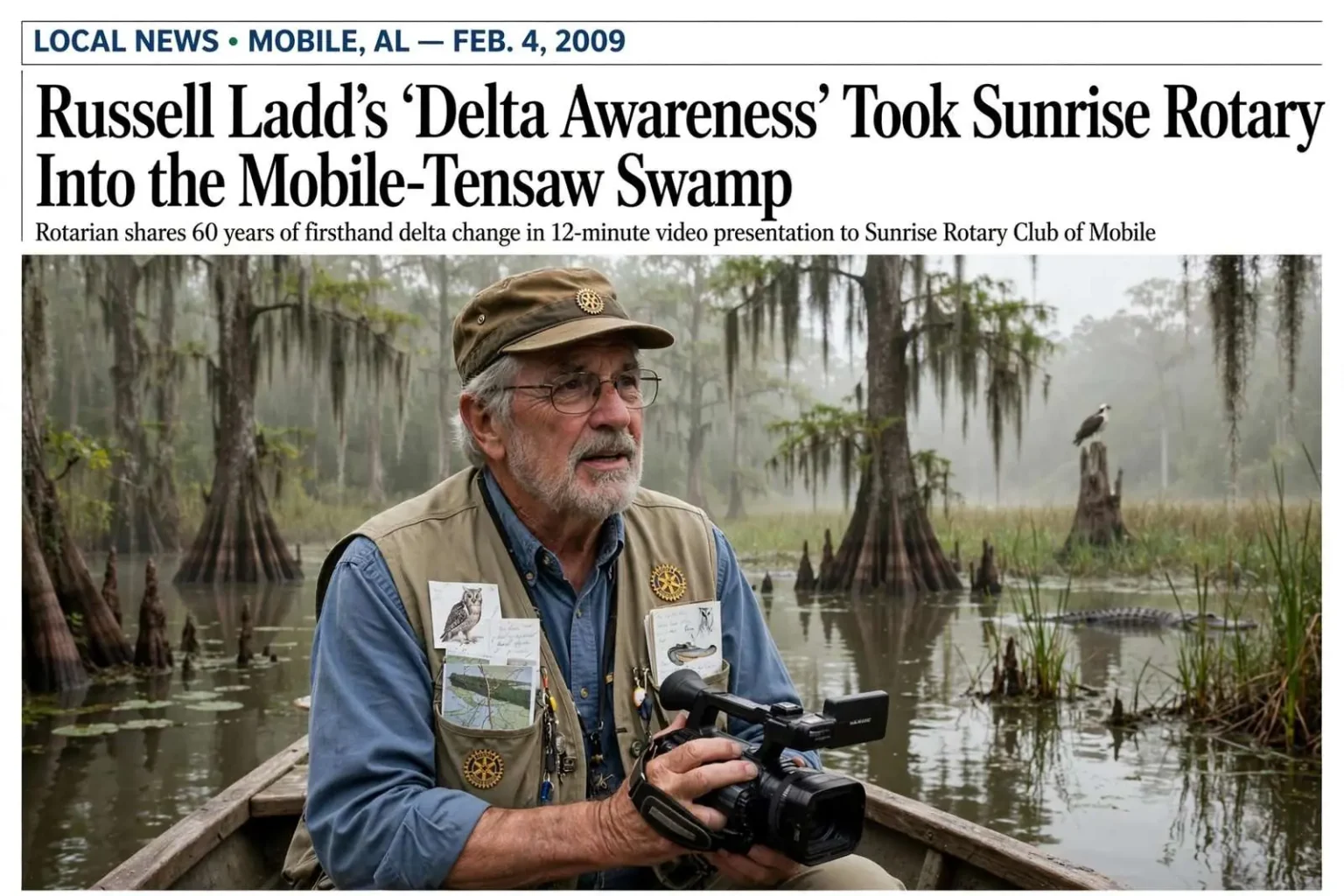
The program before the Sunrise Rotary Club of Mobile on Wednesday, Feb. 4, 2009, was called “Delta Awareness,” and it was the personal cause of Russell Ladd, a member of the Downtown Rotary club who had spent much of his life in the Mobile-Tensaw River Delta. Ladd brought to the Sunrise club the kind of presentation that only decades of first-hand experience can produce — part natural history, part warning.
Sixty years in the delta, in twelve minutes
Ladd’s presentation centered on a twelve-minute video assembled from his own experiences in the delta between 1946 and 2008. It featured his encounters with the wildlife that defines the place — an owl, a cottonmouth water moccasin, an alligator and an osprey — and it closed with a review of the possible causes of the delta’s deterioration.
That last part was the point of the exercise. The Mobile-Tensaw Delta is the second-largest river delta in the United States, a roughly 260,000-acre expanse of swamp, marsh, bottomland hardwood and braided waterways stretching north from Mobile Bay. Biologists have long described it as one of the most biologically diverse places in North America, and it sits directly upstream of a working port and a metropolitan area of several hundred thousand people.
Sedimentation, upstream dams, saltwater intrusion, development pressure and the slow retreat of certain species have all been raised over the years as threats to it. Each factor works differently. Dams on the rivers feeding the delta trap sediment that once replenished its wetlands; saltwater pushed inland by drought, dredging and storm surge alters the plant communities that everything else depends on; and the steady spread of houses and marinas along the delta’s edges fragments habitat that took thousands of years to form.
Ladd’s approach was not an academic one. He had watched the delta change across six decades, and his film made the case that residents who take the delta for granted should look harder at what has been lost. A hunter, fisherman and naturalist’s-eye record assembled between 1946 and 2008 captures a span in which the delta’s character changed more rapidly than at any time in its human history — the years of the reservoir dams, the channelization projects, the growth of Baldwin County across the river and the rise of the region’s population.
The delta talk also fit the club’s place in the city’s geography. Sunrise Rotary draws members whose businesses — marine trades, real estate, banking, law — touch the delta directly, whether through waterfront property, boat traffic or the tourism that the wilderness supports. Speakers who can put sixty years of change on screen in twelve minutes give that audience a shared reference point for the development and conservation decisions that arrive at city and county councils year after year.
Conservation groups working on the delta have long argued that the resource’s economic value — fishing, hunting, tourism and the bay’s fisheries nursery function — depends on the health of the wetlands upstream. Ladd’s video made the same case in the most persuasive form available: images of a place its neighbors love, changing before their eyes across a lifetime.
Rotary programs like “Delta Awareness” serve a purpose beyond the meeting itself. A club of business and professional leaders is an audience of decision-makers — property owners, lenders, contractors — and presentations on the delta’s condition have historically seeded the local conservation politics that followed, from wetland permitting fights to the long-running campaigns to protect the Causeway corridor and the upper bay. The delta’s defenders have always understood that its future depends less on any single regulation than on the public’s familiarity with the place itself.
Youth Merit Award
The club’s Youth Merit Award was presented the previous week to Shante Powell, a student at Dunbar, who was photographed with her award alongside club president Jay Ison. The Youth Merit program is one of the ways the Sunrise club keeps its work pointed at the city’s students, recognizing achievement at schools across the community.
Pretty in Pink Boutique
The St. Paul’s Interact Club, the high school service club affiliated with Rotary, was again sponsoring its “Pretty in Pink Boutique,” collecting gently used prom dresses so that students who could not otherwise afford one would have a dress for the spring. Donations were accepted at St. Paul’s through Saturday, March 7.
Interact members who visited the Rotary club the previous week included Sarah Boyce Wettermark, Katie Tipton, Heather Saad, Maggie Fleming, Laura Minus and Tory Liles. The boutique has become one of the Interact club’s signature projects, matching the formal-wear needs of Mobile students with the closets of families willing to pass along dresses worn once. The March 7 deadline gave donors a month’s window before the spring prom season.
A real estate summit and a literacy month
Club member Don Epley, the University of South Alabama real estate professor who directs the Mitchell College of Business Center for Real Estate Studies, was organizing the second annual Gulf Coast Commercial Real Estate Summit and Market Review for March 11 — a gathering of unusual interest in a year when commercial property values across the coast were falling.
The summit arrived in the depths of the national financial crisis, when commercial real estate was following residential markets into decline and lenders were retrenching across the board. A market review that year was less a celebration than a diagnostic — an attempt to measure how far values had fallen, which property types were holding and what a recovery would require. Epley’s center at South Alabama has long served as the region’s independent source for real estate data, and the summit drew brokers, bankers and developers looking for a grounded read on the market.
Teeto Graham was program chairman for February, with Alabama State Port Authority director Jimmy Lyons scheduled for Feb. 11 and Estella Dorn for Feb. 18. There would be no meeting Feb. 25 because of Mardi Gras. The Mardi Gras recess is a fixed feature of Mobile civic life — no club, school or agency attempts to conduct business on the two weeks when the city’s streets belong to the parades — and the Rotary calendar builds around it every year.
Billy McLean, program chairman for March, announced that the month’s programs would follow Rotary’s literacy theme and would pair it with poverty. Lydia Gaudet of the Literacy Council was to open the series with an overview of illiteracy in the region on March 4; Rose Johnson of the Department of Human Resources was set to discuss poverty and its relationship to illiteracy on March 11; and Jeremiah Newell of the Mobile Area Education Foundation, who had overseen the group’s School Dropout Summit, was to present his findings on the dropout problem on March 18.
The pairing of literacy and poverty reflected how the two subjects had come to be discussed in Mobile. The dropout summit had framed failing schools as an economic problem as much as an educational one, and speakers like Newell — whose foundation work concentrated on the connection between dropping out and lifelong poverty — were drawing straight lines from classroom outcomes to workforce readiness. For a club of employers, the argument carried practical weight: the region’s labor pool is shaped by its graduation rate.
The month was to close on March 25 with a panel of club members — among them Judy Stout, Carolyn Akers and Sam Covert — discussing how illiteracy and poverty complicate hiring and workforce development in the Mobile area. All three panelists had spent years in the city’s education and workforce circles, and the panel format gave the club’s own members the last word on a theme the outside speakers had developed through the month.
Members were also reminded that the Bill and Melinda Gates Foundation had awarded Rotary International $255 million toward polio eradication, bringing the two organizations’ combined commitment to $555 million, and that applications remained open for the RYLA leadership conference April 2-5 at Camp ASCCA on Lake Martin.
The Gates challenge grant required matching funds from Rotary districts worldwide and put the eradication campaign — which Rotary had carried since the 1980s — within sight of its goal in the last remaining endemic countries. For club members, the reminder connected their local dues and fundraising to one of the largest public health efforts ever mounted by a service organization.
RYLA, the Rotary Youth Leadership Awards, brings high school students to Camp ASCCA, Alabama’s Easter Seals camp on Lake Martin, for several days of leadership training each spring. Alabama’s RYLA program draws delegations from Rotary clubs across the state, and the Sunrise club’s sponsorship of local attendees has long been among its most direct investments in the city’s next generation of civic leadership — a theme that ran through the whole of that winter’s program calendar, from the delta’s wild places to the classrooms where its young people were being decided.