Business Council Backs Bonner as Grassroots Caucus Lines Up Behind Challenger
The Business Council of Alabama endorsed U.S. Rep. Jo Bonner for re-election while the Independence Caucus announced its support for challenger Peter Gounares ahead of the June 1 primary.
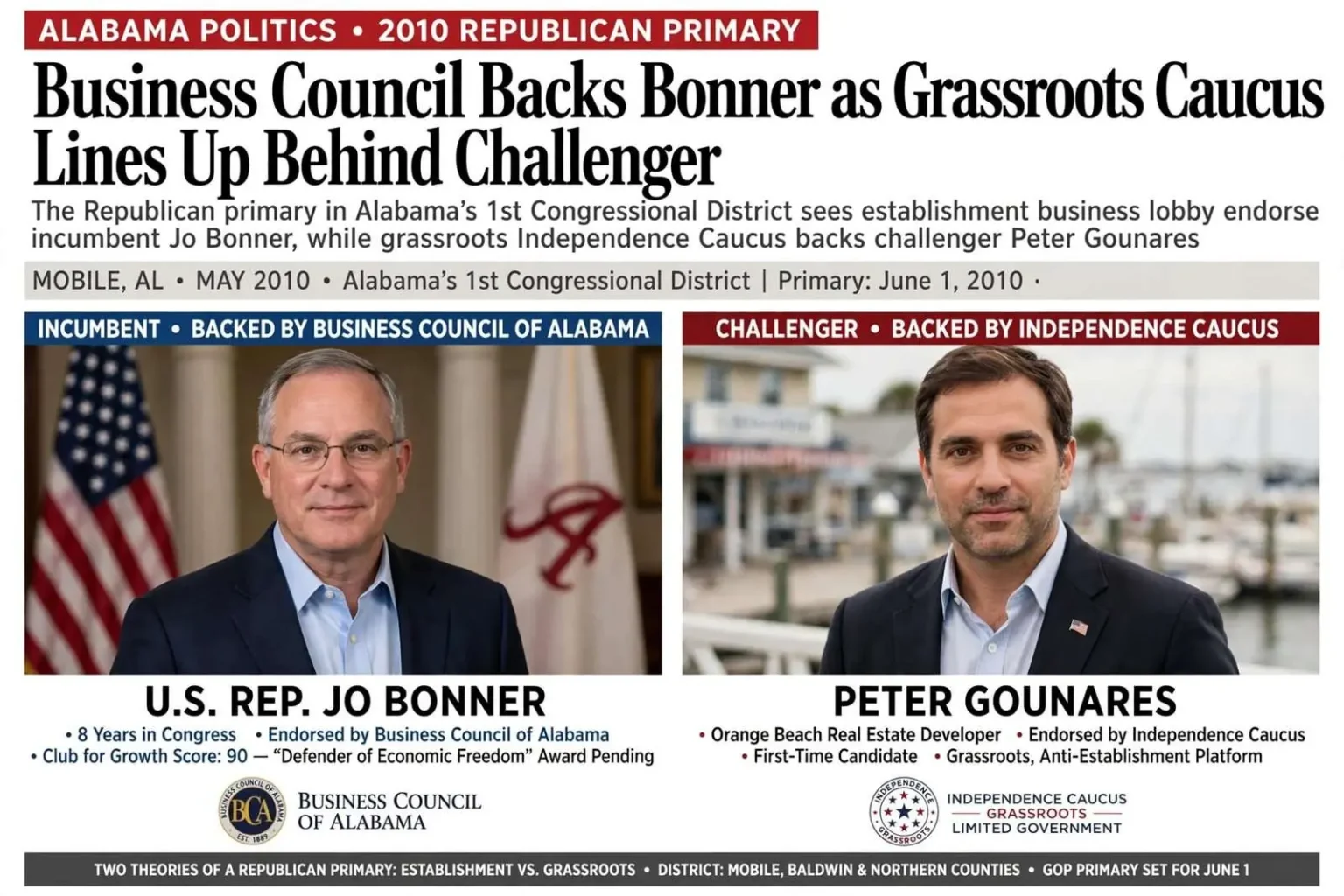
The Republican primary in Alabama’s 1st Congressional District drew competing endorsements this week, with the state’s most prominent business lobby lining up behind the incumbent and a grassroots conservative caucus backing his challenger.
BCA endorses Bonner
The Business Council of Alabama endorsed U.S. Rep. Jo Bonner in his bid for re-election. BCA Chairman Sandy Stimpson called Bonner a “tireless advocate for the growth and progress of the state of Alabama” over his eight years in Congress. The endorsement came as Bonner posted a score of 90 in legislative rankings released by the Club for Growth for the 2009 session. He ranked 57th overall in the U.S. House and scored highest in the Alabama congressional delegation. The group planned to present him with its “Defender of Economic Freedom” award later in the year.
The Business Council’s blessing carried particular weight in this district. The BCA represents Alabama’s largest employers and has been a dominant force in state Republican politics for decades, able to direct money, endorsements and campaign infrastructure to candidates it favors. For a Mobile-based congressman whose district includes the Port of Mobile, major manufacturing and a growing aerospace sector, the business lobby’s support aligned his re-election with the industries that anchor the local economy.
The Club for Growth numbers were, if anything, a more valuable asset in a primary. The group’s rankings reward votes against spending bills, tax increases and government expansion, and a score of 90 put Bonner near the top of the House — a credential no challenger could easily match from the outside. The planned “Defender of Economic Freedom” award would put a national anti-tax organization’s seal on his record weeks before voters went to the polls.
Bonner, a Mobile Republican, had held the seat since 2003, succeeding Sonny Callahan, for whom he had worked as chief of staff. The apprenticeship under Callahan — a popular moderate-to-conservative Mobile congressman who held the seat for nearly two decades — gave Bonner both an institutional base and a road map for representing a district whose politics run from downtown Mobile through the Eastern Shore to the pineywoods counties north of the bay.
Seniority had compounded quietly during his three terms. Committee work touching defense, transportation and appropriations matters directly to a district that contains a major port, shipbuilding and repair yards, the aerospace corridor around Brookley Field, and the military installations that dot the Gulf Coast. Defenders of incumbency in south Alabama have always made the same argument: whatever a challenger’s principles, a third-term congressman who knows the committee system delivers more for the district than a freshman learning the building. That argument was about to be tested in a year when the anti-establishment mood treated it as an indictment.
Independence Caucus picks Gounares
The Independence Caucus, a national grassroots organization then active in Republican primaries around the country, announced its support for challenger Peter Gounares. According to the group, its endorsement required a candidate to complete an 80-question yes-or-no survey covering fiscal policy, constitutional standards, states’ rights and personal character, with at least 70 percent agreement; to sit for a personal interview addressing any disagreements; and to win a vote of caucus members in the candidate’s own state. “For Alabama, Peter Gounares has earned the caucus’ vote of endorsement,” the group said.
The group’s process was the opposite of an establishment endorsement in nearly every detail. Where the Business Council measured a candidate by effectiveness and access, the Independence Caucus measured by questionnaire — a checklist designed to signal ideological discipline. The organization was part of a wave of anti-establishment activism following the election of President Obama, when grassroots conservative groups began fielding and endorsing primary challengers to sitting Republicans they viewed as insufficiently committed to limited government.
A challenger with deep local roots
Gounares, an Orange Beach real estate developer, was making his first run for office. His family history runs deep on the coast: in 1909 his grandfather, Alex Gounares, immigrated from Greece and later opened the Little Coney Island Restaurant and Outdoor Theater at Arlington Pier in Mobile. Through the second half of May, Gounares crossed the district on a run of meet-and-greet stops, from Bay Minette to Uriah, Monroeville to Atmore and Brewton, meeting voters in cafes and catfish houses.
The itinerary told its own story. By trailing the incumbent through the district’s small towns — the Baldwin County communities north of the bay, and the Black Belt-adjacent towns of Monroe, Conecuh and Escambia counties — the challenger was staking his campaign on voters who see a sitting congressman least often. First-time candidates rarely win on money or name recognition; a candidate making his first run competes on time, and Gounares was spending his in the diners where primary voters actually gather.
The family biography — a Greek immigrant grandfather building a restaurant and outdoor theater on Mobile’s waterfront a century earlier — gave the campaign a ready-made narrative of coastal enterprise, and Gounares leaned on his record as a developer in one of Baldwin County’s fastest-growing communities to argue he understood the district’s growth pressures from the inside.
The Arlington Pier business his grandfather built was itself a piece of Mobile lore — a restaurant and open-air theater on the waterfront that drew families in an era before television reshaped entertainment. Stories like it travel well on the campaign trail, and for a first-time candidate they serve a practical purpose: they establish roots and belonging in a way policy papers cannot, connecting a challenger’s name to the district’s own history across a full century.
Two theories of a Republican primary
The dueling endorsements captured a split running through Republican politics in 2010. The Business Council spoke for an establishment that valued seniority, committee assignments and access, and that measured a congressman by what he could deliver for the state’s industries and its port. The Independence Caucus spoke for an insurgent wing that measured candidates against a checklist of principles and treated incumbency itself as a mark against a candidate.
Neither theory fit neatly onto a general election map. In a district that Republican presidential candidates carried comfortably, the May primary was effectively the election, and the only electorate that mattered was the handful of voters motivated enough to show up on the first Tuesday of June. Primary electorates skew more ideological than the districts that elect them, which is why the questionnaire-based endorsement, with its 70 percent threshold, was aimed so precisely at the voters likely to vote twice in a decade.
The year made the insurgent theory unusually potent. The fight over the new health care law, the stimulus and the federal deficit had energized conservative voters who had not previously paid attention to congressional primaries, and incumbents across the country — including seasoned Republicans — were discovering that primary electorates had shifted beneath them. Alabama’s June 1 primary arrived in the middle of that wave, and every incumbent in the state delegation was aware that an ordinary year’s habits might not survive an extraordinary one.
Seat: Alabama’s 1st Congressional District, covering Mobile, Baldwin and several counties to the north. Republican primary: June 1, 2010. Candidates: U.S. Rep. Jo Bonner and Peter Gounares.
The district’s geography shapes its politics in ways both campaigns understood. Mobile County supplies most of the raw population and the traditional Democratic-leaning precincts that rarely vote in a Republican primary; Baldwin County supplies the fastest-growing and most reliably conservative electorate in south Alabama; and the northern counties — Washington, Choctaw, Clarke, Monroe, Conecuh, Escambia and the rest — supply the small-town voters whose turnout decides primaries that Mobile and Baldwin start. With less than two weeks remaining, both campaigns concentrated their efforts on the coastal counties, where the bulk of the district’s Republican primary vote has historically been cast.
Bonner entered the final stretch with the advantages that had made incumbents difficult to beat for a century: name recognition built over seven years and eight in Congress, endorsements from the business community and national groups that scored his voting record, and a fundraising edge no first-time challenger could close. Gounares entered with what insurgents always carry — a message about Washington’s failures, a questionnaire-driven endorsement from a grassroots organization, and the time to shake every hand between Bay Minette and Brewton. Whether 2010 was the year that arithmetic finally flipped was the question the primary would answer.
Whatever the outcome, the contest had already served as a preview of the forces reshaping Republican primaries across the South: establishment endorsements facing grassroots questionnaires, seniority facing term-limit fever, and a challenger class willing to run on principle lists rather than delivered projects. South Alabama’s coastal district, with its blend of port-city establishment politics and fast-growing conservative suburbs, was as likely a proving ground as any in the state.