
Bentley Set to Name Oden to Public Service Commission as Mobile Eyes 2013 Mayoral Race
State Rep. Jeremy Oden was in line for a seat on the Alabama Public Service Commission, while a Mobile precinct canvass showed President Obama winning roughly 60 percent inside the city.
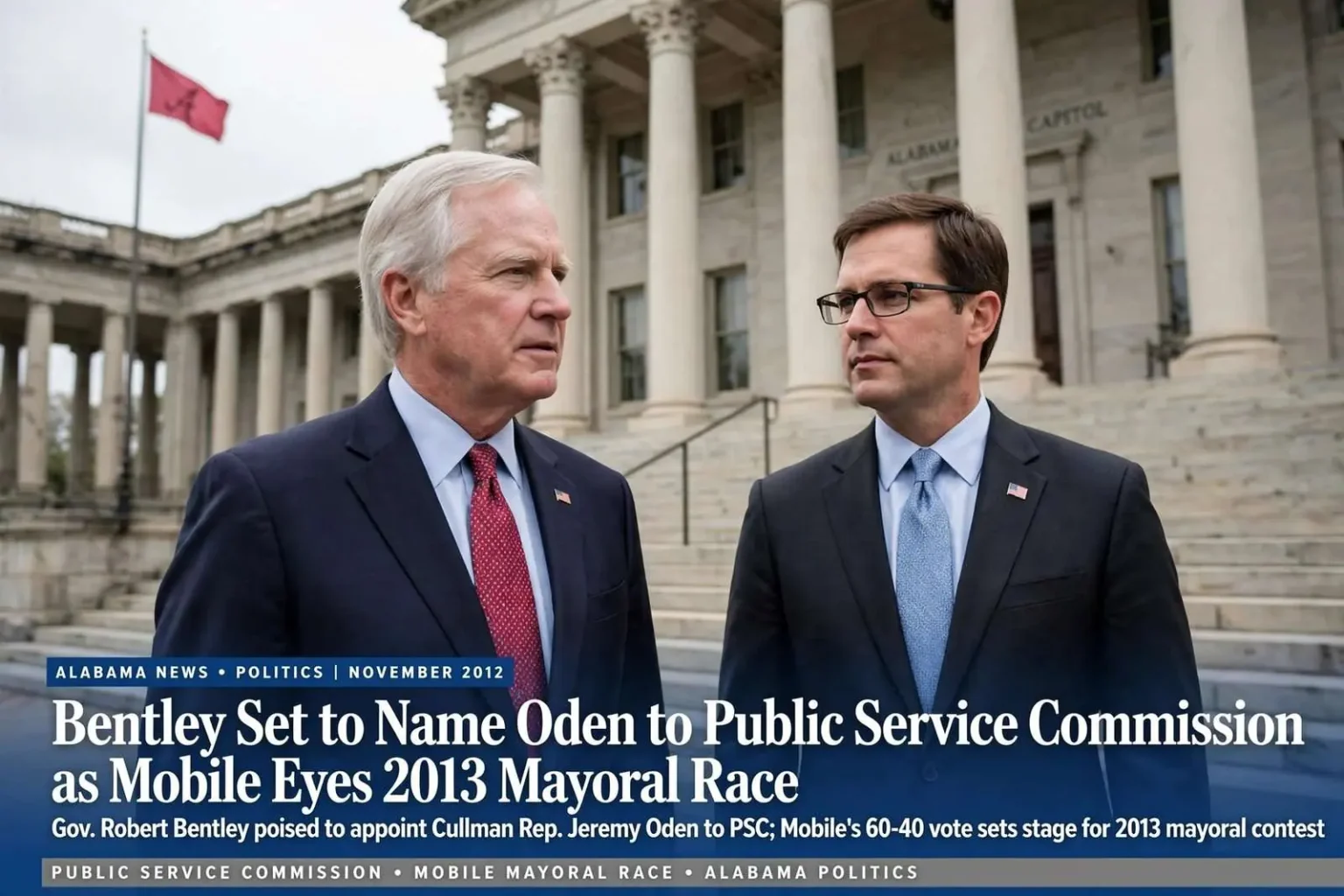
State Rep. Jeremy Oden of Cullman was poised to fill a vacancy on the Alabama Public Service Commission, according to sources familiar with Gov. Robert Bentley’s intentions. The opening was created by Commissioner Twinkle Cavanaugh’s elevation to PSC president following her Nov. 6 victory over incumbent Lucy Baxley, one of the last Democrats to hold statewide office. The appointment, once formalized, would keep the commission’s Republican alignment intact and give a veteran north Alabama legislator a seat on the panel that regulates utilities across the state.
The Public Service Commission — three elected members who oversee the rates and service of Alabama Power, the mobile utilities, and a range of regulated industries — is among the most consequential and least glamorous posts in state government. Its decisions shape the electric bills of every household and business in Alabama, and its elections rarely draw the attention of legislative or gubernatorial races. Cavanaugh’s defeat of Baxley, a former state treasurer and lieutenant governor, completed the Republican sweep of statewide offices and left the commission entirely in GOP hands.
Bentley’s choice also carried practical weight for the commission’s docket. The panel was in the middle of electric rate proceedings and regulatory reviews that touch nearly every sector of the state’s economy, and filling the seat with a sitting legislator familiar with the State House’s workings spared the commission an extended transition. A special election to fill the vacancy, the alternative route, would have left the seat open for months.
A Cullman Republican moves up
Oden, 44, represented District 11 in the state House of Representatives, a seat covering Blount, Cullman and Morgan counties, and served on the Ways and Means, Education and County and Municipal Government committees. A native of Vinemont first elected in 1998, he had built a reputation as a reliable conservative vote during nearly fifteen years in Montgomery, spanning the Democratic control of the House that defined his early terms and the Republican landslide of 2010 that transformed the chamber.
He held a degree from Asbury College and had completed graduate work at Asbury Theological Seminary. In private life he served as chief financial officer for Delta Discount Corporation and was active in his church and a range of civic and fraternal organizations. The biography — small-town roots, business background, church and community involvement — fit the profile Bentley had favored in appointments throughout his first term, and it positioned Oden to face voters statewide in the next commission election.
His anticipated appointment reflected the broader Republican consolidation of statewide power that followed the 2012 elections, in which the party swept Alabama’s constitutional offices. For a decade, Democrats had held scattered footholds in statewide government even as the party’s legislative fortunes collapsed; Baxley’s loss erased the last of them, and the PSC vacancy gave Bentley a chance to deepen the new alignment with an appointment rather than a special election.
Reading the Mobile city vote
Even amid the Republican tide, a closer look at the returns inside the city of Mobile told a different story. A canvass of Mobile County precincts showed the county splitting roughly 45 percent for President Barack Obama and 55 percent for Mitt Romney. But when the count was narrowed to city precincts alone, excluding hard-to-place absentee and provisional ballots, Obama drew about 60 percent to Romney’s 40 percent.
The split between county and city reflected the demographics of metropolitan Mobile: the city’s core and its western and southern precincts leaning Democratic, while the unincorporated county and suburban municipalities tilted heavily Republican. Analysts noted only two precincts straddled the city line, Plateau and Mt. Ararat, and appeared to largely cancel each other out. The Plateau count included Prichard voters, inflating the Obama total, while Mt. Ararat included white voters in Theodore outside the city limits, inflating Romney’s. By any method, observers concluded, the city broke roughly 60-40 for the president.
The Plateau-Mt. Ararat comparison became the talk of the local canvass precisely because it showed how arbitrary boundary lines can bend a precinct’s numbers. Both precincts stitched together neighborhoods from inside and outside the city, and each absorbed voters from a different neighboring community. Data-minded observers in both parties spent days running the alternatives — with absentees, without absentees, splitting the boundary precincts — and every arrangement landed near the same place: the city of Mobile gave the president three of every five votes cast within its limits.
Vote-counting minutiae of this kind rarely matter beyond election night, but in Mobile the numbers fed directly into the city’s own political calendar. Municipal elections in Alabama are formally nonpartisan, yet the partisan composition of the electorate shapes who turns out, who contributes and which coalitions a candidate must assemble to win City Hall.
A preview of the 2013 mayoral contest
The numbers carried immediate local significance. Advisers to Mobile Mayor Sam Jones pointed with satisfaction to the president’s strong showing on the incumbent’s home turf, hoping Jones could mirror or exceed that appeal when he faced business leader Sandy Stimpson and others in the August 2013 municipal elections. Jones, the city’s first Black mayor, had won the office in 2005 and survived a close re-election in 2009, and his team read the city’s Democratic base as the foundation of any winning coalition.
Stimpson, for his part, cautioned against drawing straight lines from the national race to a city contest. “We are running a very different campaign in Mobile than Mitt Romney or the President,” he said, arguing that municipal issues hit closer to home than the questions dominating a presidential year. He predicted a tough race and pledged a hard-working campaign, adding that his team expected to have some fun along the way.
Stimpson’s argument had a practical edge. A retired executive who had spent years in Mobile’s civic and business circles, he planned to campaign on the city’s operating budget, its crime rate and its stalled development agenda — questions, he argued, that cut across party lines and would be decided by voters judging performance rather than partisanship. His allies noted that Mobile’s municipal races in recent decades had repeatedly defied the city’s Democratic registration margins, with coalitions of business-oriented voters, neighborhood associations and disaffected residents deciding the outcome.
The exchange previewed the argument both camps would make through the following summer. Jones’s advisers would cast the race around continuity and the city’s Democratic-leaning electorate; Stimpson would run on city finances, crime and a promise to restore confidence in City Hall, building a coalition that reached beyond party lines. The 60-40 city split gave neither side a clear answer — municipal turnout in Mobile runs far below presidential turnout, and the voters who actually appear in an August city election are a different, smaller universe.
Elsewhere in the region, the Baldwin County Republican Executive Committee prepared to elect officers for the coming year at a meeting in Robertsdale, with state chairman Bill Armistead as guest speaker. The gathering in the heart of Alabama’s most reliably Republican county capped a season of reorganization meetings across the state, as local parties absorbed the results of the November sweep and positioned themselves for the municipal elections of 2013 and the statewide contests beyond.
Oden’s departure from the House also set in motion the machinery for a special election in District 11, where local Republicans in Blount, Cullman and Morgan counties would soon begin lining up to succeed him. In Alabama’s post-2010 political landscape, the Republican nomination in a north Alabama house district is effectively the election, and the vacancy drew interest from county commissioners, municipal officials and party activists across the three counties.
Armistead’s appearance underscored the energy in the party’s grassroots following the election. Baldwin County’s committee, one of the largest and most active in the state, had delivered some of the GOP’s widest margins in November, and its officer elections would set the tone for how the county party engaged city races in Daphne, Fairhope, Foley, Gulf Shores and the county seat at Bay Minette in the year ahead.
Taken together, the week’s developments traced the same theme from three directions: a Republican Party consolidating its hold on state offices with appointments like Oden’s, a national election whose returns exposed the partisan geography within Mobile’s city limits, and a mayoral campaign already framing itself for the nonpartisan contest to come. Mobile politics in the decade’s second decade would be shaped by exactly this tension — a city that voted Democratic at the top of the ticket, in a state that had gone decisively the other way, choosing its leadership on municipal terms.
For Oden, the move from the House district he had held since 1998 to a statewide commission seat represented both a promotion and a test — trading a safe legislative seat for a post whose decisions land in every Alabama mailbox with the monthly power bill. For Mobile, the numbers and the counterarguments exchanged that November were the opening notes of a 2013 municipal race that would end, in time, with City Hall changing hands.


