State GOP Chairman Hails County Gains as Republicans Advance Across Alabama
Alabama Republican chairman Bill Armistead declared his 2012 county-level campaign a success, citing a net gain of 45 offices, even as Democrats pointed to Robert Vance’s strong showing.
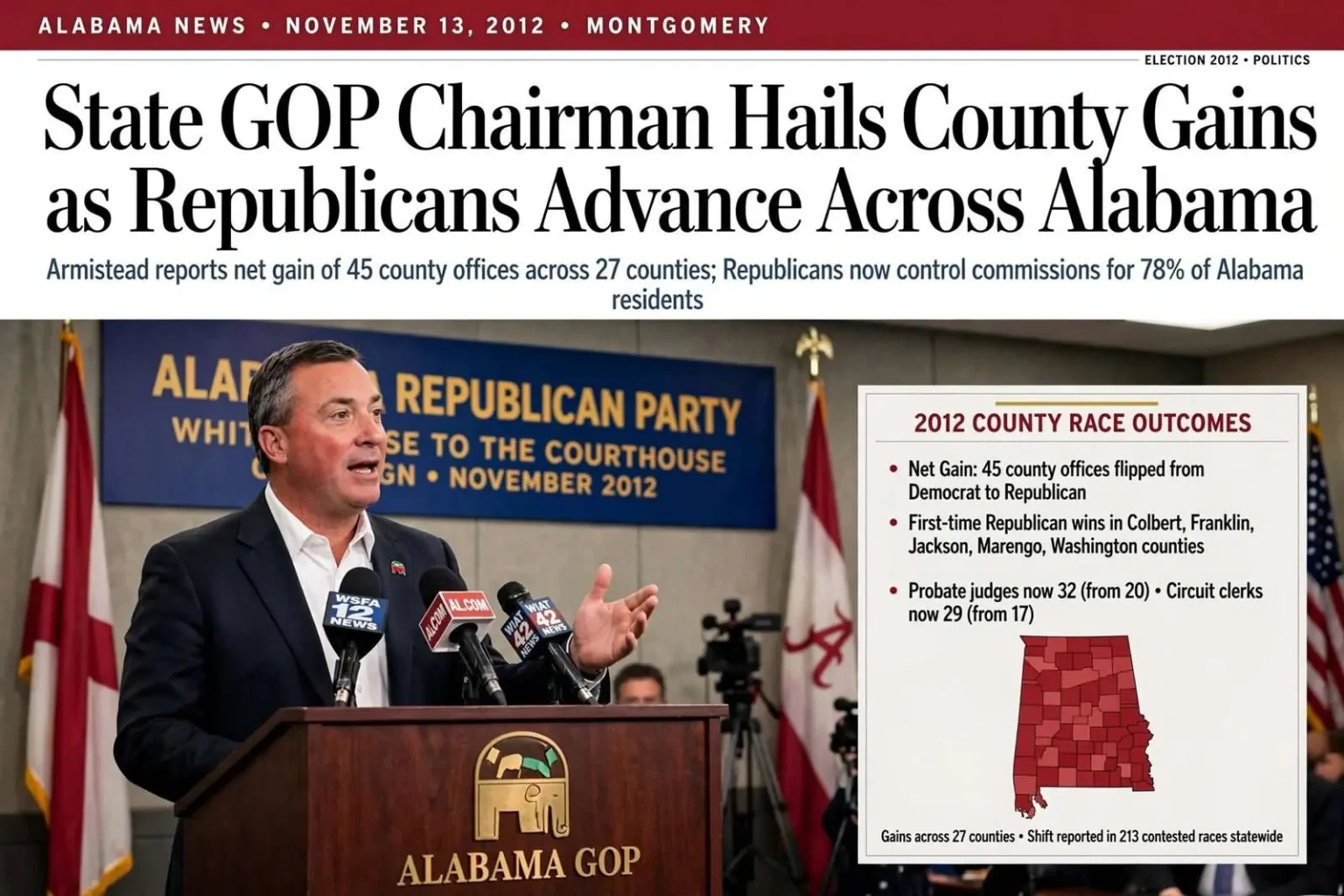
One week after the 2012 general election, Alabama Republican Party chairman Bill Armistead declared his party’s effort to win offices from the courthouse to the White House a resounding success at the local level, even as the presidency slipped away nationally. His “White House to the Court House” campaign, he said, had produced dramatic Republican gains in county offices long dominated by Democrats.
A Net Gain of 45 Offices
Armistead reported that in 213 contested county-level races statewide, Republicans had flipped more than 53 percent of Democratic-held offices in targeted counties, for a net gain of 45 offices spread across 27 counties. The results, he argued, showed that Alabama Republicans were no longer a regional party but a statewide force.
For the first time in more than a century, he noted, Republicans won office in Colbert, Franklin, Jackson, Marengo and Washington counties. In ten counties, including Chambers, Cherokee, Clarke, Cullman, Henry, Limestone, Marion, Morgan, Tallapoosa and Washington, a Republican probate judge or circuit clerk replaced a Democrat. In six others, appointed Republican officeholders who had been vulnerable held their seats and won election outright.
By Armistead’s count, the party had grown from just 20 probate judgeships and 17 circuit clerk positions to 32 and 29, respectively. Roughly 78 percent of Alabamians, he said, now lived in counties with Republican-controlled commissions.
The numbers described a quiet transformation that had been building for years. County courthouses were the last bastions of Democratic strength in a state that had already shifted decisively in federal and legislative races, and probate judges and circuit clerks — the officials who run elections, probate wills and issue marriage licenses — were the offices where the realignment finally arrived. Winning them meant Republican ballot access and organization in towns where the party had never maintained a foothold.
Symbolic Breakthroughs
The chairman singled out a handful of victories he considered especially significant. In Marengo County, in the heart of the Black Belt, Dan England became the first Republican ever elected to the county commission, a crack in what had long been a Democratic stronghold. In Escambia County, Dr. Coleman Wallace became the first African-American Republican elected to the local Board of Education, a milestone Armistead said he hoped would be the first of many.
For years, he observed, running for local office in much of Alabama had been synonymous with running as a Democrat. That assumption, he argued, no longer held.
The Black Belt counties that had anchored Democratic strength for generations — counties where race, history and economics had shaped politics since Reconstruction — remained the party’s safest ground, but the 2012 results showed even there the Republican ticket was no longer an automatic zero. Armistead’s framing of England’s win as historic reflected how thoroughly one-party local government had defined those communities, and how newsworthy any deviation had become.
Democrats Point to the Courts
Democratic leaders offered a more measured reading. State chairman Mark Kennedy and Mobile County chairman Napoleon Bracey pointed to the strong, if losing, showing by Democratic chief justice candidate Robert Vance against the controversial Republican Roy Moore as evidence of residual strength the party could rebuild upon in future cycles.
Vance’s statewide performance gave the party its most competitive bench mark of the cycle, and the two chairmen argued that a candidate nearly winning a statewide judicial race demonstrated a depth of support that county-level tallies understated. Their task, as they framed it, was recruiting candidates for the courthouse races Republicans had just swept — offices where, for the first time in generations, the Democratic label itself had become a liability in much of the state.
Mobile County Notes
Closer to home, the shifting landscape was visible in Mobile County government. Newly elected County Commissioner Jerry Carl, who had unseated longtime incumbent Mike Dean in the Republican primary before defeating Democratic nominee Terrence Burrell in the general election, received a $1,500 campaign contribution on Nov. 1 from Adams & Reese, a New Orleans-based regional law firm that employed county commission attorney Jay Ross.
The contribution drew attention because of the firm’s connection to county government through Ross, whose firm held the commission’s legal counsel contract. Campaign finance filings from the post-election period offered a first look at the donors behind the county’s newly configured commission, and the Adams & Reese check illustrated how regional firms with business before local governments tracked — and invested in — the state’s realignment.
Carl’s unseating of Dean in the primary had been one of the cycle’s notable local upsets, ending the tenure of a commissioner whose service stretched across decades of county growth along the Western Shore. Dean’s defeat in May had effectively settled the seat, given the county’s Republican tilt, but the general election contest with Burrell gave voters the formal choice that completed the transition.
A New Chief for Court Police
In the county courthouse, presiding Circuit Judge Charlie Graddick named court police lieutenant Thomas L. Stiles to succeed Court Police Chief Bob Patterson, who was retiring Dec. 1. The 13th Judicial Police Department oversees security throughout Mobile Government Plaza, as well as probate court, Mobile Community Corrections and the Strickland Youth Center.
The appointment placed Stiles in charge of security for one of the busiest judicial complexes in the state. Government Plaza houses municipal and county courts alongside city and county administrative offices, meaning the court police force’s responsibilities extend from arraignments and trials to probate proceedings, community corrections supervision and juvenile matters at the Strickland Youth Center.
Graddick, the presiding judge, made the selection as Patterson closed out a career spanning the department’s modern era. Transitions atop the court police force matter beyond ceremony: the chief sets daily posture for courthouse screening, courtroom bailiff coverage and the coordination with deputies and municipal police that keeps the plaza’s multiple courts running securely.
A Lasting Realignment
Together, the local moves underscored a county, and a state, in the midst of a lasting political realignment. The same election that produced Republican sweeps in rural courthouses also reset the composition of Mobile County’s commission, and the personnel decisions that followed — a new commissioner taking office, a new court police chief preparing to take command — showed how electoral shifts translate into the people who actually run government.
Armistead’s celebration captured one half of that story, and the Democrats’ counterpoint captured the other: a party retreating to fewer, stronger positions while claiming a foundation for recovery. What neither side disputed was the scale of the change. A state whose county governments had been Democratic institutions for more than a century had, in a single November, turned overwhelmingly Republican from the courthouse up — with the White House to the Court House campaign, whatever its limits on the national stage, having done precisely what its name promised.
What the Courthouse Offices Mean
The offices at the center of Armistead’s tally matter more than their low profile suggests. Probate judges oversee elections administration, probate of estates, adoptions and — in many counties — a wide range of record-keeping duties that touch nearly every family. Circuit clerks manage the dockets of the court system, collecting fees and processing the paperwork of every criminal and civil case filed. County commissions control roads, bridges, budgets and, in rural counties, some of the largest payrolls in the community.
Winning those offices changes the daily experience of government in ways voters feel directly, and it builds a farm team of experienced officeholders for future legislative and congressional races. That is why party chairmen count probate judgeships as closely as legislative seats, and why Armistead’s statistics — from 20 to 32 probate judges, from 17 to 29 circuit clerks — were presented as leading indicators of a durable majority rather than a one-cycle wave.
The 78 percent figure for residents living under Republican-controlled commissions carried its own significance. It meant that for most Alabamians, the county government nearest at hand — the one fixing the road, funding the volunteer fire department and setting the local tax levies — now reflected the party’s governance, not just its ballot totals.
The Black Belt and the Limits of the Wave
For all the statewide numbers, the election also mapped the realignment’s boundaries. The Black Belt’s Democratic strongholds held in most countywide races, sustained by deep community ties and a long tradition of local Democratic organization. Marengo County’s commission seat, the exception Armistead celebrated, stood out precisely because it was the exception — the first Republican ever elected there, in a county where such a result had never before occurred.
Democrats, reading the same map, drew their own conclusions. Kennedy and Bracey’s emphasis on Vance’s chief justice race reflected a strategy of consolidating strength in judicial and municipal races while rebuilding county organizations from the ground up. Whether that foundation could be converted into courthouse wins in 2014 and 2016 was the open question both parties acknowledged.
One November, Two Governments
The immediate aftermath of the election played out in courthouses and administrative offices across the state. Incoming commissioners and clerks prepared to take oaths; defeated incumbents closed out decades of service; and appointed officials who survived their first test at the polls settled in for full terms. In Mobile County, the commission’s new composition and the courthouse’s leadership change were the local face of that transition.
Political scientists would later treat 2012 in Alabama as the cycle in which the state’s party realignment completed its sweep down the ballot. Armistead’s numbers — 213 contested races, 27 counties, 45 net gains — were the raw material of that verdict, and his pride in them was plain. The courthouse, the last stop on the ballot, had finally come to match the rest of the Republican column in most of Alabama.
What remained contested was the meaning for the opposition: a warning, or a turnaround. The two parties would spend the next cycles answering that question, but the 2012 results set the terms — a state government and county map redrawn in red, with pockets of blue where the old loyalties ran deepest.