After the 2012 Vote, Mobile Bay Analysts Tally the Winners and Losers
Days after the 2012 election, attorneys, consultants and officials across the Mobile Bay area weighed the winners and losers beyond the obvious, from ticket-splitting to the AEA’s comeback.
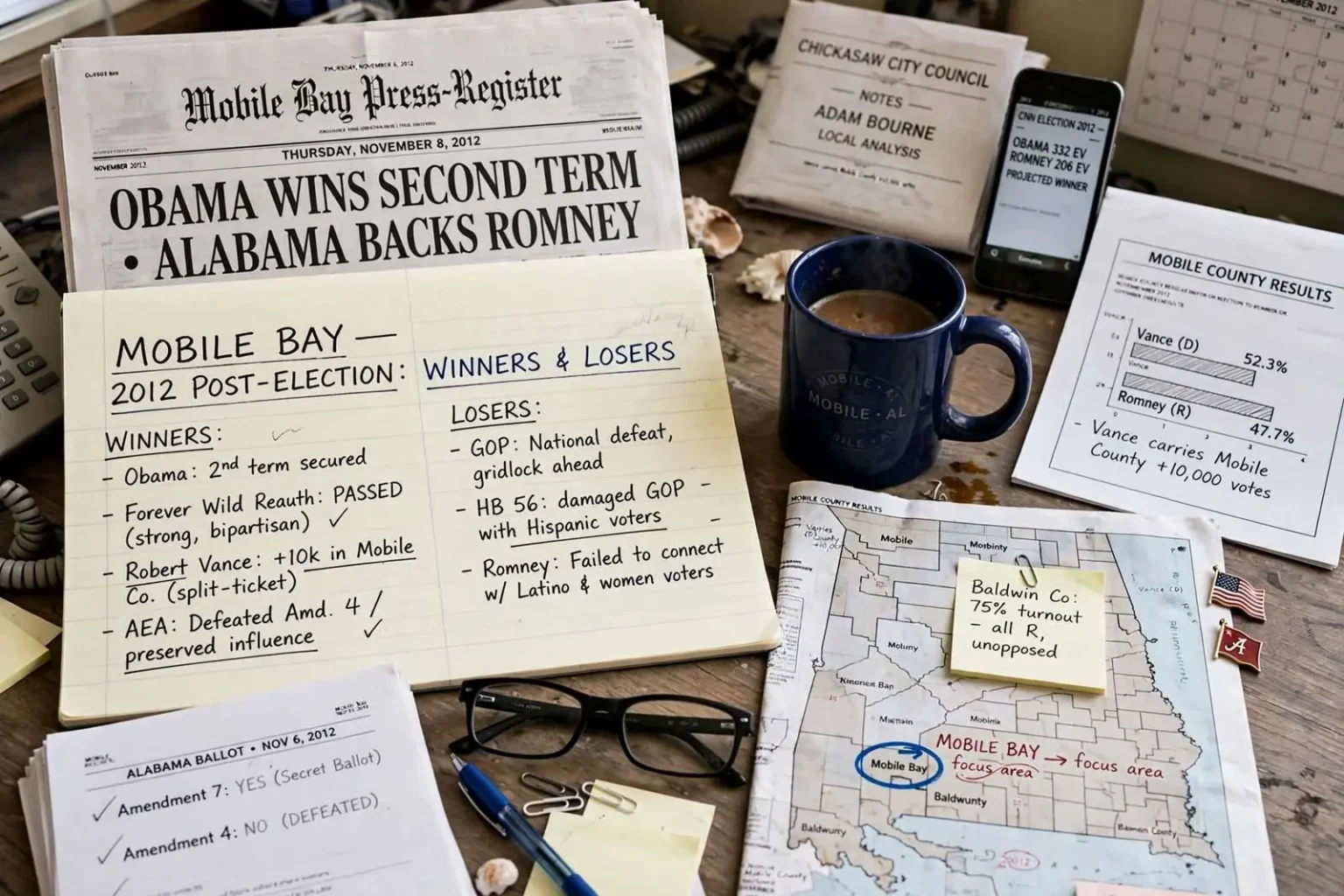
In the days after the 2012 election, the headline results were plain enough: President Barack Obama had won a second term, and Alabama had once again voted overwhelmingly Republican. Yet beneath those obvious outcomes, Mobile Bay area analysts found a more complicated ledger of winners and losers, one that turned on ticket-splitting, demographic shifts and the quiet resurgence of old power centers. What looked like a straightforward night — a Democratic president re-elected nationally, a Republican state carried easily by Mitt Romney — turned out, on closer inspection, to be a patchwork of local stories that did not fit the national narrative.
A national defeat, local consolation
Bradley Byrne, a Mobile attorney and Republican who would go on to his own career in Congress, offered one of the fullest post-mortems of the local voices surveyed in the election’s aftermath. Nationally, he argued, the taxpayer and the job-seeker had lost the most, with a divided Washington poised for continued gridlock. A re-elected Democratic president facing a Republican House, in his telling, meant two more years of stalemate on spending, taxes and the size of government — the very questions the campaign had been fought over.
At the state level, though, Byrne saw something less bleak for his opponents. Alabama Democrats had absorbed the expected blows — losing every statewide contest on the ballot — but found life in local races in Jefferson, Montgomery, Madison and Tuscaloosa counties, the four urban centers where the party’s remaining strength is concentrated. Legislative seats held in those counties, he noted, gave the party a base to rebuild from, however modest.
He pointed, too, to the roughly 200,000 Romney voters who split their tickets to support Democratic chief justice candidate Robert Vance. That figure was a sign of residual strength the party could build on, and a reminder that even in a Republican state, a substantial bloc of conservative voters was willing to cross party lines for an individual candidate they trusted on the courts.
Byrne reserved particular attention for the Alabama Education Association, the teachers’ lobby that has long ranked among the most influential forces in Montgomery. The organization, he said, had enjoyed a strong year by helping defeat Amendment 4, the property-tax measure on the statewide ballot, and by blocking several of Gov. Robert Bentley’s legislative priorities during the preceding session. Whatever else the election had settled, the AEA’s ability to shape outcomes — particularly among rural legislators of both parties — remained intact.
The Forever Wild land conservation amendment, Byrne observed, drew more votes in Alabama than Mitt Romney himself. The program, which uses interest from the state’s trust funds to buy and preserve recreational and environmentally sensitive land, had been sent back to the voters for reauthorization, and it passed with ease. The comparison between the program’s total and the Republican nominee’s was evidence, Byrne said, of broad bipartisan support for land conservation — hunters, fishermen and outdoor enthusiasts of both parties had simply refused to let the program expire.
The lessons of ticket-splitting
Adam Bourne of the Chickasaw City Council flagged a pair of local surprises that had gone largely unreported in the days after the polls closed. Two Democrats, Lucy Baxley and Vance, had actually carried Mobile County even as they lost statewide. Baxley, the former state treasurer running for a seat on the Public Service Commission, and Vance, the circuit judge from Birmingham seeking the chief justice’s chair, both ran ahead of their party’s national ticket in Mobile County, and Vance ran more than 10,000 votes ahead there.
The lesson, Bourne said, was that general elections in Alabama still mattered and that both parties needed to nominate their most effective candidates rather than take any race for granted. Mobile County, though reliably Republican in federal races, had a long history of supporting moderate Democrats for state and local office, and candidates who fit that mold could still win here even in a year when the national environment was as hostile as 2012.
Businessman Sage Lyons attributed Romney’s national defeat to the campaign’s failure to connect with Latino and female voters, two groups that had moved decisively toward Obama in the exit polls. The deficit was compounded, he argued, by the late disruption of Hurricane Sandy, which froze the campaign’s momentum along the Eastern Seaboard in its final week, and by damaging remarks from Senate candidates in other states — several of whom made comments about rape and abortion that became national stories and dragged down Republican candidates across the ballot.
A recurring theme among several of the analysts surveyed was that Alabama’s tough immigration law had done real harm to the Republican brand among Hispanic voters, an unintended consequence with national reach. HB 56, enacted the year before and billed at the time as the toughest immigration enforcement statute in the country, had drawn lawsuits, national news coverage and a steady stream of critical stories about its effects on schools, churches and businesses. Analysts noted that the law gave Democrats a ready-made talking point with Hispanic voters in swing states, making Alabama’s domestic legislation a factor in a national campaign it was never designed to influence.
Warnings for a triumphant party
Even amid Republican dominance, some voices urged caution. Consultants warned that shifting demographics — a growing Hispanic population, an increasingly urban electorate, and younger voters who had come of age in the Obama era — favored Democrats over the long term unless the GOP broadened its appeal on immigration, health care and other issues. The Republican Party’s problems, in that view, were not the quirks of a single candidate but the leading edge of a demographic trend that would only intensify in future cycles.
The Obama campaign’s mastery of micro-targeting and turnout, several agreed, had been the decisive edge in the battleground states. The campaign’s use of data to identify occasional voters and get them to the polls, block by block and precinct by precinct, outperformed the Republican effort, and the gap was visible in states like Ohio, Virginia and Florida. Republicans, the analysts concluded, would need to modernize their own ground game and use of social media — building permanent voter files, investing in neighborhood-level organizing and matching the Democrats’ digital operation — rather than treating turnout machinery as something to be assembled only in the fall of an election year.
That point was echoed by Mobile City Councilwoman Bess Rich, who took the long view from local office. She argued that campaigns increasingly were won and lost in the months before the campaign, in the quiet accumulation of contacts, data and credibility, and that Alabama Republicans should study what had happened nationally rather than assume the state’s partisan margin would protect them forever.
For Baldwin County Republicans, the mood was purely celebratory. Analysts crowned the county the reddest in a very red state, with its countywide races going entirely uncontested by Democrats — a sign of how completely the party’s old dominance had faded on the Eastern Shore. They also praised Probate Judge Tim Russell for managing a record turnout of roughly 75 percent smoothly on Election Day, with long lines moving efficiently and no significant disruptions reported across the county’s precincts.
A plea for governance
Retired congressman Jack Edwards, a Republican who represented Mobile in the House for three decades, used the moment to call for a return to regular cooperation between the White House and congressional leaders. He recalled the weekly meetings of his own years in office, when presidents of both parties sat down with legislative leadership to work through the agenda, and lamented that the practice had withered. The voters, he suggested, had chosen divided government, and divided government could only function if the people running it talked to each other on a schedule rather than only at press conferences.
Rosemary Elebash of the National Federation of Independent Business warned that small-business owners still faced uncertainty over taxes, regulation and the looming fiscal cliff — the year-end collision of expiring tax cuts and automatic spending reductions that threatened to push the economy back into recession. Her members, she said, had spent the entire campaign year deferring hiring and investment decisions because they could not tell what the tax code would look like in January, and the election’s outcome had not resolved the question.
She did have one victory to celebrate: the passage of Amendment 7, which guaranteed secret ballots in union elections and was pushed by business groups as a preemptive strike against card-check organizing. Alabama’s amendment, like similar measures in other states, passed comfortably, and Elebash called it the night’s clearest win for the state’s small employers.
If the analysts agreed on anything, it was that the election had settled less than it appeared. Obama would govern a divided capital, with the fiscal cliff and the debt ceiling waiting almost immediately. Alabama Democrats faced a long road back even as they clung to pockets of local strength in the cities and in candidates like Vance who could attract cross-party votes. And a triumphant state Republican Party confronted quiet warnings about the demographics of the future from the same voices that had celebrated its sweep. The work of governing, everyone seemed to concede, was only beginning.