Beachfront Lot Sells for $6.15 Million as Investors Circle the Coast
A five-acre Orange Beach beachfront lot sold for $6.15 million as investors also bought Eight Mile storage, a former west Mobile music store, and lined up hotels and an RV resort across Mobile and Baldwin counties.
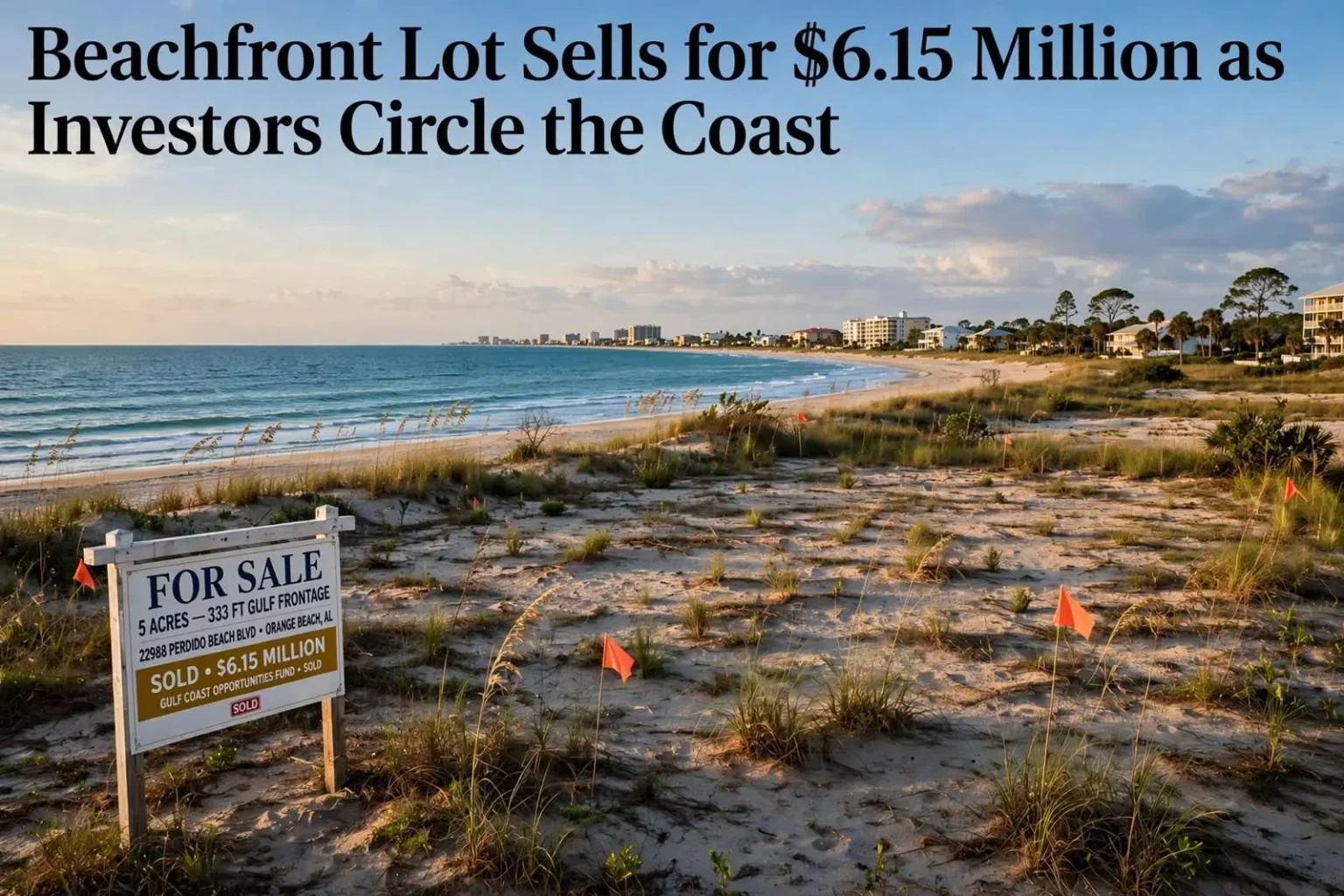
A five-acre beachfront lot changed hands for $6.15 million in Orange Beach, one of several deals that showed investors moving on land, storage and retail sites across Mobile and Baldwin counties. The sale headlined a stretch of commercial real estate activity that stretched from the Gulf front to office parks in west Mobile, and it offered a snapshot of a market in which buyers were willing to put money to work across every category, from hospitality to self-storage to medical offices.
Millions on Perdido Beach Boulevard
The lot at 22988 Perdido Beach Blvd. in Orange Beach, with 333 feet of Gulf frontage, was purchased by the Gulf Coast Opportunities Fund, according to Nathan Cox of Bellator Real Estate & Development, who represented the buyers. The seller was MMA Realty Capital of Florida.
Five acres of direct Gulf frontage is among the rarest commodities in Baldwin County real estate. Perdido Beach Boulevard is the coastal spine of Orange Beach, and parcels with unobstructed views of the Gulf rarely trade at all; when they do, they attract buyers looking for large-scale development or long-term land banking. The $6.15 million price reflected that scarcity, and the involvement of an investment fund rather than an individual buyer signaled institutional confidence in the corridor’s future.
The site had drawn ambitious plans before: in 2010, Mobile businessman K.C. Chiang had sought financing to develop a $160 million, two-tower Wyndham & Winfield Resort Hotel & Convention Center there, envisioned with 500 hotel rooms, a 1,200-seat convention center, a 20-lane bowling alley and a theater. That project never broke ground, but the scale of the proposal illustrated what investors have long believed the parcel could support: a destination-scale development on one of the last large tracts on the beach road.
Deals of this kind ripple through the local economy well beyond the closing table. Beachfront land sales set comparables that touch every nearby condominium, rental and retail property, and lenders watch them as a gauge of how aggressively capital is moving along the coast. A fund willing to spend at that level on raw land is a statement that the Orange Beach market has room to run.
Storage, a Music Store and a School Supplier
An investor paid $725,000 for the 181-unit Eight Mile Mini Storage, on 1.75 acres at 472 Lott Road in Eight Mile, according to court records. Richard Mann of Prudential Cooper & Co.’s commercial division represented the buyer, and Stuart LaGroue of Omega Properties worked for the seller. Three office spaces were included in the sale.
Self-storage has long been a favorite of small investors in the Mobile area, and for good reason: the business model is simple, the tenant turnover is high in a transient port city, and the properties require little ongoing management compared with apartments or retail. The Eight Mile area along U.S. 45 north of the city has grown steadily as development pushes out from Mobile toward the county line, and storage facilities there serve both new households and the contractors who build for them.
In west Mobile, a local investor paid $550,000 for the bank-owned, 12,000-square-foot former MMI Music building at 664 University Blvd., near Cottage Hill Road. Terry McKinney of Delaney Land & Realty represented the buyer, and School Aids, a school supply business, planned to open in the building. David Cooper of Prudential Cooper & Co.’s commercial division worked for the seller.
That transaction carried two markers of its era. First, the building was bank-owned, one of the distressed properties lenders across the Gulf Coast had taken back after the downturn and were gradually working through their books. Second, its reuse showed how quickly vacated space finds a second life in a healthy market: a former music store on one of west Mobile’s busiest retail corridors becoming home to a school supply business, a natural fit on a street that funnels traffic past some of the city’s largest public schools.
University Boulevard near Cottage Hill Road sits in the heart of west Mobile’s commercial belt, a stretch of the city that grew rapidly in the closing decades of the twentieth century and remains one of the area’s primary retail and service corridors. When space comes open there, landlords rarely wait long for tenants, and the arrival of a specialized retailer like School Aids underscored how local operators use those openings to expand.
Hotels and an RV Resort
Construction was under way on an 80-room Hampton Inn on Ala. 59 in Foley, near the Cracker Barrel restaurant, with an opening expected the following June, according to Jeff Rouzie, director of economic development for the city of Foley. The hotel’s developer also owned the adjacent Holiday Inn Express Hotel.
The project extended a pattern that has defined Foley’s growth: lodging clustering along the Ala. 59 corridor that funnels nearly all traffic from Interstate 10 down to the Gulf Shores beaches. Hotels built just outside the beach towns capture the overflow demand from Orange Beach and Gulf Shores while offering the restaurants, shopping and lower land costs of Foley itself. An operator doubling down with a second flag beside an existing hotel is a bet that the corridor’s traffic will keep growing, and the city’s economic development office has long treated that stretch of highway as its commercial front door.
A Pascagoula, Miss., developer planned to build Maritime RV Resort, a 286-lot project on Canal Road west of the Beaver Creek subdivision in Orange Beach, according to city officials. The recreational vehicle spaces were to be leased on a short-term basis of up to three months. The 182-acre site near the Backcountry Trail had earlier been planned as a single-family, mixed-use community; about 110 of the acres were wetlands.
The pivot from a residential subdivision to an RV resort illustrates how developers adapt to what the market and the land will actually support. Wetlands constrain traditional construction on a massive scale — more than half the site — while the Gulf Coast’s RV tourism market keeps expanding, with winter visitors from across the country filling coastal parks for months at a time. A short-term lease model, capped at three months, keeps the resort aligned with the tourist season rather than becoming de facto affordable housing, a distinction Orange Beach officials watch closely in zoning decisions.
Proximity to the Backcountry Trail added to the site’s appeal. The trail system threads through more than a dozen miles of Gulf State Park and connecting corridors, linking campgrounds, neighborhoods and the beach communities, and facilities along it can market direct access to one of the coast’s signature outdoor amenities.
Office and Medical Leases
The U.S. Army and U.S. Air Force recruiting offices expanded to 4,200 square feet at the Schillinger Pointe Shopping Center on Schillinger Road in Mobile, according to Pratt Thomas of Merrill P. Thomas Company. The consolidation of recruiting operations under one roof follows a model the services have adopted widely, co-locating Army and Air Force offices where shared parking and visibility serve both.
Aerostar SES, an environmental engineering and remediation firm, leased 3,800 square feet in University Place at 820 University Blvd. in Mobile, a deal handled by Nathan D. Handmacher of John Toomey & Company. Environmental and engineering firms of that kind feed off the Gulf Coast’s constant cycle of industrial maintenance, coastal construction and regulatory work, and their offices tend to follow the professional corridors of west Mobile.
And Dr. Che-Che Maltbia of Premier Choice Medical leased 1,850 square feet of office space at 6420 Hillcrest Park Court in Mobile, according to Angela McArthur of Prudential Cooper & Co.’s commercial division. Medical offices of that size are a staple of the suburban office market, and their steady demand is one reason small office parks across west Mobile have remained resilient even as larger office buildings in downtown markets elsewhere have struggled.
A Market Moving on Every Front
Taken together, the deals sketched a market moving in the same direction on every front. A fund paid millions for raw beachfront land in Orange Beach. An investor bought a storage facility in Eight Mile. A local buyer took a bank-owned retail box on University Boulevard and lined up a tenant. Developers pushed hotel rooms and RV sites toward the beach corridors, while recruiters, engineers and a physician signed leases in established west Mobile centers.
From the beaches of Orange Beach to office parks in west Mobile, the activity reflected a market in which buyers were putting money into distressed properties, retail sites and hospitality projects alike. That breadth matters more than any single transaction: markets recover unevenly, and the ones that come back strongest are those where confidence returns across sectors at once — land, income property, tenant demand and tourism investment all moving together along the Gulf Coast.