Why New Orleanians Live to Eat: A Mobile Diner’s Case for Galatoire’s, Commander’s and Antoine’s
Our critic, who once lived in New Orleans, made the case that the city 140 miles west remains the best restaurant town in America — and named the three tables he would take first.
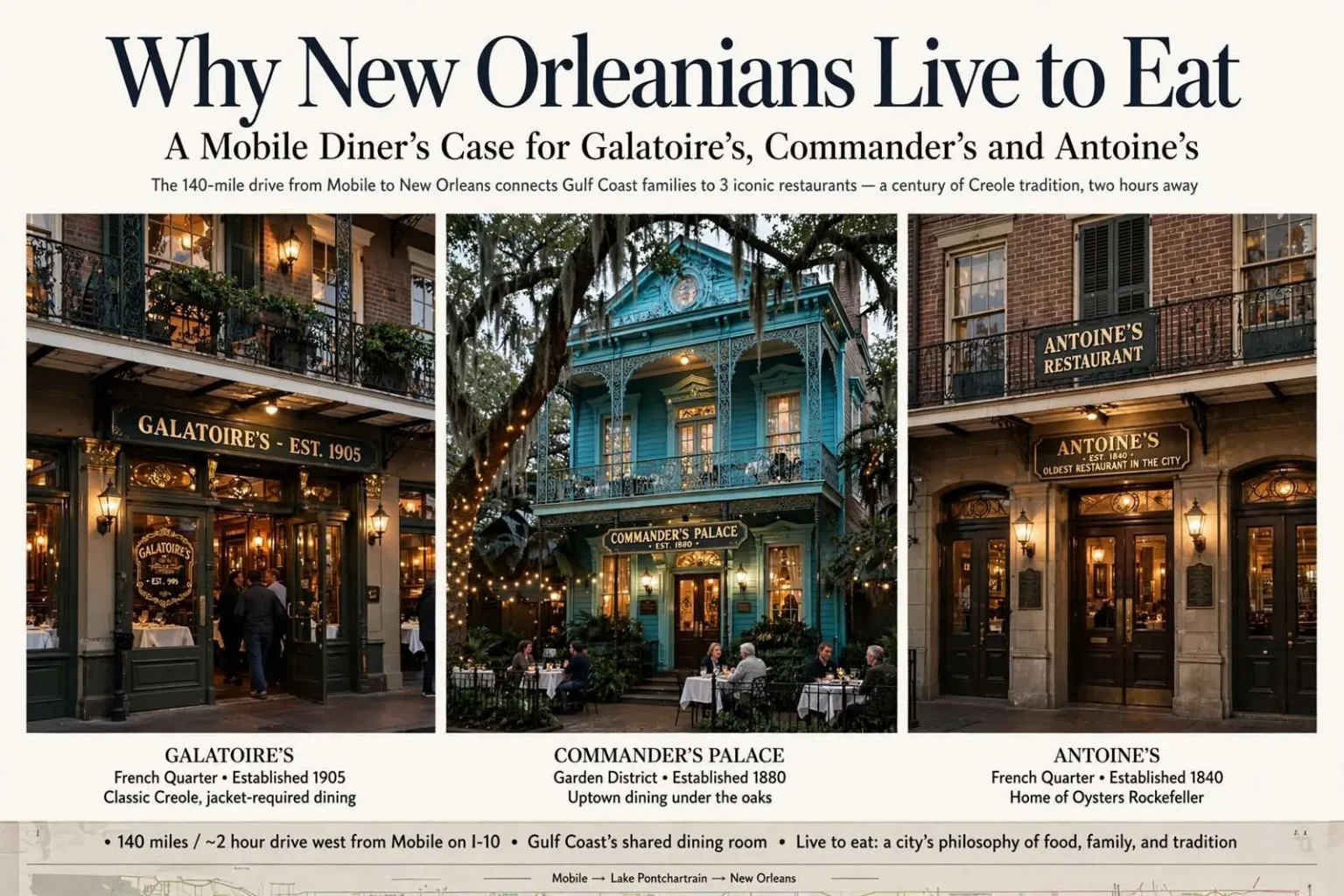
New Orleans sits about 140 miles west of Mobile, close enough that a Gulf Coast family can make the drive for dinner and be home the same night. It is, in the estimate of our anonymous dining correspondent, the finest restaurant city in the United States, and he has never been persuaded otherwise. Having lived there himself more than 20 years ago, he offered readers a set of recommendations in the spring of 2008 — not as a tourist, but as someone who once ate there daily and has been going back ever since.
For Mobile readers, the arithmetic of the trip is part of the appeal. The drive to New Orleans runs west on Interstate 10, across the Mississippi line and over the swamps and bayous of the southern edge of Lake Pontchartrain, and takes a little over two hours from downtown Mobile. A family can leave after work on a Friday, be seated at a white-tablecloth room by eight, and be back in its own beds before midnight — or, as most people do, stay the night and make a weekend of it. Either way, the city functions as the Gulf Coast’s shared dining room, and Mobile diners have long treated it that way.
Live to eat
He began with a distinction he considers fundamental. “While most people eat to live,” he wrote, “New Orleanians live to eat.” The proof is in the arithmetic: an extraordinary number of very good restaurants thriving in a city of modest size. “It is rather difficult to find a bad restaurant in New Orleans,” he observed. “Even the food at lower rated New Orleans restaurants seems good when compared to fare found in many other cities.”
The observation is less a compliment than a description of how the city works. New Orleans ate its way into its identity over nearly three centuries — French and Spanish colonial kitchens, Caribbean trade, African and Creole cooking, Sicilian immigration and German butchers all settling into a cuisine that belongs to no single tradition. A port city that fed itself on the river and the Gulf developed cooks and customers in equal measure, and the result is a place where a neighborhood bar serves better gumbo than many cities’ finest restaurants. Our correspondent’s point is that visitors should trust the city at every price level, not just the famous rooms.
Galatoire’s
His favorite is Galatoire’s, a fixture of the French Quarter restaurant scene since 1905 and, in his words, “truly old New Orleans.” Lunch is available, but he prefers the evening, when jackets are required of gentlemen — a rule he cited approvingly rather than as an inconvenience. The food is great and the ambience magnificent, he wrote, but what he was really recommending was the experience: a room that has functioned as a destination for old New Orleans families for a century, and that must not be passed up.
The jacket rule is worth explaining to a Mobile audience, because it is the visible edge of something larger. Galatoire’s on Bourbon Street holds to a standard of formality that has nearly vanished from American dining — white linens, waiters who have worked the same room for decades, and a Friday lunch crowd that treats the restaurant as an extension of the family dining room, with tables claimed by the same clans for generations. The kitchen leans on the classics of Creole cooking: Gulf fish, crabmeat, and sauces that have changed little since the early twentieth century. That resistance to change is the point. Diners who want novelty can find it elsewhere; the correspondent is recommending continuity, served nightly.
Commander’s Palace
Commander’s Palace has stood in the uptown Garden District since Emile Commander founded it in 1880. The Brennan family took it over from the Morans in 1974, and it has been run by them since. Dinner there, our critic wrote, “is an experience that always evokes a good feeling from both tourists and natives alike” — a rare combination, since the two groups do not usually love the same restaurant. The food is very good, which he described as a common theme of the Brennan family’s restaurants.
That theme deserves the explanation the review only hints at. The Brennan family’s grip on New Orleans fine dining extends across a constellation of rooms — Commander’s Palace uptown, and a series of French Quarter kitchens run under the same ownership — and their signature is a style of cooking that took the city’s Creole foundations and pushed them into something livelier and more inventive without losing the audience. Commander’s Palace became a training ground for a generation of celebrated American chefs while keeping its own traditions intact: the jazz brunch, the 25-cent martinis at lunch, the bright turquoise Victorian building under the oak trees of the Garden District. Visitors come for the spectacle; regulars come because the kitchen rarely misses.
The Garden District setting is part of the experience, and Mobile visitors who make the trip should plan for it. The neighborhood of antebellum and Victorian mansions sits a streetcar ride up St. Charles Avenue from downtown, an avenue whose oak canopy and historic homes make the ride itself part of the evening. An uptown dinner pairs naturally with an afternoon of the Garden District’s architecture, which is a different — and quieter — New Orleans than the Quarter the same visitors will see the next day.
Antoine’s
The third name in the correspondent’s lineup is Antoine’s, the grand old house of the French Quarter and the oldest restaurant in the city in continuous family operation. Founded in 1840, Antoine’s is the birthplace of dishes that New Orleans cooking is judged by — oysters Rockefeller chief among them — and a dining room that has hosted presidents, celebrities and generations of local families under the same roof on St. Louis Street. The rooms run deep into the building, each with its own history, and the service carries the formal, unhurried manners of another century.
The correspondent’s inclusion of Antoine’s alongside Galatoire’s and Commander’s Palace traces the map of old New Orleans dining almost perfectly: one room for the French Quarter’s Creole aristocracy, one for the uptown garden-party set, and one for the city’s oldest continuous culinary dynasty. A Mobile diner who manages all three in a year of visits will have eaten the canon of the city’s classic restaurants, and each is close enough for the weekend run that Gulf Coast families have made for generations.
What the recommendations add up to
Taken together, the 2008 recommendations are less a list of dinners than a philosophy of travel. Our correspondent is arguing that the 140 miles between Mobile and New Orleans connect two cities that share a table — a Gulf Coast corridor in which the fish, the crab and the oysters on a New Orleans plate were often pulled from the same waters Mobile fishermen work. The restaurants he names are the ones that treat that inheritance with the most care.
He is also making a practical point for first-time visitors. The famous rooms of New Orleans reward planning: Galatoire’s in the evening calls for a jacket and, on busy nights, patience; Commander’s Palace sits uptown and deserves an unhurried evening; Antoine’s is best approached as a piece of living history rather than a quick meal. None of the three is inexpensive, and all of them are busier on weekends, but each delivers something Mobile cannot — a century or more of accumulated dining ritual, performed nightly a two-hour drive from home.
The case for trusting the city
Beyond the three famous names, the correspondent’s larger claim stands out: that it is difficult to find a bad restaurant in New Orleans at all. That is a bold standard, but it follows from the city’s economics. A restaurant scene of that density — in a city of modest size — survives only because the customers know food and will not sustain a bad kitchen. The neighborhood po-boy shops, the corner cafes, the mid-range Creole rooms that never make a national list: the correspondent’s advice is to treat them as part of the same scene as the grand dining rooms, because in New Orleans they are.
For Mobile readers in 2008, there is a local lesson folded into the recommendations as well. Mobile shares with New Orleans a Gulf, a French colonial past, Mardi Gras traditions that predate most of the continent’s cities, and a Creole-influenced table of its own. The cities also share a river delta’s appetite. What New Orleans built — restaurants that became institutions, kitchens that passed cooking through generations — is the standard against which Mobile’s own downtown dining revival was beginning to measure itself in the same years. The correspondent’s recommendations double as a syllabus for anyone hoping to understand what a restaurant city looks like when it is fully grown.
Practical notes for the drive
The mechanics of the trip reward a little forethought. The 140-mile drive west on Interstate 10 puts most of Mobile within easy range of a 7 p.m. seating, and the route itself is simple — west through the Mississippi Gulf Coast towns of Biloxi and Gulfport, across the state line, and over the long bridges at the eastern edge of New Orleans. Parking in the French Quarter is limited, which is one more argument for the older hotels within walking distance of the classic rooms, and for treating dinner as the centerpiece of the evening rather than one stop among many.
Timing matters inside the restaurants, too. Galatoire’s lunch is a beloved institution, but the correspondent prefers the evening, when the jacket rule sets the tone of the room. Commander’s Palace and Antoine’s both offer weekday seatings that are easier to book than weekend prime time, and travelers from Mobile who can make a Sunday or Monday run often find the famous rooms at their most relaxed. None of this is complicated; it is simply the difference between a spur-of-the-moment drive and a properly planned one.
Why the recommendations hold up
The deepest reason to revisit these 2008 recommendations is that all three restaurants were, even then, institutions by design rather than by accident. Galatoire’s had been feeding the same families for a century; Antoine’s was approaching its second century of continuous operation; Commander’s Palace had survived a change of ownership and emerged as the flagship of a restaurant family with influence far beyond Louisiana. Institutions like that do not depend on any one reviewer’s praise — but a Mobile diner who trusted our correspondent’s list in 2008 would have eaten well then, and a diner who trusts it now will eat well still.
That is the quiet argument of the whole review: the best reason to drive west is not novelty but continuity. New Orleans reinvents itself constantly — new chefs, new neighborhoods, new menus — and yet the rooms that define it are the ones that refuse to move. For Gulf Coast families deciding how to spend a weekend, the correspondent’s advice is unchanged: point the car west, dress for dinner, and eat the way New Orleanians do, as if eating were the point of the day. In that city, it is.