Orange Beach Residents Push Back as Council Sets School Referendum Date
Orange Beach council set a September referendum on a school tax hike as some residents voiced sharp opposition to breaking from Baldwin County schools.
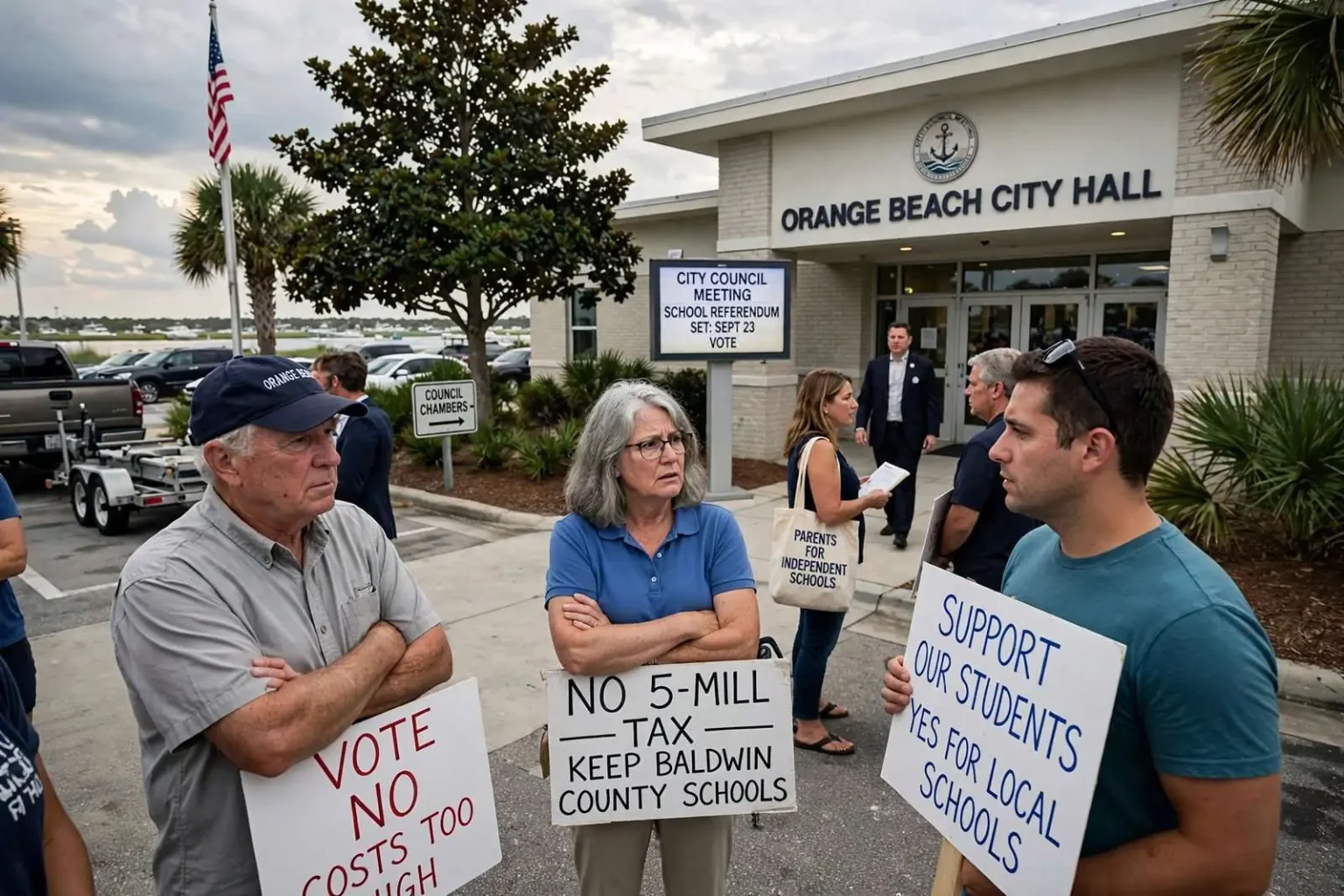
Not everyone in Orange Beach is on board with the city’s plan to break away from the Baldwin County school system, and several residents made that clear during a recent city council meeting. Even as officials moved forward with scheduling a public referendum, pointed questions and pushback from the audience showed the proposal is far from a sure thing. The exchange offered the most public test yet of whether the city’s voters share their leaders’ enthusiasm for a split that would reshape how local children are educated.
The Orange Beach City Council voted to set a referendum for late September, asking voters to approve a 5-mill property tax increase that would help fund the creation of an independent, city-run school district. Mayor Tony Kennon has repeatedly said the decision ultimately belongs to residents, and the council intends to honor whatever the vote determines. If the tax hike fails, the breakaway plan would be shelved.
A mill, in Alabama property tax terms, is one-tenth of a cent, so a 5-mill levy amounts to $5 per year for every $1,000 of assessed value. The state assesses owner-occupied homes at 10 percent of appraised value, which means the practical cost to a homeowner is a fraction of what the raw millage figure might suggest — a point supporters have leaned on in public discussions of the plan.
The money behind the split
Should voters approve the increase, city leaders have signaled they would also pursue additional lodging and sales tax adjustments to help finance new schools, based on an earlier feasibility study commissioned by the city. Officials have floated the possibility of leaning more heavily on lodging taxes rather than a sales tax bump, though those details remain under discussion.
The lodging-tax option reflects Orange Beach’s unusual economics. The city’s population swells dramatically during the summer season, and its restaurant, condo and short-term rental economy generates lodging tax revenue paid overwhelmingly by visitors rather than residents. Funding schools in part through that stream would shift a meaningful share of the burden onto tourists, a structure that has obvious political appeal in a resort town — and limits too, since visitor revenue rises and falls with the weather, the economy and the length of the season.
The feasibility study commissioned by the city examined enrollment projections, facility costs and the tax mix needed to sustain a standalone district. Any new system would need academic facilities from the earliest grades through high school, along with administration, transportation and the staff to run it all — a build-out measured in years, not months, even after the money is secured.
Pushback in the chamber
During the meeting, several residents pushed back on the notion that the community was broadly supportive of leaving the county system. One longtime resident told the council he had heard from neighbors who were firmly against another tax increase, arguing the current county schools are adequate. His argument was a familiar one in towns contemplating a split: the existing schools function, the buses run, and the money saved by staying put is money available for everything else a city needs.
The mayor countered that the county system, serving tens of thousands of students across dozens of campuses overseen from Bay Minette, has struggled with outcomes at local high schools. The geography is the crux of his argument: Baldwin County is geographically one of the largest counties in the state, its schools stretch from Bay Minette in the north to the Gulf-front communities in the south, and decisions about money, staffing and curriculum are made far from the beach.
A parent advocate who has spent months building community support for an independent district cited low college-readiness scores at the area’s current high school compared with other Baldwin County campuses, arguing that local control of neighborhood schools would better serve students and reflect the city’s investment in other public amenities like its recreation center and trail system. The comparison carries weight in a county where campus-to-campus differences are stark: schools in some fast-growing communities have been built or rebuilt with new facilities and expanded course offerings, while others have waited longer for reinvestment.
A city council member weighed in personally, describing frustration with what he called a lack of rigorous instruction at the high school his children attend, and said the issue is part of why he chose to homeschool one of his kids. An elected official volunteering dissatisfaction with the schools his own children sit in did more than any statistic to signal where the council’s sympathies lie.
History hangs over the vote
The debate also revisited a similar effort in 2007, when voters overwhelmingly rejected a joint school district tax increase shared with a neighboring beach town. The mayor said his opposition at the time stemmed from concerns about funding fairness between the two cities, not from opposition to local schools in general. That history matters, because it is the reference point every Orange Beach voter carries into the current debate: a school tax question has failed here before, and by a wide margin.
The difference this time is the structure. The 2007 proposal asked voters to fund a shared arrangement between two cities, with all the complications of splitting money and control between them. The current plan is a straightforward Orange Beach-only district, funded by a tax applied only to Orange Beach, which supporters argue answers the fairness objection that sank the earlier effort.
There is also a proven template nearby. Gulf Shores pursued and won its own breakaway after voters there approved a school tax in 2013, creating a city system that has since taken over facilities and set its own course. What happened in Gulf Shores hovers over the current debate on both sides: it is the proof of concept for backers and the cautionary tale for opponents who watched that split divide neighbor against neighbor and drive up costs.
The stakes of local control
Backers of the current plan point to research suggesting home values tend to rise in communities that establish their own independent school systems, citing a similar move by a north Alabama city that created its own district after a tax vote in 2013. Real estate agents in Gulf Shores have made the same case since that city’s split: a dedicated school system with its own identity markets homes to families relocating from out of state, in a way a zoned county campus does not.
For Orange Beach, the argument carries particular force in a city that has invested heavily in quality-of-life amenities. The recreation center, the trail system, the boat launches and the public safety spending all reflect a city accustomed to running its own services at a high standard, and supporters see schools as the missing piece of that portfolio. Opponents respond that schools are also the most expensive piece, with recurring costs that do not end when the ribbon is cut.
Teachers, staffing and curriculum are the quieter part of the debate. A new district would set its own academic calendar, hire its own administrators and decide its own course offerings, from advanced placement classes to career-technical programs. Whether a small city system can offer the breadth of a large one — and whether it can attract and keep teachers in one of the state’s most expensive housing markets — are open questions that the referendum will not answer by itself.
What happens next
If approved, the new millage rate would still fall below several neighboring Baldwin County cities. Supporters cite that comparison as evidence that the city is asking for less than what residents of comparable communities already pay, a framing meant to counter the “another tax increase” argument head-on. Critics counter that comparing millage rates across cities with different property values and service portfolios obscures more than it reveals.
The September referendum will give residents the final say on whether the coastal city moves forward with building its own school system from scratch. The campaign on each side is expected to intensify as the vote approaches, with backers pointing to Gulf Shores as the model and opponents warning about costs, disruption and the uncertainty of building an institution from nothing.
For the council, the meeting served its purpose either way. Residents who support the split got a date on the calendar, and residents who oppose it got their arguments entered into the record in front of the officials who will carry out whatever the voters decide. Kennon’s repeated refrain — that the decision belongs to residents — sets up a vote in which the city’s leadership has made clear which way it leans, while leaving the outcome entirely in the public’s hands.
Whatever the result, the referendum will settle more than a tax question. A yes vote commits the city to a years-long project of hiring, building and organizing a school system, with all the budget commitments that follow. A no vote shelves the breakaway and leaves Orange Beach families in the county system, with the grievances that sparked the movement still unresolved. Either way, the September vote will shape the city’s budget, its schools and its self-image for a generation.
Voters in late September will weigh those stakes at the ballot box, in a city where a school-tax question has now arrived for the second time in less than a decade — and where, this time, everyone agrees the choice is Orange Beach’s alone to make.