Four people were arrested in Mobile after police say two of them traveled from Atlanta specifically to recruit local residents into a scheme to pass counterfeit checks, according to the Mobile Police Department. The case offers a look at how check-fraud operations work along the Gulf Coast, where investigators say out-of-town organizers periodically tap into local networks to do the passing while keeping themselves a step removed from the transactions.
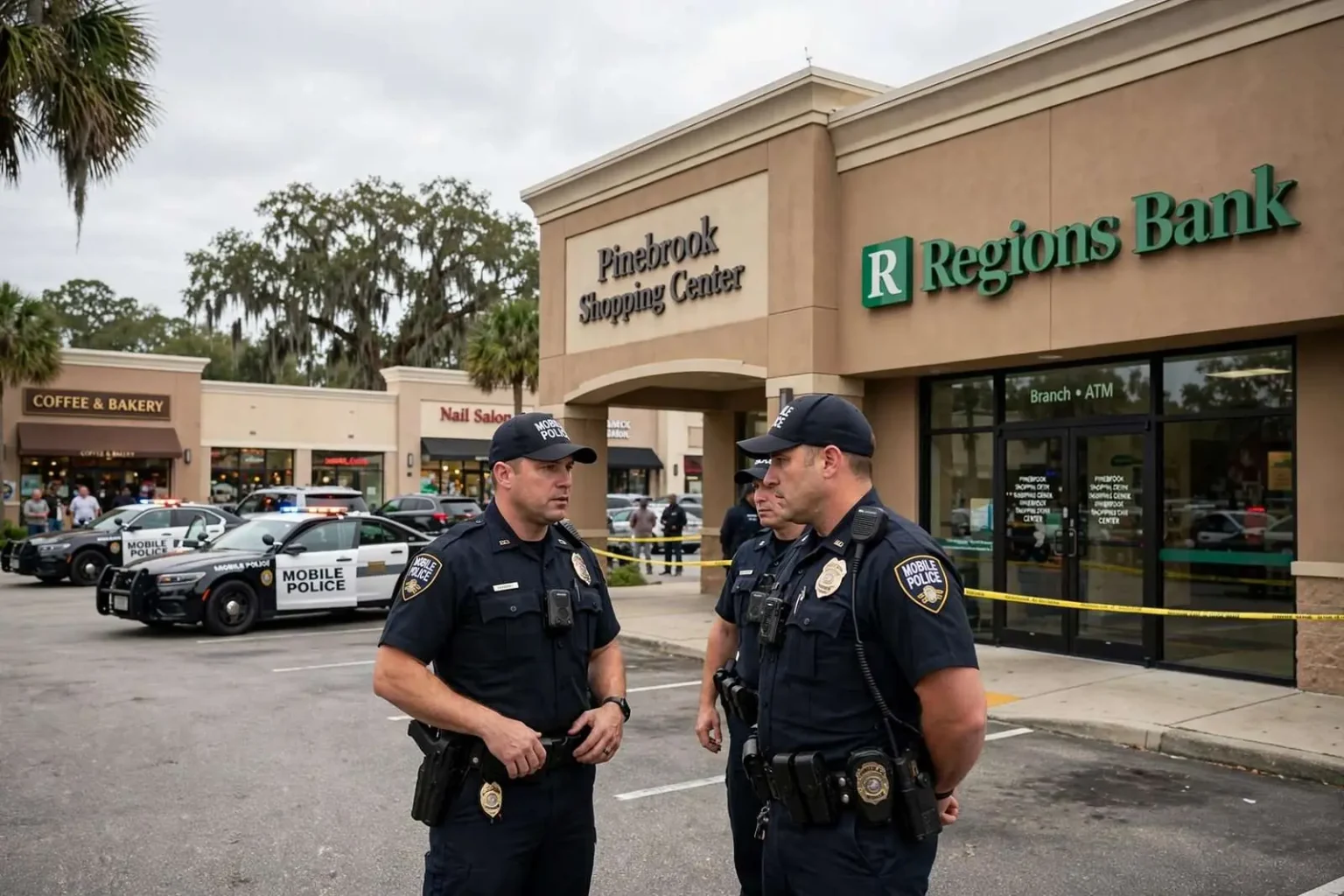
Investigators say the operation came to light after someone reported suspicious activity involving forged checks at a Regions Bank branch inside the Pinebrook Shopping Center. Responding detectives detained four suspects at the scene following the report, a police spokeswoman said. Bank employees are often the first line of detection in schemes like this one, since tellers see patterns that individual victims never do — multiple attempts to cash checks with similar characteristics, customers who appear unfamiliar with the accounts the checks draw on, or several people arriving in succession with instruments from the same source.
Dejean Washington, 26, and Bernithia Young, 31 — both of whom listed an Atlanta address when booked — each face 15 counts of second-degree possession of a forged instrument, according to jail booking records. Two additional suspects, Lionel Houze, 58, and Kenneth Wayne Patton, 46, were each booked on one count of the same charge. The difference in the counts suggests investigators believe the two Atlanta residents were the volume operators, while the two Mobile suspects played smaller roles in the transactions that came to light that day.
Police say Washington and Young had no prior arrest record in Mobile County, suggesting the pair had recently begun operating in the area. Patton and Houze, however, were already known to local law enforcement — Patton was arrested in 2012 on drug possession and resisting arrest charges, while Houze has faced previous charges connected to worthless and forged financial instruments. That kind of local connection is frequently how out-of-town operations establish themselves: organizers arrive with the fraudulent instruments and the plan, then rely on residents who know the area, and in some cases have prior exposure to the justice system, to help move the checks through local banks and retailers.
How these schemes typically work
Check fraud rings generally follow a recognizable structure. Counterfeit checks are produced using real routing and account information, often drawn on legitimate businesses or individuals who have no idea their details are being used. Recruiters then bring in people willing to take the checks into banks or stores, cash them or deposit them and withdraw the funds, and hand most of the money up the chain in exchange for a cut. The recruits — sometimes called passers — absorb the most visible risk, since they are the ones standing at the counter when a teller gets suspicious, while the organizers move on to the next city and the next group of participants.
Mobile police say check-fraud schemes involving out-of-town recruiters are not unheard of along the Gulf Coast, where investigators periodically track coordinated efforts to bring in outside participants willing to pass forged financial instruments at local banks and retailers in exchange for a cut of the proceeds. The interstate nature of the alleged operation is a defining feature of this case. Atlanta sits hours away along the I-85 and I-65 corridors, and investigators in jurisdictions across the Southeast have long noted how easily fraud operations move between mid-size cities, staying ahead of local detection by never operating in one place long enough for patterns to catch up with them.
What the charge carries
Second-degree possession of a forged instrument is a felony under Alabama law, carrying potential prison time and fines for anyone convicted. The law criminalizes possessing or uttering a forged writing with intent to defraud, and the charge is commonly brought in check-fraud cases because it applies to each instrument separately — which is how a single sweep can produce counts in the double digits, as it did for Washington and Young. Multiple counts can shape both bond amounts and any eventual plea negotiations, since each count represents a separate alleged transaction. Prosecutors in Mobile County have historically pursued forged-instrument cases with an eye toward the organized operations behind them, because the losses compound quickly across victims that include banks, small retailers and the account holders whose information was used.
The court process ahead
All four suspects were being held at Mobile County Metro Jail and were scheduled for an initial appearance in Mobile County District Court later in December. The initial appearance is where defendants hear the charges against them, have counsel appointments addressed, and learn the conditions of their bonds. From there, felony cases move to a preliminary hearing or grand jury review before any trial date is set, a process that typically stretches over months. For the two suspects facing 15 counts each, the volume of alleged transactions means investigators may continue working to match each count to a specific check and a specific victim business or bank.
The rapid resolution of this case — from a suspicious-activity report to four arrests at the scene — reflects how bank-level vigilance and quick police response combine to interrupt these operations. A single alert teller or branch manager can end an operation’s run in a city, which is why fraud organizers press recruits to hit multiple locations quickly and why banks train staff to treat unusual cashing patterns as reportable events rather than routine transactions.
What residents and businesses should watch for
Authorities urged bank customers and business owners to remain alert to unfamiliar individuals attempting to cash large or unusual checks and to report suspicious transactions promptly. For retailers, the warning carries practical weight: forged checks passed at a store become a direct loss for the business once the instrument bounces, and small operations feel those losses more sharply than national chains. Retailers are advised to scrutinize checks for signs of tampering, to verify funds when amounts are unusual for the customer, and to capture identification information at the time of the transaction so that investigators have a record to work from if a check turns out to be counterfeit.
For consumers, the risk runs in the other direction. Counterfeit check schemes frequently victimize the people recruited to pass the checks as well, since participants who deposit fraudulent instruments into their own accounts can find the funds clawed back by their banks once the forgery is discovered — leaving them liable for the full amount and, as this case shows, exposed to felony charges. Anyone offered quick money to cash a check for a stranger, or to receive funds and forward most of them along, is being asked to take on both financial and criminal liability that belongs to someone else.
The Pinebrook Shopping Center branch where the scheme surfaced sits in one of west Mobile’s busiest retail corridors, an area where bank branches, restaurants and shops draw steady traffic through the day. That volume works both ways: it gives fraud operators cover in the crowd, and it means alert employees see enough transactions to recognize when something does not fit. In this case, the report from the bank gave detectives a scene to respond to while all four suspects were still present — an outcome that is far from guaranteed in fraud investigations, where suspects often scatter before officers arrive.
Police departments across the region treat forged-instrument cases as a recurring category rather than an isolated one, and the Mobile department’s guidance to the public emphasizes the same few points each time: verify before cashing, never agree to cash a check for someone you do not know, and report suspicious activity immediately rather than waiting to see whether a transaction resolves. Quick reporting, officials note, is what turns a pattern of small losses into an arrest like the one made here.
As the cases against the four suspects move through the court system, the investigation may expand — fraud operations of this kind rarely confine themselves to a single bank branch or a single week of activity, and investigators typically review recent transactions at other institutions for matching instruments. Businesses that believe they accepted a counterfeit check connected to this or any similar operation are encouraged to contact the Mobile Police Department so the transactions can be documented as part of the case.
The case also illustrates why law enforcement agencies across the Southeast treat bank branches as the front line of fraud detection. Investigators cannot watch every retail counter in a city, but a bank’s internal systems flag unusual deposit and cashing activity automatically, and trained staff add a human layer on top of that. When a branch reports activity while it is still happening, police can respond to a location where suspects, instruments and records are all in one place — which is how this case produced four arrests on the spot rather than a lengthier hunt for suspects identified only after the fact.
For the Mobile County court system, cases like this one are processed through the same channels as other felony matters, but the multi-count structure changes the arithmetic. Fifteen counts against each of the two principal suspects means the prosecution’s file includes a check-by-check accounting, and defense negotiations will turn on which transactions can be proven and how the two local suspects’ roles compare with those of the alleged organizers. Cases with recruited local participants often resolve with outcomes that differ sharply by defendant, reflecting the distinction between who allegedly organized the scheme and who allegedly passed its instruments.
The episode is a reminder, too, of how fraud migrates. Cities along the Gulf Coast and throughout the Southeast trade the same recurring schemes back and forth, moving along the interstate corridors as detection catches up in one market and organizers look for fresh ground. That mobility is exactly why local reporting matters: an alert bank in west Mobile ended an operation that may have been planning weeks more activity in the area, and the same vigilance repeated across the region’s branches is what keeps these operations from putting down roots anywhere.