Kitchen Fire at Golden Dragon Sends Smoke Through the Roof and Shuts Down Part of Azalea Road
Mobile Fire-Rescue crews found flames in the kitchen and smoke pouring from the roof at Golden Dragon Chinese Food on Azalea Road Monday morning, forcing a traffic detour.
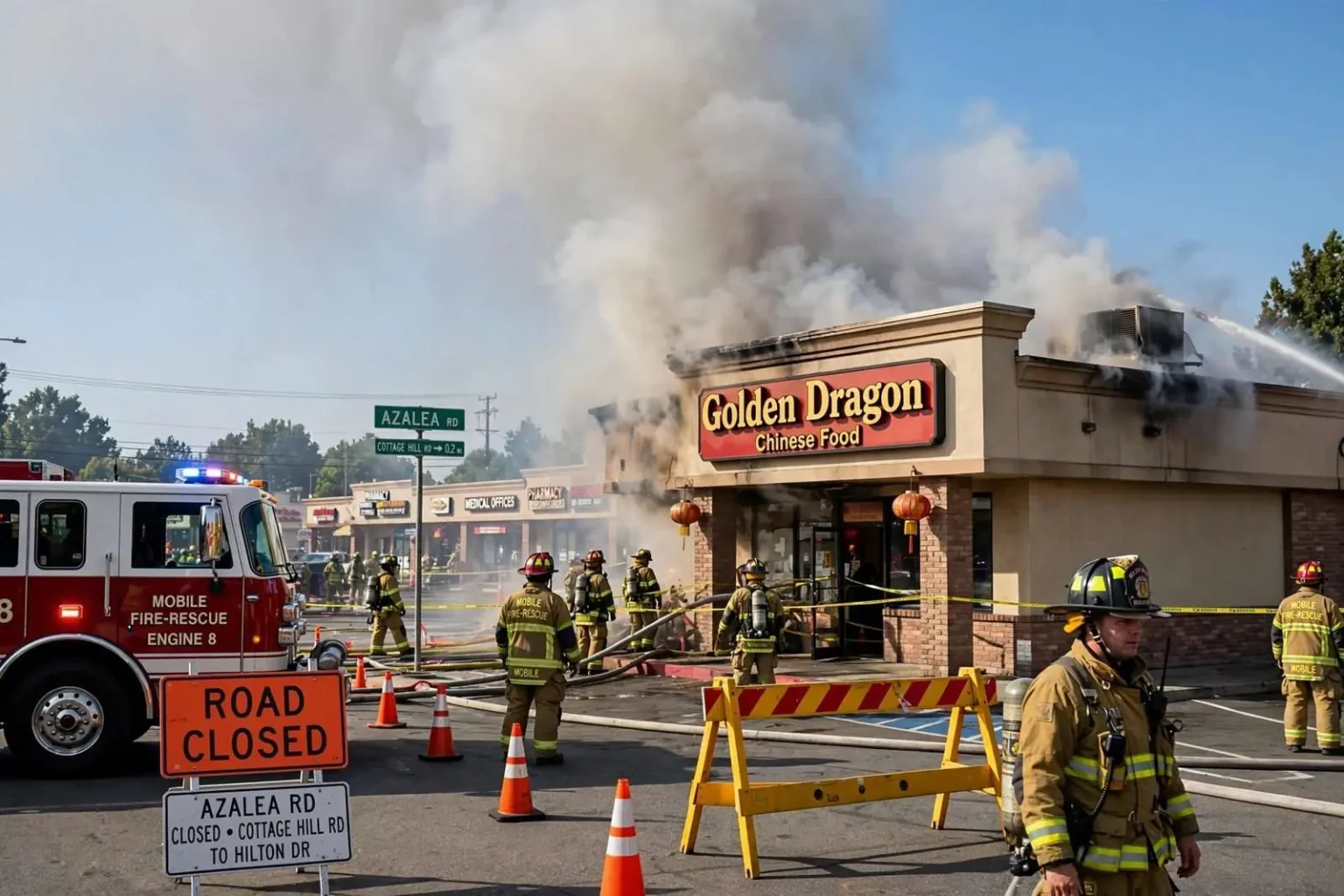
Mobile Fire-Rescue crews responded to a kitchen fire at a well-known Azalea Road restaurant Monday morning, arriving to find flames inside the building and smoke pushing out through the roof.
Firefighters were on scene at Golden Dragon Chinese Food just before 11 a.m. on Monday, July 13, according to Mobile Fire-Rescue Department officials. The fire was located in the kitchen, and smoke was visible coming from the roof of the structure as crews worked.
Traffic Impact
Officials redirected traffic on Azalea Road between Cottage Hill Road and Hilton Drive while crews worked the scene. That stretch sits in one of the busier commercial corridors in midtown Mobile, and the closure came in the middle of the lunch hour, when the road typically carries heavy volume.
Drivers heading through the area during the response were advised to seek alternate routes.
Kitchen Fires and Restaurant Structures
Commercial kitchen fires are among the most common calls fire departments handle, and they are also among the most likely to spread beyond the room of origin. Grease built up in exhaust hoods and ductwork provides a fuel path that runs directly from the cooking line up toward the roof — which is why smoke showing at the roofline, as it did at Golden Dragon, is a signal firefighters treat seriously.
Modern commercial kitchens are required to have automatic suppression systems installed over the cooking line, along with regularly cleaned exhaust hoods. When those systems work, a fire that starts on a fryer or range is often contained before crews arrive. When grease has accumulated in the duct, the fire can travel.
What Has Not Been Released
Mobile Fire-Rescue has not announced a cause for the fire, has not released a damage estimate, and has not reported any injuries to restaurant staff, customers or firefighters. The department has also not said how long the restaurant is expected to remain closed.
Fire investigators typically return to a scene like this one after the fire is out to determine the point of origin and cause, a process that can take several days.
This story will be updated as officials release additional information.
Azalea Road: A Commercial Spine in Midtown Mobile
Azalea Road runs north-south through the heart of midtown Mobile, connecting Old Shell Road to the south with Airport Boulevard and Interstate 65 to the north. The segment between Cottage Hill Road and Hilton Drive is lined with strip centers, standalone restaurants, medical offices, and retail establishments — a corridor that sees some of the highest daily traffic counts in the city outside of the interstate system. Alabama Department of Transportation data for nearby segments of Azalea Road show average annual daily traffic in the range of 25,000 to 30,000 vehicles, with peaks during morning and afternoon commutes and the lunch hour.
A road closure at this location, even for a few hours, ripples through the surrounding network. Cottage Hill Road, Hillcrest Road, and Airport Boulevard all absorb diverted traffic, and the signal timing at intersections along those alternates was not designed for the sudden volume surge. Mobile Police Department traffic units often assist with manual direction at key intersections during extended fire responses, but on Monday the closure was resolved before that level of intervention was needed.
How Commercial Kitchen Fire Suppression Works
Under the Alabama Fire Code — which adopts NFPA 96, the Standard for Ventilation Control and Fire Protection of Commercial Cooking Operations — every commercial kitchen with grease-producing cooking equipment must have a Type I hood system with an automatic fire suppression system listed for that application. The most common systems use a wet chemical agent (typically a potassium-based solution) that both cools the flame and reacts with hot grease to form a soap-like foam that seals the surface and prevents re-ignition. Nozzles are aimed at each appliance (fryers, griddles, ranges, woks) and at the hood plenum and duct entry.
Inspection and maintenance requirements are specific: hoods, ducts, and fans must be cleaned by a certified company at intervals that depend on cooking volume — monthly for solid-fuel or high-volume operations, quarterly for typical restaurants, and semi-annually for low-volume sites. The suppression system itself must be inspected semi-annually by a licensed fire protection contractor, with fusible links replaced annually. Mobile Fire-Rescue’s Fire Prevention Bureau enforces these requirements through routine inspections and plan review for new construction and renovations.
When a suppression system activates, it simultaneously shuts off gas or electric supply to the cooking equipment, discharges agent, and sends a signal to the building fire alarm panel (if one is present) and often directly to the monitoring company that dispatches the fire department. This automated sequence is designed to put water or chemical on the fire within seconds of ignition, long before a 911 call can be placed and crews can roll.
The Investigation Process: Origin and Cause
Once the fire is out and the scene is safe, Mobile Fire-Rescue’s Fire Investigation Division begins the origin-and-cause determination. Investigators work from the area of least damage toward the area of greatest damage, following burn patterns, heat shadows, and the behavior of materials to trace the fire back to its point of origin. In a kitchen fire, they examine the cooking equipment, the hood and duct system, electrical panels and wiring serving the line, gas supply lines and connections, and any portable appliances in use at the time.
Common causes in restaurant kitchens include: unattended cooking (especially deep frying), failure of thermostatic controls on fryers, grease accumulation in ducts that ignites from a flare-up on the line, electrical faults in aging equipment or overloaded circuits, and gas leaks at appliance connections. Less common but possible causes include spontaneous combustion of oil-soaked rags improperly stored, arson, and failures of the suppression system itself (such as a blocked nozzle or an expired fusible link that did not melt at its rated temperature).
The investigation also considers whether the suppression system activated as designed, whether the hood and duct cleaning schedule was current, and whether any code violations contributed to the fire’s spread. Findings are documented in a formal report that is shared with the property owner, the business operator, their insurance carriers, and — if a code violation is found — the Mobile Fire-Rescue Fire Prevention Bureau for enforcement follow-up.
Business Impact and Recovery
For a restaurant like Golden Dragon, a kitchen fire means an immediate cessation of revenue at the same time that remediation costs begin to mount. The typical timeline from fire to reopening can range from a few weeks for minor damage confined to the hood and duct system, to several months if the fire extended into the dining room, damaged structural elements, or triggered a full environmental remediation for smoke contamination. The building’s HVAC system, insulation, drywall, and finish materials may all require replacement if smoke penetration was extensive.
Insurance coverage for commercial kitchen fires typically falls under a Business Owners Policy (BOP) or a package policy combining property, general liability, and business interruption coverage. Business interruption insurance — when it is carried — can reimburse lost net income and continuing operating expenses (rent, payroll, loan payments) during the period of restoration, subject to a waiting period (often 72 hours) and a maximum indemnity period (often 12 months). Many small independent restaurants, however, carry only the minimum coverage required by their landlord or lender, which may not include business interruption or may have sublimits that leave a significant gap.
The Mobile Area Chamber of Commerce and the Alabama Restaurant & Hospitality Association both offer resources for members navigating post-fire recovery, including contractor referrals, guidance on working with adjusters, and advocacy on permitting timelines for repairs. The City of Mobile’s Development Services Department handles building permits for fire damage repairs, and in recent years has implemented expedited review for commercial fire restoration projects to reduce downtime for affected businesses.
Community Context: Golden Dragon on Azalea Road
Golden Dragon Chinese Food has been a fixture on Azalea Road for years, part of a dining corridor that includes a mix of long-standing independent restaurants and newer chain establishments. The restaurant serves a lunch crowd drawn from nearby medical offices, corporate campuses along Airport Boulevard, and the residential neighborhoods of Spring Hill, Midtown, and West Mobile. Its closure, even temporarily, removes a dining option for hundreds of daily patrons and affects the employees who depend on it for wages.
For regular customers, the question is not just when the restaurant will reopen but whether the quality and menu will be the same. Post-fire renovations sometimes result in kitchen layout changes, equipment upgrades, or even menu revisions — outcomes that can be positive if the restaurant uses the disruption as an opportunity to modernize, or negative if cost pressures force compromises.
Fire Safety for Diners and Employees
While kitchen fires are a behind-the-scenes risk for most restaurant patrons, diners can take note of basic fire safety cues: visible and illuminated exit signs, unobstructed paths to exits, and the presence of portable fire extinguishers in accessible locations. Employees in commercial kitchens receive training on manual pull stations for the suppression system, proper use of Class K fire extinguishers (the only type rated for cooking oil fires), and evacuation procedures. Mobile Fire-Rescue offers free fire safety presentations to businesses and community groups on request, covering topics from kitchen fire prevention to emergency action planning.
Resources and Next Steps
Residents and business owners with questions about commercial kitchen fire safety, hood cleaning requirements, or fire code compliance can contact the Mobile Fire-Rescue Fire Prevention Bureau at (251) 208-7351. For real-time traffic information during incidents, the City of Mobile’s traffic map and the Alabama Department of Transportation’s ALGO Traffic system provide live camera feeds and congestion data. Anyone with information about the Golden Dragon fire is encouraged to contact the Mobile Fire-Rescue Fire Investigation Division.