A Mobile man is facing a string of forgery charges after investigators say he used an ordinary photocopier to churn out counterfeit currency, according to Mobile Police Department officials.
Glenn Whitney Hensley, 32, was booked into Mobile County Metro Jail over the weekend on ten counts of first-degree possession of a forged instrument. The charges, filed one for each fake bill attributed to him, accuse Hensley of knowingly possessing currency that had been altered or reproduced with intent to pass it as genuine.
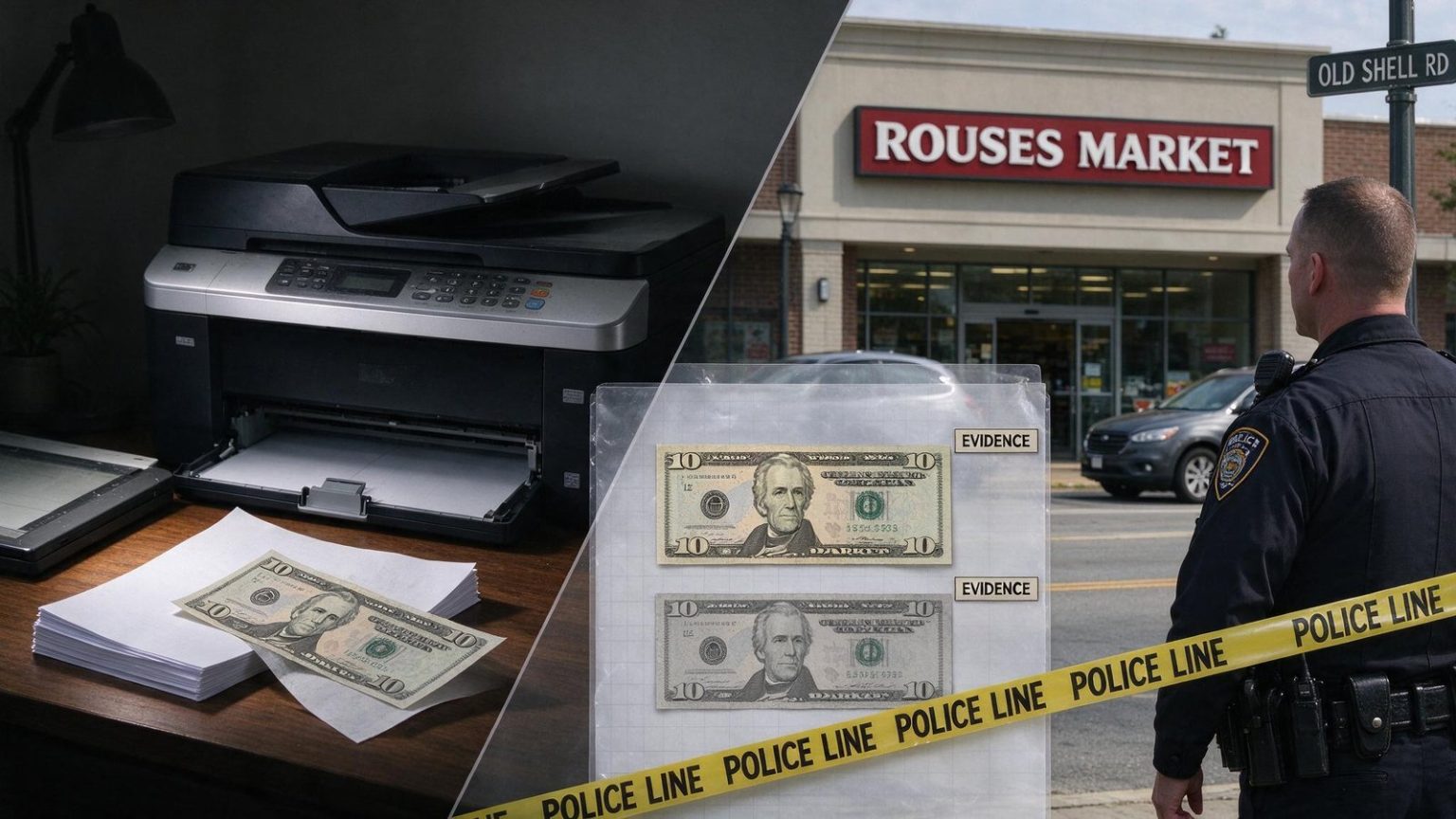
Police say officers first encountered the counterfeit bills when Hensley was found carrying several of them at a Rouses Market location on Old Shell Road. The grocery store, part of a Louisiana-based chain with locations across the Gulf Coast, sits along one of Mobile’s busiest retail corridors, and the encounter there set the case in motion.
A search connected to the case reportedly turned up the photocopier investigators believe was used to produce the fake currency inside Hensley’s home. Household copying equipment has become the most common starting point for low-level counterfeiting, and the discovery of the machine itself often provides prosecutors some of their most straightforward evidence.
According to a police spokesman, the counterfeit notes were primarily copies of ten-dollar bills, a denomination that was redesigned nearly a decade earlier specifically to make this kind of low-tech counterfeiting far less convincing.
The ten-dollar bill’s redesign added layered security features — a watermark portrait visible when the note is held to light, an embedded security thread, color-shifting ink and microprinting too fine for a consumer copier to reproduce. Those features were introduced precisely because photocopied currency had become the entry-level crime of forgery, and a photocopy of a modern bill misses nearly all of them at once.
As of the days following the arrest, detectives said they were still trying to determine whether any of the fake bills had actually been successfully spent at area businesses before Hensley was caught. Tracing passed counterfeit notes is tedious work: detectives must canvass retailers, collect suspect bills and match serial numbers and paper characteristics back to a common source.
Because counterfeiting currency is a federal crime, the U.S. Secret Service, which investigates such cases nationwide, was brought in to assist local police with the investigation. The agency’s involvement is routine whenever fake currency surfaces, and its forensic expertise — from ink analysis to printing-method identification — extends what a local department can prove.
A Federal Case in the Making
Authorities indicated that additional charges against Hensley were possible as the investigation continued, and did not rule out the Secret Service eventually taking primary jurisdiction over the case given the federal nature of currency counterfeiting offenses.
Federal law criminalizes the making, possessing and passing of counterfeit obligations at every stage, and prosecutions are typically brought in U.S. District Court where the evidence supports them. A federal counterfeiting conviction can carry years in federal prison, and sentences tend to scale with the volume of currency involved and whether the defendant manufactured the notes or merely circulated them.
Alabama’s own forged-instrument statute, under which the local charges were filed, treats first-degree criminal possession of a forged instrument as a felony — the charge prosecutors reach for when a person knowingly holds a forged writing, including currency, with intent to use it. The ten-count structure of the case reflects the one-count-per-bill approach local prosecutors commonly take in possession cases.
Which forum ultimately handles the case may depend on what the investigation finds. If the evidence shows a handful of photocopied notes and one possessor, the local charges may resolve the matter in Mobile County’s state courts. If detectives link the photocopier to a larger volume of notes that moved through local businesses, federal prosecutors could absorb the case — a common progression in counterfeit investigations that cross city lines or involve production rather than simple possession.
Mobile police asked that anyone with information related to Hensley or the counterfeit bills contact the department’s investigators. Merchants who suspect they have received fake currency are typically advised to hold the bill, note the details of the transaction and notify police, since the bill itself is evidence and the passer may be one of several people circulating the same batch.
The ten counts also shape the practical stakes of the case. Felony counts filed individually give prosecutors room to negotiate — some counts may be dropped in a plea, or consolidated at sentencing — but they also multiply the exposure a defendant faces if convicted at trial. In Mobile County, ten felony counts of the same offense, arising from a single arrest, mark the case as one prosecutors consider serious enough to charge exhaustively from the outset.
The weekend booking also places the case in the county’s highest-volume criminal intake stream. Metro Jail processes thousands of arrestees a year, and property-and-forgery cases of this kind typically move through the system faster than violent felonies, from initial appearance through district court, where felony cases are screened before any grand jury review.
How Counterfeit Bills Are Caught
Counterfeiting cases involving photocopiers or home printers are relatively unsophisticated compared to more advanced schemes involving specialized paper and ink, but they can still cause real financial harm to local businesses that unknowingly accept the fake currency, particularly smaller retailers and markets that may lack the training or equipment to screen every note.
The professional-grade counterfeits that concern the Secret Service involve genuine currency paper — a cotton-linen blend the government controls closely — intaglio printing presses and bleached lower denominations reprinted as higher ones. A photocopied bill, by contrast, is printed on ordinary office paper that feels wrong from the first touch, and most are detected by cashiers within seconds of handling.
Detection relies on three simple habits that banks and the Secret Service teach retailers: feel, tilt and check. Genuine bills carry a raised texture from the intaglio printing process; the color-shifting numeral changes hue as the note is tilted; and every denomination above a dollar carries a watermark and security thread that photocopies cannot replicate. Counterfeit-detection pens, widely used at grocery and convenience store counters, mark ordinary copier paper while leaving currency paper largely unaffected — an imperfect but useful screen for exactly the kind of notes alleged in this case.
Rouses Market stores, like most grocers, train cashiers to watch for fake currency at the register, and the volume of cash that moves through a grocery line on a weekend makes such stores a common place for counterfeit notes to surface — often the first time a fake bill’s journey becomes visible to law enforcement.
The harm from passed counterfeits lands entirely on the business that accepts them. A retailer stuck with a fake bill absorbs the loss outright — federal regulations do not reimburse merchants for counterfeit currency — and smaller operators feel each loss in a way that national chains may not. That is why local business groups periodically urge members to train staff on the security features, especially for the twenties and tens that make up most counterfeit traffic.
The Secret Service’s Original Mission
The Secret Service’s role in currency cases is older than its better-known protective duties. The agency was founded in 1865 specifically to suppress counterfeit currency, a problem so widespread after the Civil War that an estimated third of the currency in circulation was fake, and it hunted counterfeiters for decades before taking on presidential protection.
That original mission continues through field offices across the country, including in Alabama, where agents work local counterfeiting cases alongside city and county police. The agency maintains databases of counterfeit seizures, tracks the printing methods and serial numbers of fake notes, and coordinates prosecutions with U.S. Attorney’s offices when cases justify federal charges.
Modern anti-counterfeiting design is a partnership between the agency and the Bureau of Engraving and Printing, which has redesigned American currency in stages since the 1990s precisely to stay ahead of consumer-grade reproduction technology. As copiers and scanners have improved, so have the microprinted, color-shifted and watermarked features meant to defeat them — an ongoing contest that turns each new generation of office equipment into a new counterfeiting threat.
For Hensley, the case now moves through Mobile County’s courts on the ten felony counts, with the possibility of federal charges still open as the Secret Service completes its review of the photocopier, the notes and whatever trail of passed bills detectives are able to reconstruct. Investigators continue to ask merchants and residents who may have encountered the fake tens to come forward.
The case stands as a reminder of how little technology it takes to commit a serious federal crime — and of how quickly the security features built into American currency give it away. A photocopier and a stack of paper can produce something that looks like money at arm’s length, but not for long, and not without leaving the maker facing charges in both the state and federal systems.