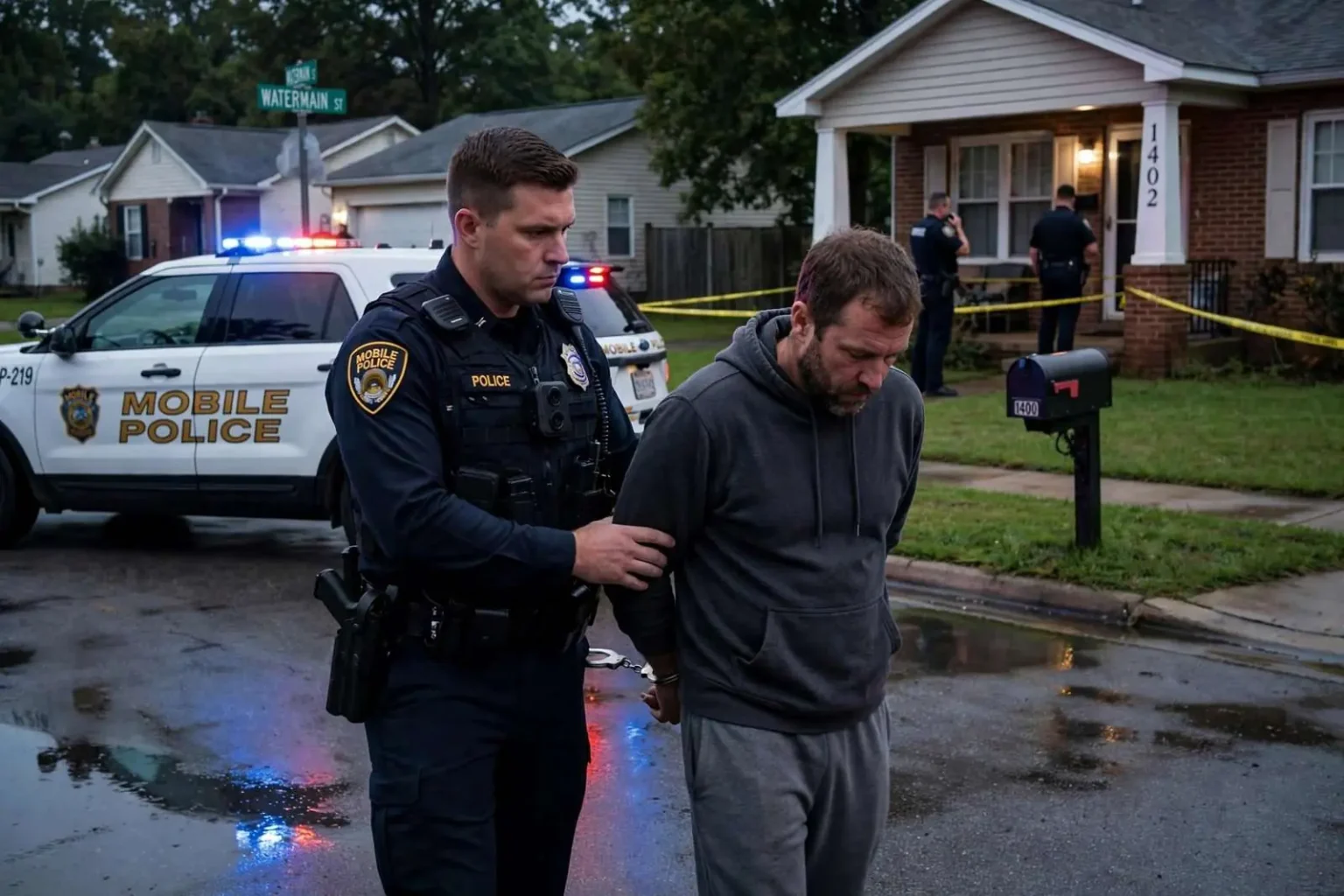
A Mobile man is facing charges after a domestic violence call turned into a struggle with officers when he tried to avoid arrest by entering a neighbor’s residence, according to the Mobile Police Department. Police say 52-year-old Steve Allen was taken into custody after officers responded to the 1400 block of Watermain Street on a domestic violence complaint. When officers arrived and attempted to make contact with Allen, he instead went into a neighboring home in what police described as an effort to elude arrest. A physical struggle with officers followed before Allen was ultimately taken into custody.
The episode illustrates how quickly a routine-sounding call can escalate. Domestic disturbance calls are among the most common — and most unpredictable — runs a patrol officer answers. Two officers dispatched to a residential block for a reported domestic argument must account for the people inside the original residence, the layout of neighboring homes, and the possibility that a suspect will move the confrontation into someone else’s property, exactly as police allege happened on Watermain Street. Once a suspect crosses into a neighbor’s home, the call gains a second set of victims to protect and a second set of legal questions, all while the original complaint remains unresolved.
The Charges
According to a police spokesman, Allen was booked into Mobile Metro Jail on charges of indecent exposure and harassing communications. Officers said the exposure charge stemmed from an earlier encounter in which Allen reportedly walked over to the neighbor’s property, exposed himself, and then walked away before officers were called to the area. The harassing communications charge, by its nature, involves alleged unwanted contact — calls, messages or other communications directed at a person in a manner the law defines as harassing — and the pairing of the two charges suggested a pattern of conduct directed at the same neighbors rather than a single isolated incident.
Mobile Metro Jail, the detention facility the city shares with Mobile County on the county complex, is the booking point for virtually all of the police department’s arrests, and the charges Allen faced spanned two categories of Alabama law — one covering public sexual conduct, the other covering communications intended to harass or alarm. Both are misdemeanor-level offenses on a first offense, but prosecutors can evaluate the underlying pattern when deciding how to proceed, and the domestic violence complaint that started the encounter remains part of the record officers documented that night.
What Officers Say They Found
The department’s account of the incident focused on the confirmed elements of the case: the domestic violence complaint that first brought officers to the street, Allen’s attempt to avoid arrest by entering a neighboring residence, the physical struggle that ensued, and the charges ultimately filed against him. That discipline in the public account matters. Departments typically release only the facts that can be substantiated at booking, leaving the full narrative — what prompted the domestic complaint, what happened inside the neighbor’s home, how the struggle unfolded — to the investigation and, eventually, the courts.
Struggling with a suspect who has fled into another residence also raises operational questions that patrol supervisors train for: whether additional units are needed, how to secure the scene so the neighbor’s household is safe, and how to take a subject into custody without further damage to the neighboring property. None of those details were released, but the sequence police described — a flight into a neighbor’s home, then a physical struggle — indicates the arrest did not go smoothly, and that officers ultimately managed it without the charges expanding to include injuries to anyone beyond the suspect himself.
A Neighbor’s Account
Separately, at least one area resident described a pattern of ongoing harassment and exposure incidents involving Allen stretching back several weeks, and characterized the neighborhood’s experience with him as unsettling well before the arrest. That account, shared anonymously by a person who said they lived nearby, has not been independently verified by authorities and represents the perspective of a single resident rather than a confirmed police finding.
The distinction between that account and the police record is worth keeping in view. Neighbors on a block where such incidents recur often accumulate a shared history — incidents they witnessed, calls they say were made, complaints they believe went nowhere — that never appears in a single arrest report. Authorities, for their part, can confirm only what was reported and documented. Both things can be true: an arrest report that lists two charges from one evening, and a street where residents say the trouble had been building for weeks. The weeks-long pattern, if borne out in earlier calls for service, becomes relevant later — to prosecutors weighing the case, and to any review of how the department handled prior complaints from the same address.
What the account does confirm is the atmosphere such a pattern creates. Residents of a quiet block who believe they are dealing with repeated exposure and harassment change how they use their own property — watching who is outside, keeping doors locked during the day, hesitating to let children play in front yards — long before any single incident rises to an arrest. That erosion of a neighborhood’s sense of security is one of the real costs of persistent nuisance behavior, and it is the part of the story that a booking record cannot show.
How the Case Proceeds
Mobile police have not indicated whether additional charges are expected as the case proceeds through the court system. That is standard. The charges a subject is booked on reflect what officers could document at the scene; the district attorney’s office reviews the full file, including the original domestic violence complaint, before deciding what to pursue. Potential outcomes range from prosecution on the booking charges to amended or additional counts, and any alleged violation involving the neighbor’s household — the entry into the home itself — can be evaluated separately from the offenses that carried the booking.
The domestic violence complaint that precipitated the arrest also follows its own track. Alabama’s domestic violence statutes carry protections and procedures distinct from other assault and harassment offenses, and the relationship between the parties determines how the case is classified. If the original complaint’s allegations are substantiated, they could result in separate counts; if not, the case proceeds on the exposure and harassing communications charges alone.
Anyone with additional information related to the case is encouraged to contact the Mobile Police Department. The department’s investigators can add incident reports to the file, and in cases involving a pattern of conduct, testimony from additional residents can materially affect how the case is charged and resolved.
The Broader Pattern for Patrol Officers
The incident adds to a string of recent domestic disturbance and public nuisance calls handled by Mobile officers in residential neighborhoods across the city, underscoring the unpredictable situations patrol officers can face when responding to what initially appear to be routine complaints. A domestic call is routinely ranked among the most dangerous assignments in patrol work precisely because officers cannot know the emotional state, the weapons or the intentions of the people inside when they knock — and because, as the Watermain Street case shows, the call can move. A suspect who will not stay at the scene turns a contained confrontation into a neighborhood incident involving additional households, additional legal exposure, and a physical struggle on someone else’s porch.
For the department, each such call is also a test of process: whether prior complaints from the same address were documented in ways that warned responding officers what to expect, whether the response was adequately staffed, and whether the charges captured the full scope of the conduct. For the residents of the 1400 block of Watermain Street, the arrest ended the evening’s crisis — but the case’s progress through Mobile’s courts, not the struggle in a neighbor’s yard, is what will determine whether the neighborhood’s weeks of reported trouble actually conclude.
How Mobile Police Handle Domestic Calls
The Watermain Street response fits the standard framework Mobile officers apply to domestic violence complaints. Dispatchers screen such calls and grade their priority based on the presence of weapons, injuries and the history of the address, and officers are trained to approach separately, make contact with all parties, and determine whether a crime has occurred before leaving the scene. Alabama law requires arrest when officers find probable cause that a domestic violence offense occurred — an officer does not have the discretion simply to mediate and leave — which is why the encounter on Watermain Street became an attempted arrest the moment officers substantiated the complaint.
That mandatory posture is also what makes these calls logistically demanding. Once a decision to arrest is made, it must be carried out even if the subject resists, flees or crosses property lines, as police allege happened here. Backup arrives, a perimeter of sorts forms around the block, and the arrest that began as one officer’s decision becomes a multi-unit operation on a residential street. The Mobile Police Department, like departments across the state, documents each of those steps in the incident report, and the report becomes the foundation for everything the district attorney later evaluates.
The Role of Mobile Metro Jail
The booking at Mobile Metro Jail set the formal machinery in motion. The jail intake process records the charges, photographs and fingerprints the subject, checks for outstanding warrants from other jurisdictions, and sets the initial appearance before a magistrate — where bond is determined and, in domestic-related cases, where no-contact conditions can be imposed as a condition of release. For the neighbor’s household at the center of the allegations, those no-contact terms are often the first meaningful protection the court system provides, arriving within a day of the arrest and enforceable by further arrest if violated.
Misdemeanor cases such as these typically move through Mobile County’s district court, where they can be resolved by plea, dismissed for evidentiary reasons, or bound over for further proceedings. The harassing communications count in particular tends to rest on documentary evidence — phone records, messages, testimony about repeated unwanted contact — which is why officers collect phones and written statements when a victim reports a pattern rather than a single incident.
What Residents Can Do
The case also illustrates the practical options available to residents in a neighborhood experiencing recurring nuisance behavior. Each separate incident — an exposure, a threatening message, an unwanted entry — can be reported on its own, and a series of individual reports builds the documented pattern that both patrol officers and prosecutors need. Anonymous accounts shared among neighbors, while valuable for awareness, do not enter the official record; reports to the department do. The department’s non-emergency lines handle incidents that are not in progress, while 911 remains the channel for anything unfolding at the moment.
Victims of domestic violence in Mobile additionally have access to resources beyond the criminal case, including court-ordered protective filings and victim advocates who work with the department and the district attorney’s office. Those services exist precisely because the research on domestic incidents shows that the period surrounding an arrest — when a case is pending and tempers remain raw — carries its own risks, and because a single night’s charges rarely capture the full history of what a household or a street has endured.
As for the Watermain Street block, the arrest marked the transition from a neighborhood’s private endurance of alleged misconduct to a public, documented process with defined next steps. Whether the pattern residents described is ultimately reflected in the case will depend on the reports on file — and on whether those who lived through those weeks choose to add their accounts to the record while the case is still open.